Station Name: BAYNARDS[Source:
Nick Catford]
old1.jpg)
Looking south towards Baynards station and good yard in 1948, the down line is to the left. Station Road level crossing is seen beyond the station. There was originally another siding between the good shed siding and the up line.
Photo from John Mann collection 
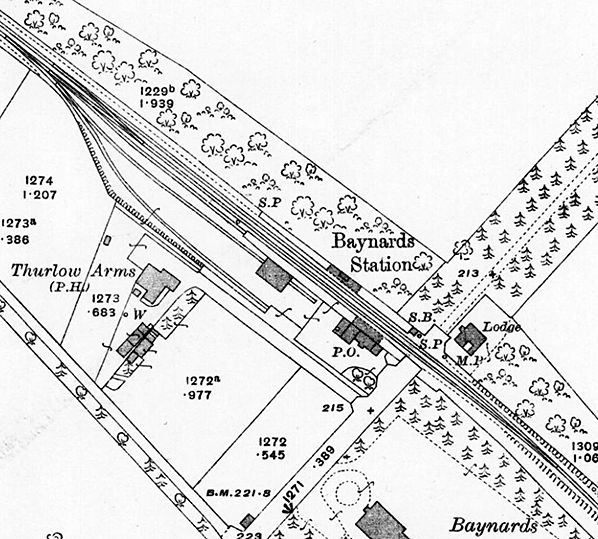 1915 1:2,500 OS map shows the layout of the station, The main station building is on the up (south) side of the line with a waiting room on the up platform. There are three sidings one running end on to the down platform (this was later lifted and isn't seen in the 1948 photo above), one passing through the goods shed and one running along the south side of the yard. A signal box is shown at the south end of the down platform. P.O indicates the station also functioned as the local post office. The lodge at the entrance to Baynards Park is seen.
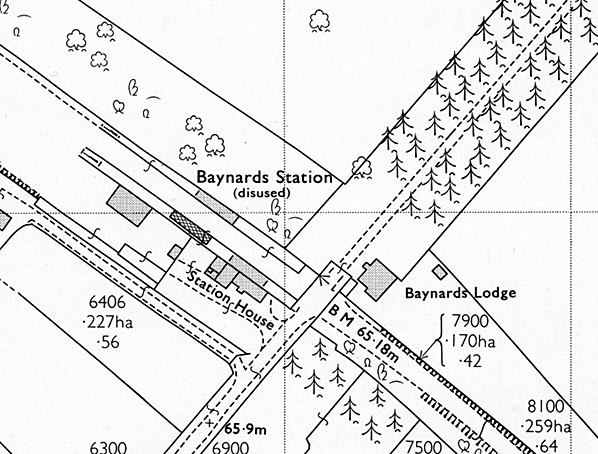
1971 1:2,500 OS map. The station is now disused but all the buildings remain apart from the signal box which was demolished shortly after closure.
old5.jpg)
LB&SC Bilinton designed D3 class 0-4-4T tank 32379 is seen heading north at Baynards station c1950. This loco was withdrawn from Horsham shed in December 1952.
Photo from John Mann collection old2.jpg)
Baynards station looking north from the level crossing in August 1952. The signal box is clearly seen in this view.
Photo from John Mann collection old3.jpg)
Looking north from Cox Green Road bridge towards Baynards station in 1952. The level crossing only gives access to Baynards Lodge (out of view to the right) and Station Road.
Photo from John Mann collection old4.jpg) Another Bilinton designed D3 class 0-4-4T tank 32390 waits to pick up passengers at Baynards station in July 1955. This loco was built in May 1894 and was withdrawn from service 1 October 1955 and subsequently scrapped.
Photo by JH Aston old6.jpg)
Baynards station looking south from the up platform in June 1961. The side of the goods shed is seen far right.
Photo
by Ben Brooksbank
old11.jpg) A passenger train hauled by an unidentified ex-LMS Ivatt Class 2MT 2-6-2T waits in the up platform at Baynards station in September 1963. Note the large number of dahlias planted by signalman Geoff Burdfield, these are seen in many photos of Baynards during the 1960s. A passenger train hauled by an unidentified ex-LMS Ivatt Class 2MT 2-6-2T waits in the up platform at Baynards station in September 1963. Note the large number of dahlias planted by signalman Geoff Burdfield, these are seen in many photos of Baynards during the 1960s.Photo
by Derek Martin
old9.jpg)
This picture is likely to have been taken during one of nine films that were made at the station. Probably The Horsemasters in 1961. The loco on the right is a Drummond M7 0-4-4T. She was withdrawn at from Bournemouth Shed 8 December 1953 but at the time of this photo was allocated to Brighton Shed. The loco on the left appears to be another Drummond M7.
Photo
from Lynda Burdfield
old14.jpg) Another view of Barnards in 1961 when it was renamed Valleywood for the TV film The Horsemasters. The film crew is seen on the right. An unidentified Drummond M7 loco is seen.
Photo from Lynda Burdfield
 Home Page Home Page
|
 Notes: In the mid 1800's there were two proposals for a railway linking Guildford & Horsham. One from the Horsham & Guildford Direct Railway and the other from the Wey and Arun Junction Canal Company who wanted to drain 16 miles of their canal and build a railway along the canal bed. The Wey and Arun scheme was quickly forgotten but a bill to incorporate the HGDR was put before Parliament. On 16 February 1860, initially the London Brighton & South Coast Railway opposed the Bill but following an agreement that the LBSCR should run the line they withdrew their opposition.
  The Horsham and Guildford Direct Railway Act was passed on 6 August 1860, with a clause that required the London & South Western Railway to allow the company to use one and a half of its line, still unfinished at that time, between Peasmarsh and Guildford.
 The station had two platforms and a 17 lever signal box, which controlled the level crossing immediately to the south. Baynards station comprised the stationmaster's house, two waiting rooms, covered platforms, storage sheds, a booking hall, a porch and a large goods shed with a 1-ton capacity crane. A private long-siding served a Fuller's earth manufacturer, which became the site of Steetley chemical works in 1937. Freight trains served the nearby brickworks. Baynards was the only place on the single-track line with a passing loop for passenger trains. To the south of the station the line ran through Baynards Tunnel, where it crossed the county boundary between Surrey and West Sussex. In the 1890s, the station also functioned as the local post office.
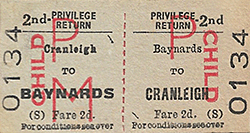 There was a proposal to electrify the line between Peasmarsh and Cranleigh in the 1930's to allow a through service to Waterloo but the proposal was dropped with the coming of WW2. During the war there was a camp for American troops at Baynards Park. The station was heavily used to supply the training facilities with armoured vehicles and ammunition. In the 1950s and 1960s Geoff Burdfield, the signalman who lived in the station house, cultivated 240 varieties of dahlia, amounting to around 1000 plants in total, on the station platforms.
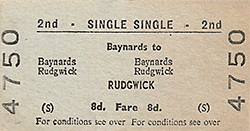 The goods service was withdrawn from the five stations including Baynards on 10 September 1962 although a private siding remained open for a while. The 1956 Handbook Of Stations lists a siding for for FW Berk & Co, Ltd. With only 5000 passengers a week using the line and 5000 tons of freight passing over it, the branch was listed for closure under Beeching's 'The reshaping of British Railways' and closed from 14 June 1965.
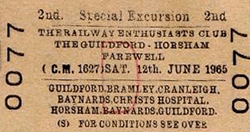
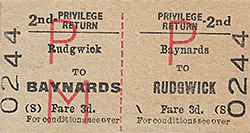 The final day of operation of scheduled public services was Saturday 12 June 1965. After the last service train, a Railway Enthusiast Club special
 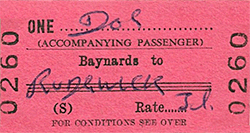 The track was lifted c1966. In June 1973, the station was sold to Fraser Clayton for conversion into a private residence, to fund the construction of a bridleway along the course of the old railway. The works to create the path included sealing the entrance to Baynards Tunnel with concrete blocks and filling the cutting on the northern approach with inert waste to create a ramped access to Cox Green Road. The bridleway was officially opened as the Downs Link at a ceremony at Baynards on 9 July 1984.
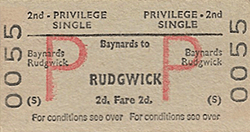 The goods shed was not included in the initial sale in 1973, but it was acquired by Mr Clayton in 1984. The project to restore Baynards station was recognised by an award given by the Surrey Industrial History Group in 1985.
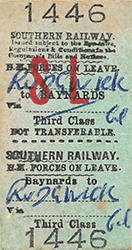 The Black Sheep Of Whitehall (1942)
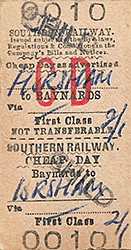 Train ride from Guildford to Cranleigh and Horsham in the early 1960's