
[Source: Joshua Guest and Nick Catford]
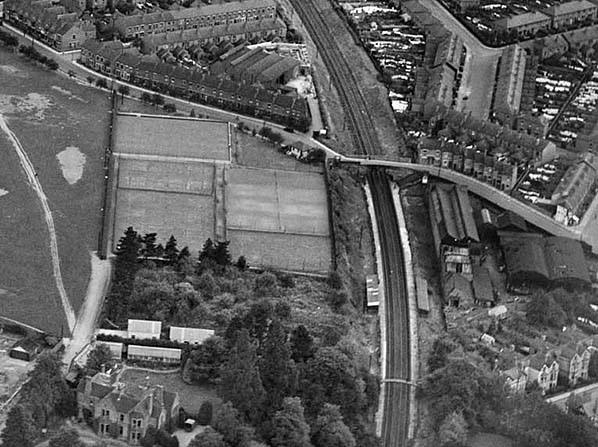 An aerial view of Daimler Halt and the Daimler Company, taken in 1938. At this time, the halt was only used by employees of the Daimler Company. The halt can be seen at the bottom of the photo, complete with its platforms and waiting shelters. The Daimler factory is out of view to the north.
Photo from Britain From Above reproduced with permission 
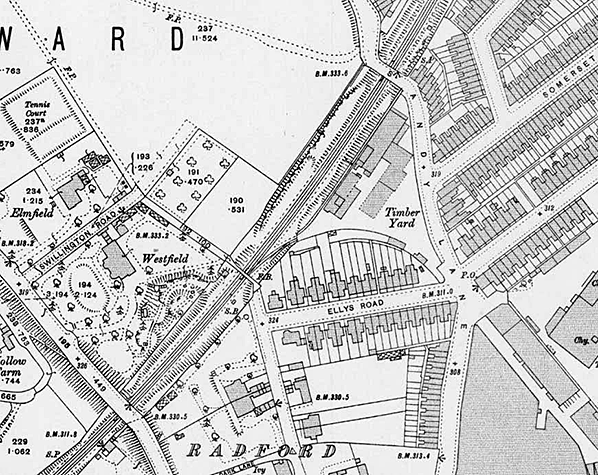
1913 1:2,500 OS map showing the site of Daimler Halt and the surrounding area before the private halt opened.
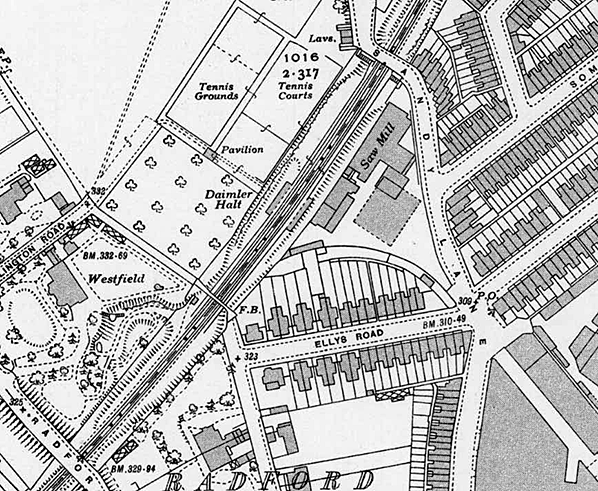 1937 1:2,500 OS map showing Daimler Halt and the surrounding area. Access steps down to the two platforms are shown immediately south of Sandy Lane. Although named on the map there is no indication that the halt was a private stop for the nearby Daimler Company only.
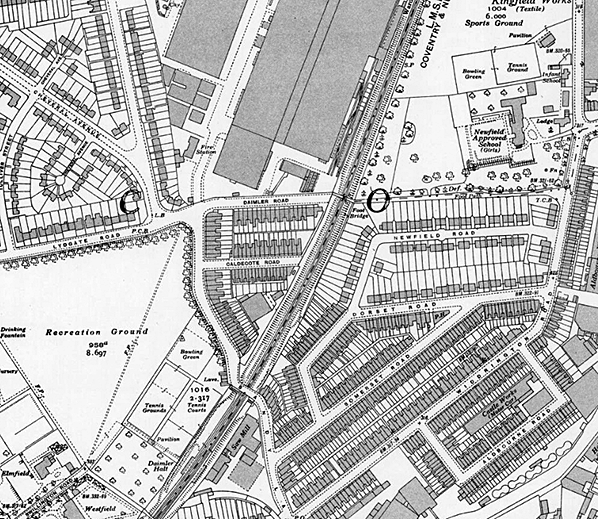 1937 1:2,500 OS map showing Daimler Halt and the Daimler Works alongside the railway to the north of the halt. The Daimler Works closed in 1997 and wasw quickly demolished.
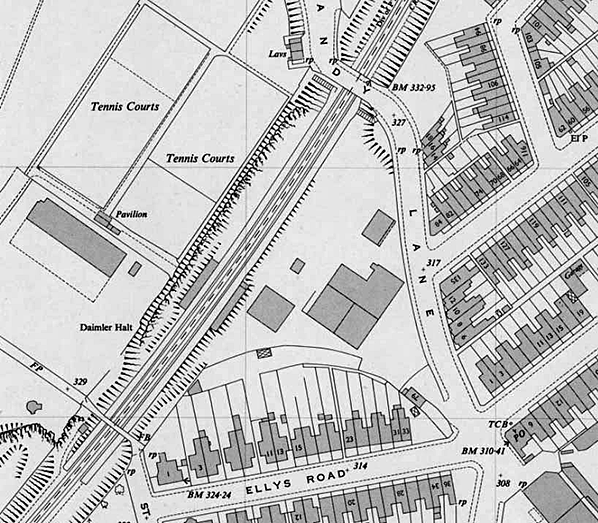
1937 1:2,500 OS map showing Daimler Halt and the surrounding area. The waiting shelters on the two platforms are clearly seen.
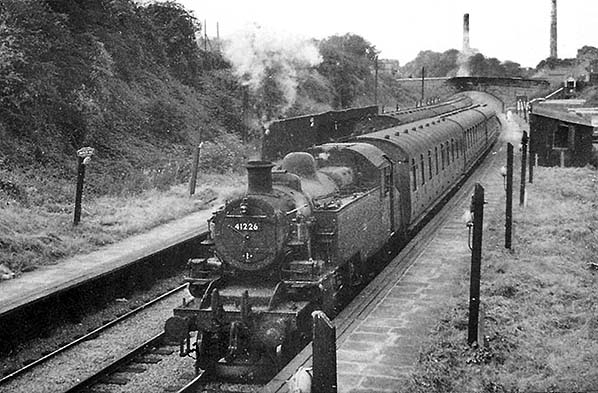
Daimler Halt in July 1957, a British Railways Ivatt 2-6-2T No. 41226 is seen waiting at the Coventry-bound platform on its way from Nuneaton. By this time, the station was an active station for both the Daimler Company and locals living in the area. Totem signs had been fitted by this time.
Photo by G. Biddle 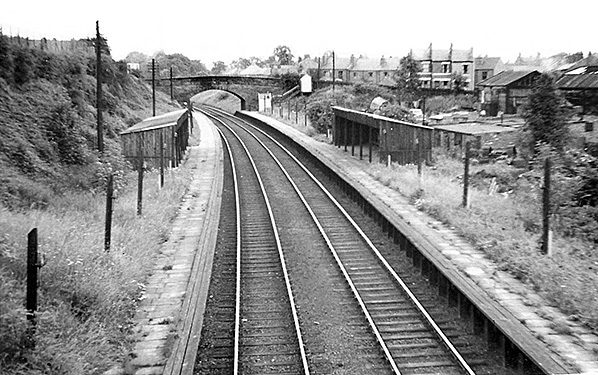 Daimler Halt in January 1964. The halt by this time was likely in its final few days of use before its closure as part of passenger services being withdrawn along the line as a whole. Note the rush hour booking offices by the steps alongside the bridge. It is unclear why there are two. perhaps on for the issue of hand written tickets and the other for collection.
Photo from John Mann collection 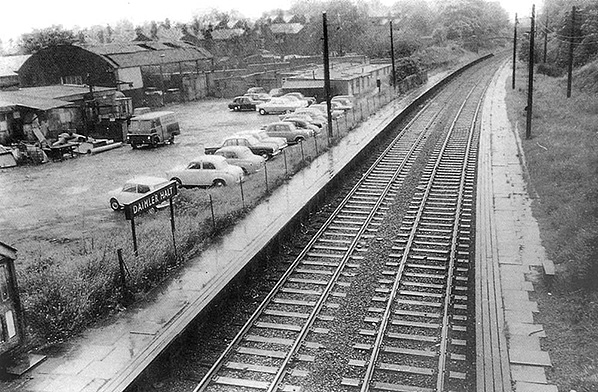
Daimler Halt in June 1964, five months after closure, looking from Sandy Lane at the Coventry and Nuneaton platforms. The station's nameboard can be seen to the left but totem signs have been removed and the waiting shelters have been demolished. Some cars located behind the fencing, belong to the East Midlands Electricity Board who had offices in Sandy Lane. This is the site of a Cartwright's timber yard and saw mill and eventually became The Sandy Lane Business Park. One of the morning rush hour booking offices is seen far left.
Copyright photo from Stations UK 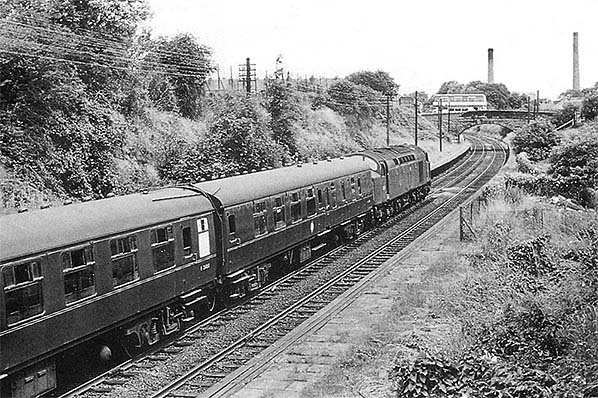 English Electric Type 4 (Classs 40) D298 passing through the closed Daimler Halt hauling a diverted Euston to Birmingham New Street express service during the electrification of the Birmingham to London route in 1967. This allowed fully electric train services to operate directly between Birmingham, London, Manchester, and Liverpool. D298 was built by the Vulcan Foundry in Newton-le-Willows, Lancashire and officially entered traffic in October 1960. Upon delivery, it was allocated to the Crewe North motive power depot. It spent its entire 20-year working life operational across the London Midland Region. The locomotive survived in active service until it was withdrawn in April 1981. It was later sent to Swindon Works, where it was cut up and scrapped in April 1983.. Note the steps down to the platform from Sandy Land bridge, one of the small ticket offices can be seen.
Photo from John Mann collection 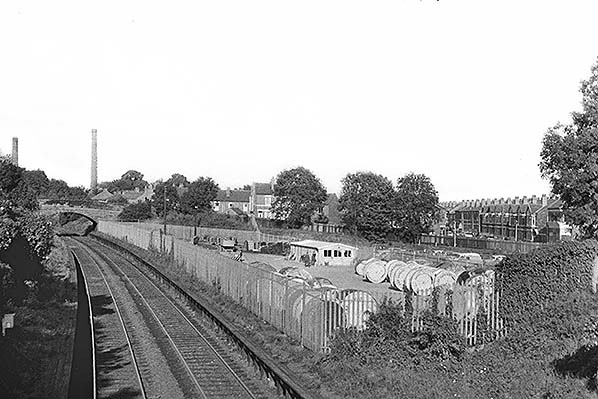
Daimler Halt in September 1969, four years after the withdrawal of passenger services. By this time, the access to the Nuneaton platform fenced off, and used for storage of what appears to be large industrial cable drums and other bits of industry like equipment and storage. This would become part of the Sandy Lane Business Park which was built on the Daimler site. The Coventry platform can be seen to the left, with nature starting to reclaim the platform. The booking offices by the bridge have gone.
Photo by Robert Hodgekins 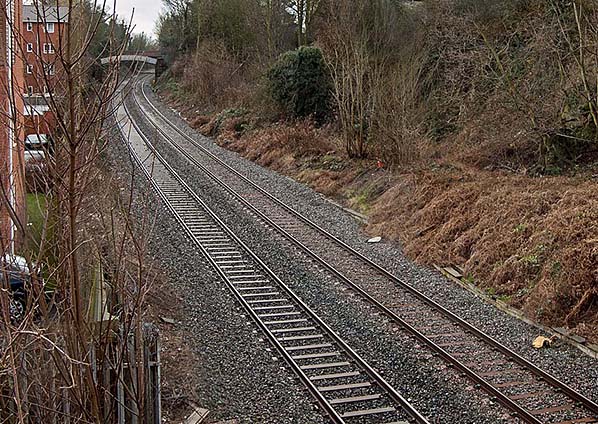
The site of Daimler Halt in January 2007, by this time the platforms had long been demolished. The site of the storage site as seen in the 1969 photo has been redeveloped for a housing estate.
Photo by Cliff Jones 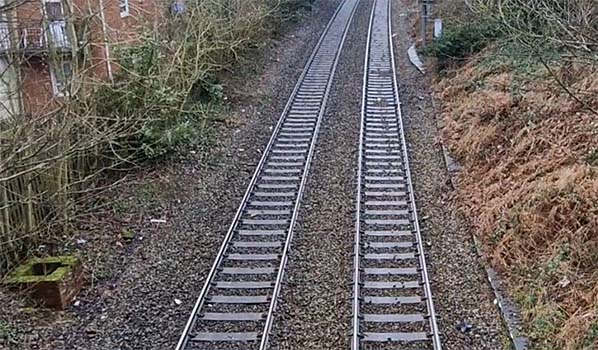 The site of the platforms at Daimler Halt station in February 2026. The platforms were removed after closure of the halt to passengers and nothing remains of either the platform edges or the earthworks where the platforms once stood.
Photo by Joshua Guest 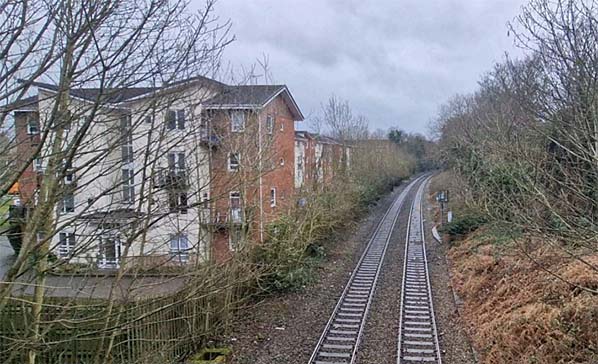
The site of the halt in February 2026. The land behind the Nuneaton platform, formerly part of the Sandy Lane Business Park has been redeveloped for residential use.
Photo by Joshua Guest
|

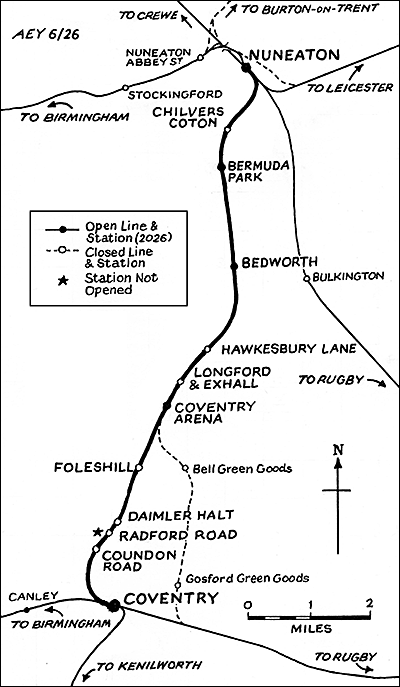 Original intermediate stations included Coundon Road, Foleshill, Longford & Exhall, Hawkesbury Lane, Bedworth, and Chilvers Coton. Daimler Halt was added later as a private station for workers at the adjacent Daimler Company factory. A further station, Radford Road, was constructed between Coundon Road and Foleshill but never opened to the public, reputedly due to disputes between the LNWR and Coventry City Council.
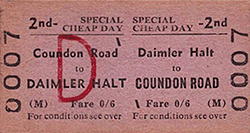
 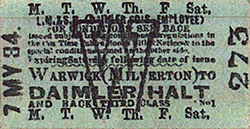 After Daimler Halt was made a public station on 11 June 1956, tickets were not available immediately for the station and passengers who wanted tickets to Daimler Halt had to buy a ticket to Foleshill. Eventually, tickets were produced to the halt but passengers travelling from the halt could only purchase hand written tickets from a small ticket office at the bottom of the entrance steps. These offices were only manned during the morning rush hour with booking office staff coming from Foleshill and maybe other stations. At other times the halt was unmanned.
 During the demolition, a digger on the site had accidentally cut through the cables and as a result. This caused disruption to the signalling at Coundon Road Signal Box and Three Spires Junction Signal Box. As a result, a temporary “timed interval” was installed until the cables were fixed after the demolition of Daimler Halt was completed.
 Home Page