Notes: Liverpool Exchange was the Lancashire & Yorkshire Railway (LYR) terminus at Liverpool. The LYR had first reached Liverpool on 20 November 1848 when their Liverpool & Bury railway had opened. That line had been promoted by the Liverpool & Bury Railway Company (L&BR) and was authorised on 31 July 1845. The route of the line took in the towns of Wigan and Bolton and had been promoted by prominent industrialists who wanted a more direct route between the industrial areas of east Lancashire and the port of Liverpool. Since 1830 the Liverpool & Manchester Railway (L&M) had held a monopoly on trade between those areas and it did not offer a direct route. Work on the line began in January 1846 and on 9 July 1847 the L&BR merged with other companies to form the Lancashire & Yorkshire Railway (LYR). When the line was authorised the Liverpool terminus was to be at Great Howard Street close to the Liverpool Gaol. This location was a short distance to the north of the central area and shortly after work had begun on 3 August 1846 the L&BR obtained an Act to extend the line to Tithebarn Street which was to be the location of Exchange station.
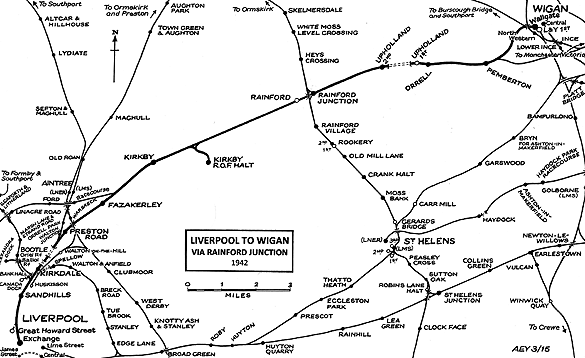 |
When the line opened trains ran to a station at Great Howard Street which because of the 3 August 1846 Act was intended to be temporary.
On 16 August 1846 the East Lancashire Railway (ELR) had obtained an Act to build a railway between Liverpool and Preston. It contained a clause which allowed for the sharing of the Liverpool and Bury railway south of Walton Junction (which was the point where the Preston line joined it). As the Liverpool and Bury line was already under construction the ELR agreed to pay the LYR a sum equal to half of the cost. The Preston line was completed by March 1849 and from 2 April 1849 ELR trains started to run into Great Howard Street station.
Liverpool Exchange 1850 to 1884
John Hawkshaw was put in charge of the extension to Tithebarn Street. He was given the position on 25 May 1847. William Dodds was appointed as resident engineer. An order for work to begin was given on 23 July 1847 but work didn’t start until after the new goods facilities had opened at Great Howard Street in March 1849.
The new terminus station opened on 13 May 1850 and from that date LYR trains ran to the new facility. ELR trains continued to run to Great Howard Street until July 1851. Whilst the LYR called the station Liverpool Exchange, to the ELR it was Liverpool Tithebarn Street.
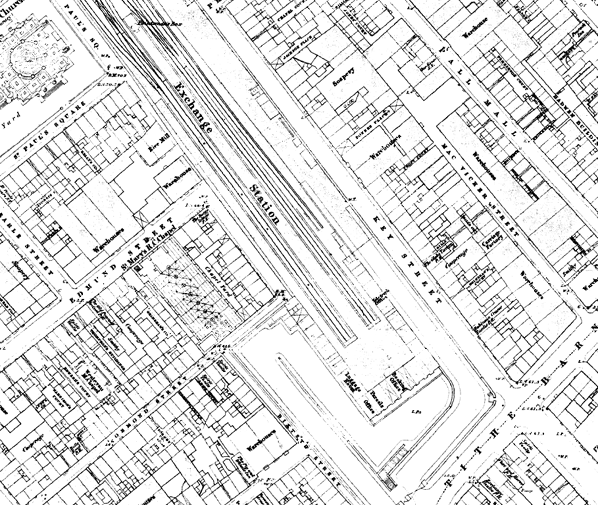
exchange_old_small70.jpg) The station was located on the north side of Tithebarn Street close to the business district of the town. It was elevated above street level on brick arches. The frontage towered 90ft above the street because the lines approaching the station had to clear the Leeds & Liverpool Canal. From Tithebarn Street ornamental steps and a 30ft-wide driveway sloped up to the frontage. The building was in the ‘Italian Style’. It was stone-built, consisted of two storeys, and was 117ft wide. Within the building were booking offices for both the LYR and the ELR. At right-angles to the building there were two single-storey wings that extended 193ft which contained refreshment rooms and waiting facilities for both companies. Behind the main building the five tracks were covered by two trainshed roofs: one was 638ft long, its span tapering from 136ft to 128ft without supports, and the other was 161ft long with a 78ft span. There was one arrival platform, 630 ft long, and two departure platforms - one for each company. The station was described by contemporaries as a ‘handsome piece of architecture’, and it seems to have been widely praised. The station was located on the north side of Tithebarn Street close to the business district of the town. It was elevated above street level on brick arches. The frontage towered 90ft above the street because the lines approaching the station had to clear the Leeds & Liverpool Canal. From Tithebarn Street ornamental steps and a 30ft-wide driveway sloped up to the frontage. The building was in the ‘Italian Style’. It was stone-built, consisted of two storeys, and was 117ft wide. Within the building were booking offices for both the LYR and the ELR. At right-angles to the building there were two single-storey wings that extended 193ft which contained refreshment rooms and waiting facilities for both companies. Behind the main building the five tracks were covered by two trainshed roofs: one was 638ft long, its span tapering from 136ft to 128ft without supports, and the other was 161ft long with a 78ft span. There was one arrival platform, 630 ft long, and two departure platforms - one for each company. The station was described by contemporaries as a ‘handsome piece of architecture’, and it seems to have been widely praised.
The LYR was the dominant partner, and it was they who decided how the station would be divided. The LYR took the west side and left the ELR with the east. Even before it opened the ELR objected to the way the LYR had allocated facilities, a formal objection being lodged on 11 March 1850. This proved fruitless so they took their complaint to the Railway Commissioners, but it is not known what they decided at a meeting on 13 January 1851.
At the time of opening the LYR operated trains to Wigan, Bolton, Bury and onwards to Leeds. The ELR operated to Preston and onto its network of lines in east Lancashire. From 1 October 1850 trains of the Liverpool Crosby & Southport Railway began to run into Exchange/Tithebarn Street station. This line had opened in two stages between Liverpool and Southport.
On 14 June 1855 the LYR absorbed the LC&SR On 13 August 1859, the LYR also absorbed the ELR, from which date the only name of the station was Liverpool Exchange.
The February 1863 timetable (seen below) showed fast express services reaching Bolton in as little as 55 minutes.
Although the former LC&SR had been a minor railway serving sparsely populated areas, housing developments along the route brought many thousands of extra passengers into Exchange. The line continued to grow in importance as a commuter route throughout the second half of the 19th century.
By the 1880s traffic levels at Liverpool Exchange had built up to such a degree that further expansion was needed. An Act of 24 July 1882 authorised the LYR to widen the approach lines to the station. Just over a year later a further Act dated 2 August 1883 allowed for a complete rebuild of Exchange station. After some debate it was agreed that the station would be lowered from its original elevated position, and this would be facilitated through alterations made to the Leeds & Liverpool Canal route. Henry Shelmadine was appointed architect of the new facilities, and his drawings were agreed on 8 November 1882. The contract for building the station was awarded to Robert Neill & Sons for £97,997 on 22 July 1884.
Click here to continue reading about Liverpool Exchange
|

exchange_old35.jpg)



.jpg)

 Home Page