
[Source: Nick Catford]
Morley Low Station Gallery 1 c1900 - May 1960
low_old1.jpg) A London & North Western Railway train at Morley Low during the Edwardian period. The carriages are in the company's plum and off-white livery which some sources claim gave rise to the nickname 'Plum and Spilt Milk'. The proportion of plum to off-white was dictated by the location of the bodyside beading and the result was not to the liking of everybody. The company crest was also applied, an example being visible on the left. Note the robust-looking wooden footbridge with roof; this is the original footbridge which was relocated a little to the south after. At first glance this scene is unremarkable but a closer examination is warranted. The presumably intending passengers are a mix of working class men, another man in somewhat elegant attire and carrying what appears to be a set of golf clubs and hatted lady running in what was, for the period, a most unladylike manner. She appears to be at risk of tripping on her typically long, for the time, skirt. Other ladies are also present but displaying more sedate poses. Obviously the train is busy and there is a clammer for Third Class accommodation. The gentleman with what are assumed to be golf clubs is not of the type who one would expect to find travelling Third Class. As this photograph shows, when out of the home and in public view this was an age when the wearing of some form of cap or hat was obligatory and regardless of age, gender and social status.
Photo from John Mann collection  
1894 1:2,500 OS map. The main station buildings face each other at the end of a short approach road. The larger building is on the Up side with a canopy wrapped around one end. A signal box is sited near the north end of the platform. A footbridge spans the track to the south of the buildings. The two storey booking office is at street level alongside the bridge. The goods yard is on the north side of the Up line to the north of the station. It comprises three parallel sidings one of which passes alongside a goods shed. A short fourth siding along the back of the yard served a cattle dock. There are a number of sidings on the Down side of the line serving Morley Gas Works and Valley Mills alongside. Another siding ran across Valley Road into the Morley Main Colliery which opened in 1855. Click here for a larger map.

1922 1:2,500 OS map. Few changes to the station are noted. The Up platform canopy now wraps round the south end of the building to allow weather protection for passengers coming down the covered steps from the footbridge. A crane is now shown on the dock alongside the goods shed. This had a capacity of 10 tons. A small turntable is shown at the end of one of the yard sidings. On the Down side Morley Main Collieries closed in 1911. All rails have been lifted and the buildings demolished. Click here for a larger version
 1933 1:2,500 OS map. The footbridge has been replaced by a new bridge a little to the south on the south side of the booking office. There are now steps from the booking office to the Up platform. The turntable at the end of the siding is no longer shown. Click here for a larger version
low_old2.jpg)
A busy scene circa first decade of 20th century, when the steps down to this platform from the footbridge still afforded the luxury of a roof. The people on the platform comprise a mix of men, women and children which might suggest they await an excursion train. However, the barrow well laden with luggage might suggest the start of a Wakes Week holiday from one of the many mills which once dotted the area. Detail of the platform lamps is by no means clear but the suggestion is of the station still being oil lit at this time, despite the presence of the nearby Valley Road gasworks. At this time gas supplies could be erratic and with variations in pressure, while railway companies were frequently involved in disagreements with the gas companies over the latter's pricing. In some cases these are the reasons why stations remained oil lit despite the presence of a main gas supply although whether this applied at Morley Low is purely a matter of speculation. The advertisement for Epps's Cocoa was one of many which once adorned railway stations, on shops etc. Epps dated from 1839 and had its own plantation in Jamaica and at least one ship to transport the crop. The company was taken over by Rowntree in 1925 and the Epps's brand disappeared in 1931.
Photo from John Mann collection low_old3.jpg)
The south end of Morley station showing the close proximity of Morley Tunnel in the first decade of the 20th century.
Photo from John Mann collection low_old4.jpg)
The north end of the Up platform c1950s. This is the only picture which shows the substantial canopy which wraps around both ends of the building. Although this is the largest building on the station and included toilets and waiting rooms, it did not house the booking office which was in a separate building further south along the platform. The signal box seen here was replaced with a new box a few yards to the north at the end of the decade. One end of the timber goods shed is seen on the far right.
Photo from John Mann collection 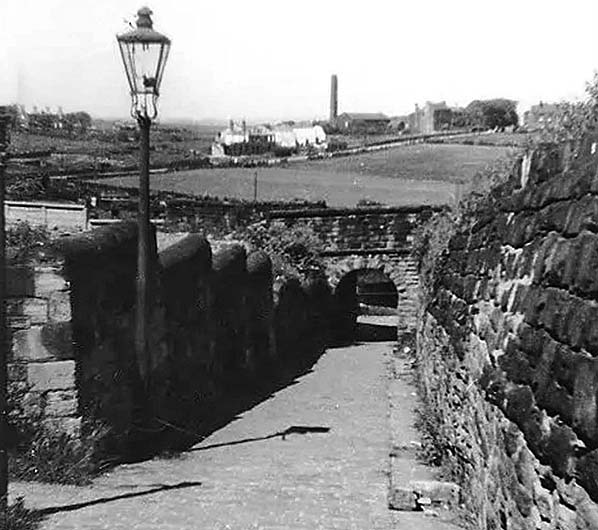 The top of the steep path and steps from Albert Road in Morley town on the hill to Morley Low station.
Photo from John Mann collection 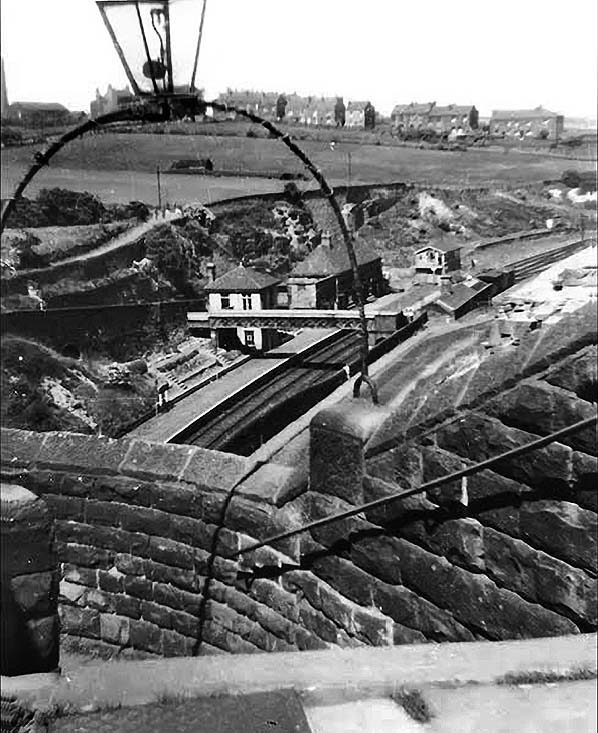
The top of the steps to Morley Low station in 1959. The subway seen in the photo above is behind the photographer. Most of the station buildings are still standing but canopies have been removed. The building immediately in front of the footbridge is the station entrance and booking office with steps down to the platform out of sight. The station garden was still being maintained at this time. The second signal box is seen at the end of the platform. The goods yard is closed and the buildings demolished and track lifted. The dock can be seen.
Photo
from John Mann collection
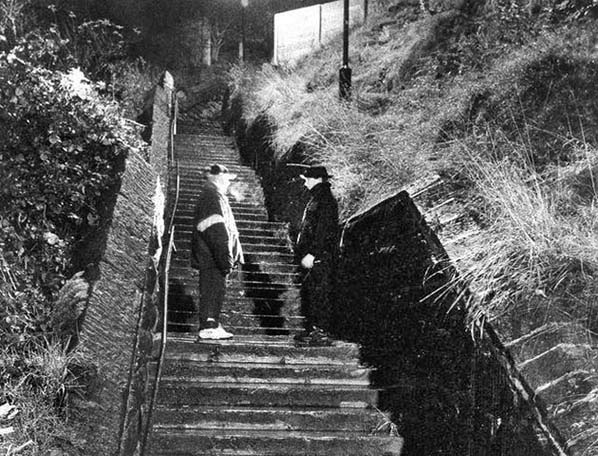
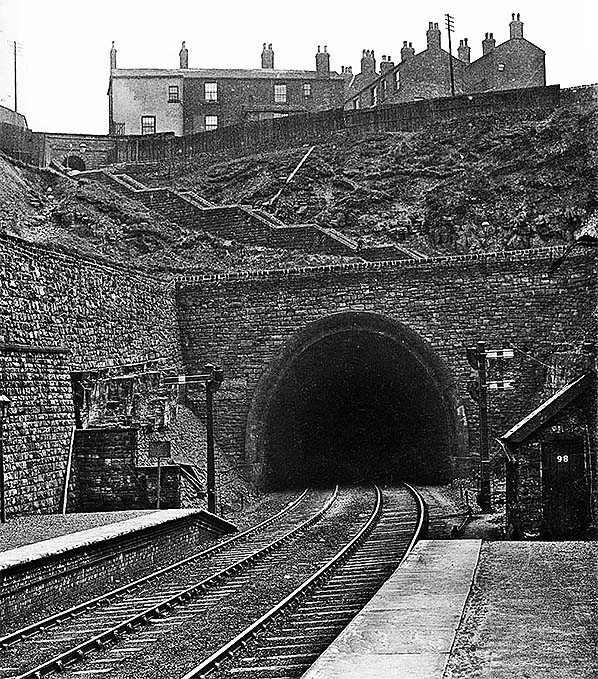
In this view looking south from the end of the Up platform the steps up to town are clearly seen with a short subway at the top of the steps. Beyond the subway the steep path continues to Albert Road.
Copyright photo from John Alsop collection low_old12.jpg) We are looking at a Stanier Class 8F 2-8-0 heading a parcels train and will shortly enter Morley Tunnel. The locomotive cannot be positively identified but is possibly No. 48081, a Rose Grove locomotive at this time. The train has just passed a banner repeater signal, present due to track curvature, while a four-aspect colour-light signal stands on the left adjacent to the signal box. Also on the left it can be seen the station was still gas lit at this time. Not immediately obvious is that Morley goods shed had stood on the left, behind and just beyond the signal box. It was served by a short siding which itself branched from another siding which ended at the north end of the signal box. The yard closed in 1959 so that is the probable date of this photo. Two rakes of excursion coaching stock are stored in the sidings in the background and the other sidings served the gasworks. What came to be known as 'Morley old gasworks' had ceased operation in 1949. There was another, larger, gasworks further south and known as 'Tingley gasworks'. We are looking at a Stanier Class 8F 2-8-0 heading a parcels train and will shortly enter Morley Tunnel. The locomotive cannot be positively identified but is possibly No. 48081, a Rose Grove locomotive at this time. The train has just passed a banner repeater signal, present due to track curvature, while a four-aspect colour-light signal stands on the left adjacent to the signal box. Also on the left it can be seen the station was still gas lit at this time. Not immediately obvious is that Morley goods shed had stood on the left, behind and just beyond the signal box. It was served by a short siding which itself branched from another siding which ended at the north end of the signal box. The yard closed in 1959 so that is the probable date of this photo. Two rakes of excursion coaching stock are stored in the sidings in the background and the other sidings served the gasworks. What came to be known as 'Morley old gasworks' had ceased operation in 1949. There was another, larger, gasworks further south and known as 'Tingley gasworks'.Photo by GW Morrison low_old5.jpg) This view from September 1959 offers a glimpse of the then neat although basic but not unattractive station garden along with a similar effort around the bench on the right. For all the station's faults this must have provided a welcome sight amidst the general gloom of the area at the time. The gas lamps appear to be minus their glass globes; perhaps they have been removed for cleaning. The locomotive is a rather dirty ex-LMS Jubilee 4-6-0. The photograph came with the information that the train is an express but close examination casts some doubt upon this. As we look at the locomotive there is white lamp over the right buffer and a red lamp over the left buffer. Accepting the lens colours are difficult to determine, this lamp arrangement was that displayed by locomotives shunting yards. Looking at the exhaust, the locomotive is under power but is not working hard and is not running at speed. The one carriage visible is of LNER origin and placing all these observations into the proverbial melting pot the suggestion is that the locomotive is engaged in shunting excursion stock from the sidings just north of the station. While we cannot be certain of course, it is nevertheless an interesting question to ponder.
Photo from David Atkinson Archive low_old6.jpg) In May 1960 an ex-LMS Fowler 2-6-4T is about to pass the banner repeater signal and enter Morley Low with a southbound local train. 'Fowler', incidentally, refers to Henry Fowler of the LMS and nothing to do with Messrs. John Fowler & Co. of Leeds. The banner repeater signal gave drivers advance warning of the starter signal situated just before the tunnel mouth which was obscured due to the track curvature through the station. The signal box was new at around this time and had replaced that positioned a little further south on the end of the platform. Morley Low had closed to goods traffic in 1959 and some remnants of this former activity can be seen; the disused dock to the left of the locomotive and another, still with track, lower right with its somewhat degraded sett surface. The goods shed had also stood in the area to the left of the locomotive In May 1960 an ex-LMS Fowler 2-6-4T is about to pass the banner repeater signal and enter Morley Low with a southbound local train. 'Fowler', incidentally, refers to Henry Fowler of the LMS and nothing to do with Messrs. John Fowler & Co. of Leeds. The banner repeater signal gave drivers advance warning of the starter signal situated just before the tunnel mouth which was obscured due to the track curvature through the station. The signal box was new at around this time and had replaced that positioned a little further south on the end of the platform. Morley Low had closed to goods traffic in 1959 and some remnants of this former activity can be seen; the disused dock to the left of the locomotive and another, still with track, lower right with its somewhat degraded sett surface. The goods shed had also stood in the area to the left of the locomotivePhoto from David Atkinson Archive. Click here for Morley Low Station Gallery 2 low_old7.jpg) In August 1960 an excursion for Blackpool calls at Morley Low. The train is formed, insofar as can be seen, of ex -LNER stock but the locomotive is unidentified. Evidently the fireman has been busy stoking the fire. Immediately after departure the train will enter the 3,369 yard Morley Tunnel. This tunnel passes entirely beneath the town of Morley, including beneath the railway which served Morley Top, to emerge effectively in the middle of Howley Hall Golf Course just north of Batley. The tunnel has four ventilation shafts of which one, at Alden Avenue, famously sits amidst modern housing. The excursion train seen here could have taken one of two routes into Blackpool, either to Blackpool North or to Blackpool Central, the latter likely via the Marton Direct line. In August 1960 an excursion for Blackpool calls at Morley Low. The train is formed, insofar as can be seen, of ex -LNER stock but the locomotive is unidentified. Evidently the fireman has been busy stoking the fire. Immediately after departure the train will enter the 3,369 yard Morley Tunnel. This tunnel passes entirely beneath the town of Morley, including beneath the railway which served Morley Top, to emerge effectively in the middle of Howley Hall Golf Course just north of Batley. The tunnel has four ventilation shafts of which one, at Alden Avenue, famously sits amidst modern housing. The excursion train seen here could have taken one of two routes into Blackpool, either to Blackpool North or to Blackpool Central, the latter likely via the Marton Direct line.Photo from David Atkinson Archive low_old8.jpg)
A view from the top of the steps leading down to Morley Low station, across the valley to Daisy Hill in 1962. The station buildings were all largely intact at this time although the platform canopies have been removed. The station garden on the Up platform still appears cared for. The building in front of the footbridge is the booking office with a waiting room on the lower floor. The station signal box stands at the end of the platform, this replaced and earlier box a few yards to the south a few years earlier. The goods yard, which closed in 1959 has already been cleared with track lifted and the goods shed demolished. A cattle dock can be seen to the right of the signal box.
Photo from David Atkinson Archive low_old9.jpg) A young boy stands on land off Albert Road c1962 where the former tip of Morley Main Colliery is being landscaped to provide more area for the parking of lorries and earth moving plant. The view is looking westwards towards Morley old gasworks and its manager's house, and to the beginnings of the development of the site on Valley Road for Orcal 'Oil Recoveries'. Daisy Hill is seen in the background. Morley Low station is out of view to the left. Excursion stock is seen stabled in the Down sidings. The stock is a mix of ex-LMS and ex-LNER.
Photo from David Atkinson Archive low_old10.jpg)
Few long views of both platforms of Morley Low station have emerged. This view looking south along the up platform dates from 1963. The Down platform still retains its canopy but that on the Up platform which wrapped around both ends of the building has been demolished. The slight stagger in the platforms is clearly seen as is the curve towards Morley Tunnel. The building on the Up platform is unusually tall compared to that on the Down. The weather boarded building before the footbridge is a booking office on the upper floor with a waiting room below.
Photo
from John Mann collection
low_old11.jpg)
A close up view of the southbound platform building in October 1965. The atmosphere is one of general shabbiness with repainting long overdue. Note the British Railways North Eastern Region totem, illuminated by a gas lamp and angled slightly to make visibility easier from inside trains. Across the BR system there were variations in totem design over and above the regional colour schemes and Morley Low had two different styles, the difference being in style of flange. British Railways had added the 'Low' suffix in 1951 to distinguish the station from Morley Top but Top station had closed to passengers in 1961 so when this photograph was taken 'Low' was superfluous but the full title nevertheless remained, on signage, and probably until BR corporate (black and white) signage was introduced. Readers may be surprised by the ex-LNWR line through Morley Low coming under BR North Eastern Region. At Nationalisation in 1948 the line logically became part of the London Midland Region but a reorganisation in West Yorkshire during 1958 saw the encroachment of the North Eastern Region. The latter disappeared in 1967 when it merged into the Eastern Region but Morley reverted to London Midland Region jurisdiction. There is no evidence that Morley Low had LMR maroon totems prior to 1958 and probably got by until that year with lamp and/or wall tablets along with the usual running-in boards. The four posters nearest the camera are easily identifiable. That on the left informs people they can 'Arrive earlier by train on the Dorset Coast' and featured a lady sitting on a sundial and with a selection of Dorset destination tickets at bottom right. This poster design was issued by the Southern Region in 1963. The poster second from left promotes York. Issued by the North Eastern Region it was one of countless designs promoting York of which almost all depicted an 'olde worlde' scene so characteristic of York. Others depicted, unsurprisingly, York Minster. The poster third from left was issued by the Eastern Region and promotes inland destinations in East Anglia. East Anglian coastal resorts, such as Great Yarmouth and Cromer, usually had separate posters. The poster fourth from left promotes the Firth of Clyde and depicts a slightly whimsical scene of a steamer passing a lighthouse. This one is thought to have been issued by the Scottish Region. Original and good condition copies of such posters are, like BR station totems, now collectors items and sadly we are unlikely to see the likes of them again. Posters and notices on National Network stations today tend to be either of a basic information nature or issue warnings and threats of fines or a combination of all.
Photo from David Atkinson Archive 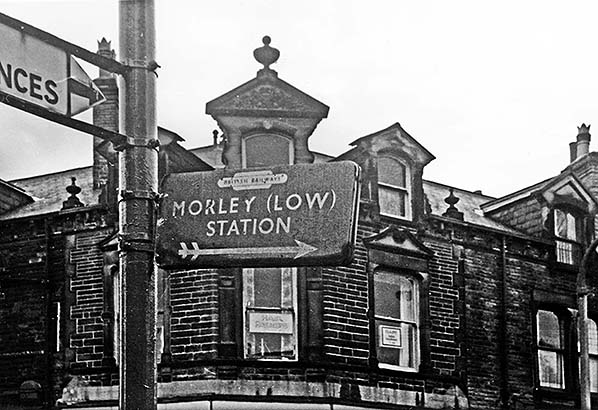 Morley town had two stations. Morley Top was well sited in the town and Morley Low involved a long steep walk from the town centre. In 1970 this BR double sided enamel direction sign at the junction of Queens Street and Fountain Street points passengers in the right direction. Morley town had two stations. Morley Top was well sited in the town and Morley Low involved a long steep walk from the town centre. In 1970 this BR double sided enamel direction sign at the junction of Queens Street and Fountain Street points passengers in the right direction.Photo by John Mann 
In April 1972 an apparently freshly painted Derby Class 108 DMU emerges from Morley Tunnel. The yellow band above the first two windows of the DMU indicates the First Class seating. Waiting on the platform is what we can surmise to be one passenger, left, and one member of staff, right. The scene is an uneasy mix of the old and the new, not uncommon at this time. The DMU in blue with full yellow end and the corporate signage clashes with the general air of dilapidation, the flagged platform surface and the gas lighting. The entrance building and steps, also sit uneasily together. The station was in essence constructed in the northern approach cutting to the tunnel and this is quite evident in this view.
Photo from David Atkinson Archive 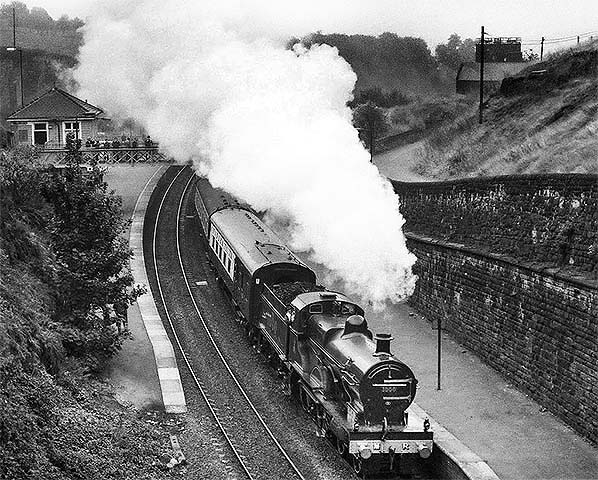
On 28 September 1983 preserved Midland Compound No. 1000 is about to enter Morley Tunnel with a York - Rochdale and return National Railway Museum private charter while a group on enthusiasts watch, left background. The first vehicle behind the locomotive is a BR Mk 1 Pullman. The locomotive was new in January 1902 as Midland Railway No. 2631 and became No. 1000 five years later, a number she retained right through until Nationalisation when she became British Railways No. 41000 in May 1949 and was withdrawn in September 1951. Earmarked for preservation, she was for some years stored at Crewe before being moved to Derby and restored to 1914 condition. In 1959 she was given a replacement boiler and cylinders, thereafter working occasional specials until 1962 following which she was repainted and retired to the, then, Museum of British Transport situated in what had been Clapham tram depot. She then moved to the National Railway Museum, York, in 1975 and once again restored to working order in order to take part in the Stockton & Darlington 150 cavalcade at Shildon. She then continued to work specials until 1983, with 28 September 1983 reputedly being the final time before once again retiring to the museum as a static exhibit. Two final points of interest are her restoration involved being paired with the tender from ex-Somerset & Dorset 2-8-0 No. 53805 and the special to Rochdale involved her running light to Manchester for turning on Miles Platting triangle.
Photo by Scott from his Flickr photostream 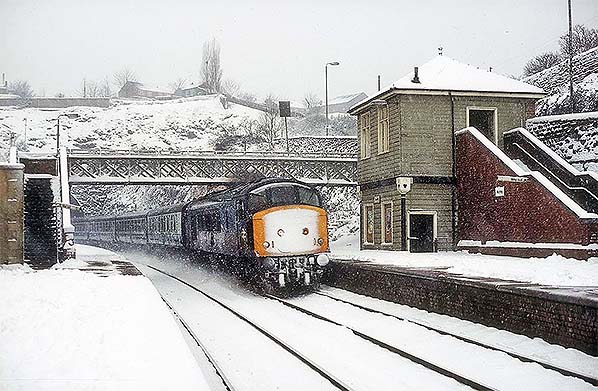
On a snowy 10 February 1984 an unidentified Class 45 emerges from Morley Tunnel on an unidentified working. We have a good view of the neat entrance building and flight of steps, soon to disappear. The railheads are still above the snow but if this scene were today the train operators would be seriously considering suspending the service. Part of the problem today is the widespread use of multiple-unit stock with much vulnerable equipment mounted below the floor. In the days of locomotive-hauled trains and indeed diesel mechanical multiple-units snow presented far fewer problems, although it could cause problems with unheated points and mechanical signalling. British Rail, however, were usually well prepared and often had staff close to hand who could quickly deal with such problems and with little fuss
Photo by Paul Corrie from his Flickr photostream 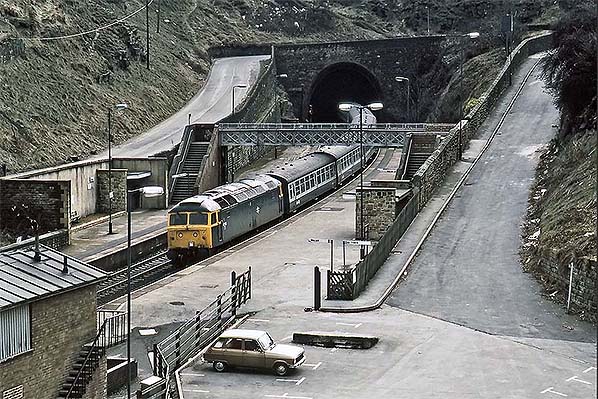 On 12 April 1986 Class 47 No. 47473 emerges from Morley Tunnel and coasts through the station with the 13:00hrs Bangor - York train. New to service in July 1964 as D1601, she was withdrawn in June 1998 and scrapped at Crewe Works, apparently by an outside contractor. This not-especially-attractive scene exemplifies one reason the station was rebuilt and slightly relocated - disabled access - as part of the broader and so-called Trans Pennine Route Upgrade. The upgrade also saw the end of Morley signal box, lower left, one of the last manual signal boxes in West Yorkshire at the time. Interesting, perhaps, the signal box at the long-closed Morley Top was a flat roofed ARP type structure. The structure to the left of the Class 47 is the remains of the southbound platform building now reduced to a roofless shell with a seat. To the right there had been a small but neat entrance building with steps down to the platform. The steps are still there but the building has gone. The signal box which closed the previous year is boarded up. By this date the station was unstaffed. Most of Morley Low's small car park is here largely out of view at bottom right, although a Renault 6 has made sure it gets into shot.
Photo by David Rostance from his Flickr photostream 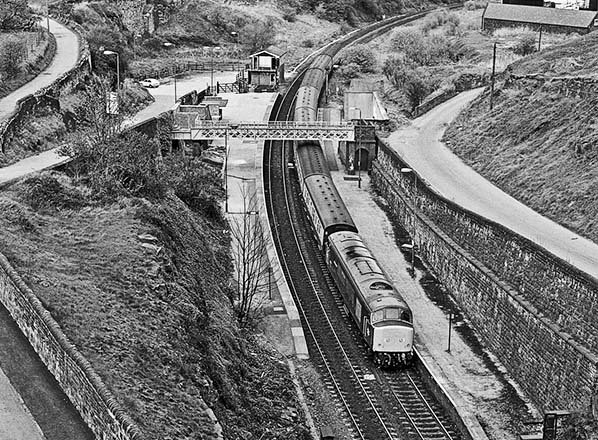
On 10 May 1986 Class 45 No. 45118 'The Royal Artilleryman' passes Morley with 1M75, the 13:55 Scarborough - Liverpool service. The vantage point is above the tunnel mouth on Valley Road, which road can be seen on the right and at lower left as it is routed to cross the railway effectively on a 'U' bend. We are afforded a good view of what remained of Morley Low by this time, with its quite short and slightly staggered platforms. The area to the left of the signal box had been the location of the goods shed. Nature is taking over the site of the sidings which had existed in the right background. Locomotive No. 45118 was distinguishable by virtue of her nameplates being given, for some reason, white backgrounds. Built at Crewe, she was new to traffic as No. D67 in May 1962 but was not named until March 1966. Withdrawn in May 1987 she was one of several locomotives famously dumped at March, Cambridgeshire to await their fate but she was lucky enough to survive into preservation. At least one of her original nameplates is now at the Royal Artillery Museum, Larkhill from which measurements have been obtained for the manufacture of replacements.
Photo
by Rob T from his Flickr photostream
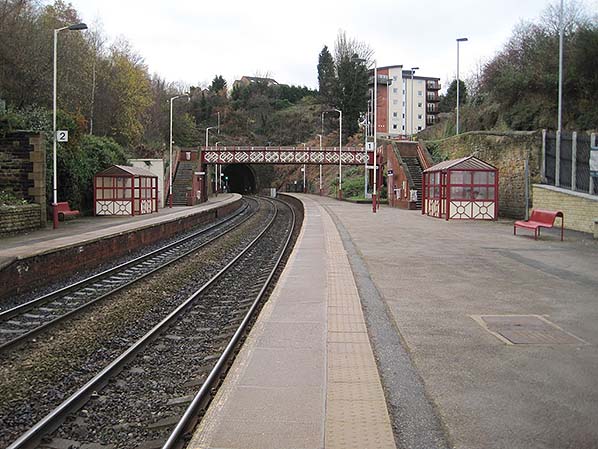
Morley station looking south towards Huddersfield in December 2013. New bus shelters have now been provided for passengers.
Photo by Nigel Thompson, reproduced from Geograph under creative commons licence 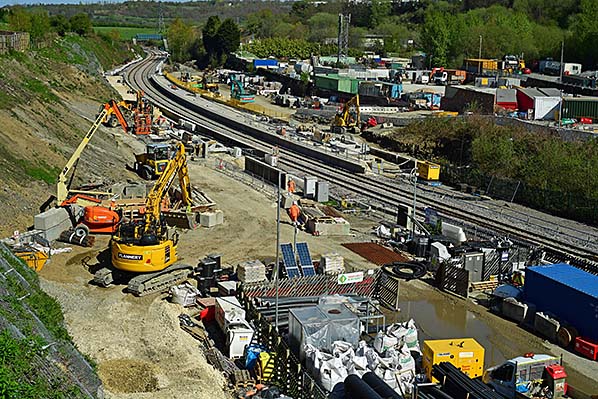
On 20 April Work on the new Morley station is progressing well.
Photo by Paul Bigland 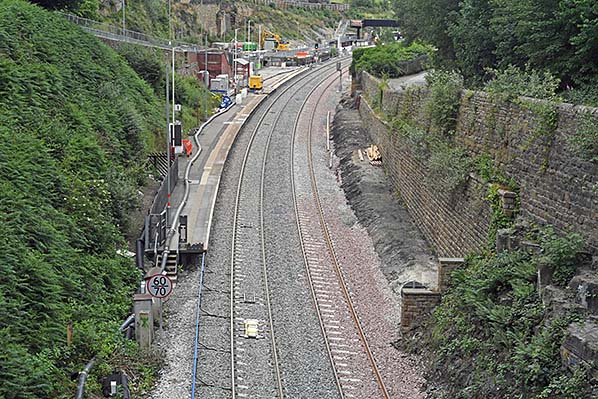 Morley station looking north from Valley Road on 28 June 2023, two days after the new station opened. The footbridge for the new station is seen in the distance. The footbridge and Huddersfield platform have already been demolished and track through the site relaid.
Photo by Paul Bigland 
A TPE service from Huddersfield to Leeds calls at the new platform 1 at Morley station on 28 June 2023, two days after the new station opened.
Photo
by Paul Bigland
|

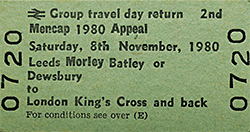 Morley station was opened by the London and North Western Railway on 15 September 1848. It had two facing but slightly staggered platforms on a curve immediately north east of 3369 yard Morley Tunnel. The main station building was on the north (Down) side with a canopy for weather protection wrapped around both ends. The building, which had a pitched slate roof, was unusually tall considering it was single storey. A smaller two storey weather boarded building stood to the south of the main building. This housed the booking office with a waiting room on the lower floor. The station signal box was at the east end of the Down platform. The building on the Up platform was also of stone construction with a hipped slate roof. It had a shorter canopy just extending over the platform. A covered footbridge spanned the tracks at the west end of the main station buildings.
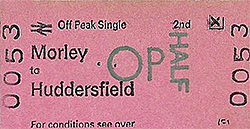 The goods yard was on the Down side and comprised three sidings one of which passed in front of a goods shed with a canopy. The other sidings were parallel between the shed and the Down line. A 10 ton capacity crane stood close to the east end of the goods shed where a fourth short siding served a cattle dock. The yards handled a full range of goods traffic including livestock and horse boxes. In the early years of the 20th century a new, longer timber shed was provided. The footbridge was resited a short distance to the south c1920s. The new bridge was open and of lattice construction. At the same time steps were provided from the booking office to the Up platform.
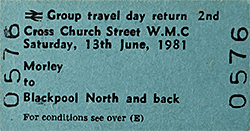 A second station much closer to the town centre was opened by the Great Northern Railway on 10 October 1857, served by trains on the Bradford to Ardsley line. This station was also called Morley which must have led to confusion. The station was immediately above Morley Tunnel. For many years, local people referred to the two stations as ‘Low’ and ‘Top’ rather than LMS and LNER. After Nationalisation both stations became part of British Railways, so some way of distinguishing one from the other was needed. The unofficial names were adopted by British Railways on 2 March 1951 when the former LNER station officially became Morley Low and the LMS station became Morley Top. Morley Low closed to goods traffic in 1959 and the sidings were lifted and the goods shed quickly demolished. The signal box closed around the same time and was replaced by a new box a few yards to the north. On the Down side Morley Gasworks closed in 1948 but the gasworks siding is still listed in the RCH Handbook of Stations in 1956. The gasworks site was later used for Orcal Oil Recoveries and they may have used the siding. Other sidings on the Down side were also used for storing railway excursion carriages.
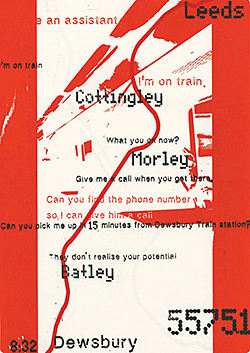 In the mid-1980's the station buildings were demolished and staff were withdrawn. The Down platform building was reduced to a roofless shell with a seat. All Up platform buildings were demolished with open access to the platform from the end of the approach road. The steps up to the now demolished booking office remained as a second, unnecessary way out.
 Home Page