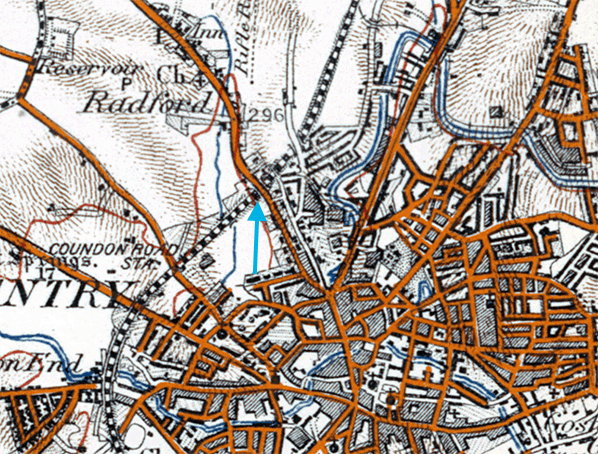
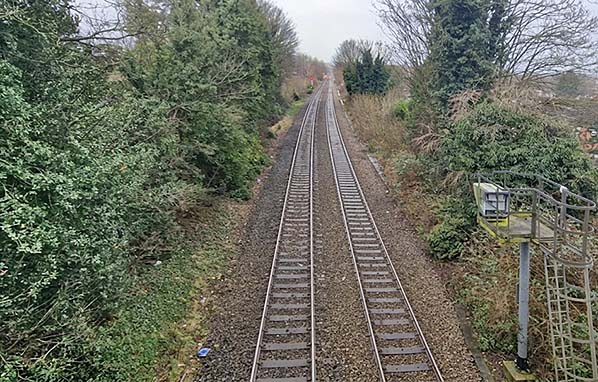
Notes: Radford Road was intended to be situated on the London and North Western Railway's (LNWR) Coventry-Nuneaton Line. Named after the Coventry suburb of Radford, it was to be the second intermediate station north of the city centre. The station was to be located in a cutting, south of Radford Road, near the Barr's Hill School.
This section of the network forms part of the Stafford-Birmingham-Rugby Loop, connecting Stafford to Rugby via Wolverhampton, Birmingham New Street, Birmingham International, and Coventry.
The Coventry-Nuneaton Line itself opened on 2 September 1850, providing the LNWR with a strategic link to the Trent Valley Railway at Nuneaton and facilitating direct services to Leicester via the Birmingham-Leicester-Peterborough Line.
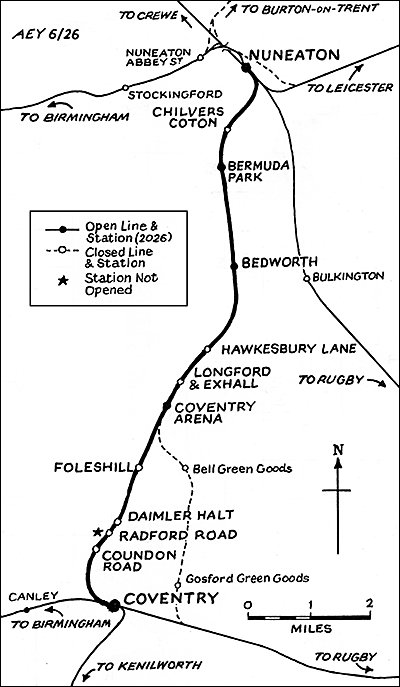 Original intermediate stations included Coundon Road, Foleshill, Longford & Exhall, Hawkesbury Lane, Bedworth, and Chilvers Coton. Daimler Halt was added later as a private station for workers at the adjacent Daimler Company factory. A further station, Radford Road, was constructed between Coundon Road and Foleshill but never opened to the public, reputedly due to disputes between the LNWR and Coventry City Council. Although the station building survived for over a century, it never served a scheduled passenger train. Original intermediate stations included Coundon Road, Foleshill, Longford & Exhall, Hawkesbury Lane, Bedworth, and Chilvers Coton. Daimler Halt was added later as a private station for workers at the adjacent Daimler Company factory. A further station, Radford Road, was constructed between Coundon Road and Foleshill but never opened to the public, reputedly due to disputes between the LNWR and Coventry City Council. Although the station building survived for over a century, it never served a scheduled passenger train.
On 26 January 1857, the Spon End Viaduct failed due to construction deficiencies. During the repairs, Nuneaton services were forced to terminate at Coundon Road. The viaduct and the link to Coventry station reopened on 1 October 1860. At Three Spires Junction, the freight-only 'Coventry Loop Line' (opened 1914) diverged to serve industrial hubs at Bell Green and Gosford Green, rejoining the main line at Humber Road Junction.
Due to the unscheduled opening to passengers, the Coventry Herald pressed multiple questions in 1855 towards readers and the LNWR, regarding when the station at Radford Road would finally be opened. Or when the temporary closure of the line between Coventry and Coundon Road was in effect, due to construction deficiencies found on the Spon End Viaduct on 26 January 1857. Once more, the Coventry Herald asked the question regarding the status of Radford Road station and its opening. The station was complete with platforms and a station name, but they never saw any passenger footfall during their time.
However, it was ultimately decided that Coundon Road station was better placed for the city centre. As a result, Radford Road station remained unopened, even after repairs to Spon End Viaduct had been completed, and the line between Coventry and Coundon Road reopened. The station house was built, but not in any similar style to neighbouring Coundon Road or Foleshill stations.
The usual reason for not opening Radford Road station was commonly blamed on its proximity to nearby Coundon Road station. It was seen as not viable for use as a passenger station and was instead left only partially completed with the station building only. Therefore, Radford Road station would be the only unopened station on the Coventry-Nuneaton Line. The name of the station did continue to appear on a few OS maps and sketch maps, but it was never formally recognised as an active station on any passenger timetables.
Following the 1923 Grouping, the line became part of the London, Midland and Scottish Railway (LMS), passing to British Railways (London Midland Region) upon nationalisation in 1948. The first station closure occurred that year at Longford & Exhall. The remaining intermediate stations, Coundon Road, Foleshill, Hawkesbury Lane, Bedworth and Chilvers Coton, were withdrawn from passenger service on 18 January 1965 under the Reshaping of British Railways (Beeching) report.
By the early 1960s, the Coventry Loop Line was in a state of terminal decline. The route was abandoned by 1981, following the closure of the Chrysler (formerly Rootes/Humber) factory, with the tracks being lifted in 1982. Much of the trackbed was subsequently repurposed for the A444 and residential developments, with only small stubs preserved as greenways.
The station house at Radford Road was demolished in the mid 1990s as part of an expansion of the neighbouring Barrs Hills School. During the demolition of the station building in 1994, an unexploded bomb was found near the site of the former station building and was taken away and exploded in a safe, undisclosed location. After it was all cleared, the school expansion was completed on the site of the former station in the late 1990s.
Passenger services on the main line were partially restored on 16 May 1987 with the reopening of Bedworth station, followed by the addition of Coventry Arena and Bermuda Park in 2016. Trains are operated by West Midlands Railway.
The line also forms an important diversionary corridor and freight corridor between Coventry and the Trent Valley Line at Nuneaton.
Despite a 2021 bid for the Restoring Your Railways Fund to reopen Coundon Road, and a 2023 proposal by Transport for West Midlands (TfWM) to reopen Foleshill, neither was successful. Proposals persist for the reinstatement of the "dive-under" at Nuneaton to restore the direct Coventry-Leicester link lost during the 2004 WCML upgrades.
Route map drawn by Alan Young
See also Coundon Road, Radford Road, Daimler Halt,Foleshill, Coventry Arena*, Longford & Exhall, Hawkesbury Lane, Bedworth* Bermuda Park* Chilvers Coton
* station still open but included for completeness |

old1.jpg)


road.jpg)
road2.jpg)
 Home Page