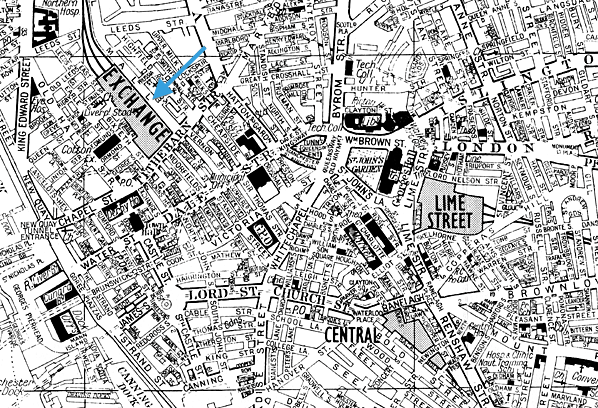
Notes: Notes: Liverpool Exchange was on the northern side of the city centre in its business district on Tithebarn Street. It served the East Lancashire Railway’s (ELR) line to Preston, the Lancashire & Yorkshire Railway’s (LYR) route to Bolton and the Liverpool, Crosby & Southport Railway (LC&SR).
 |
The LYR route had originally been proposed by the Bolton, Wigan & Liverpool Railway Company which was formed in 1844 by prominent industrialists who wanted to create a better link with Liverpool and break the monopoly of the Liverpool & Manchester Railway (L&M). Early in 1845 these industrialists decided to extend the line to Bury and apply for |
powers to build it under the title of the Liverpool & Bury Railway. On 31st July 1845 a Liverpool & Bury Railway Act was passed, and work began in November of that year. The Liverpool and Bury Railway was absorbed into the Manchester & Leeds Railway on 27th July 1846 and that company became the LYR on 9th July 1847.
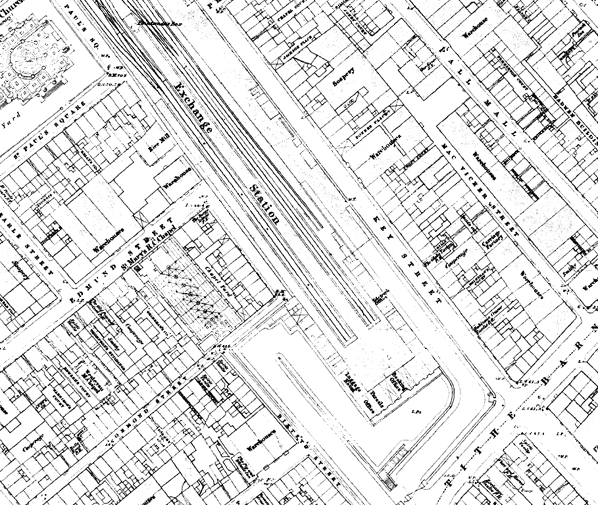
exchange_old_small70.jpg) Liverpool Exchange station in 1850
Liverpool Exchange station in 1850 |
The ELR line was authorised as the Liverpool, Ormskirk & Preston Railway on 16th August 1846. Work began on the line on 15th March 1847. The ELR and LYR routes converged at Walton, to the north of Liverpool. As heavy engineering works would be necessary southwards from Walton (a lengthy tunnel under Walton and viaducts into the city were required) the two companies agreed to share the route. The LYR line opened on 20th November 1848 and the ELR on 2nd April 1849. The Liverpool terminus was at Great Howard Street. From the start |
the two companies made uneasy bedfellows, and they could not even agree on a joint name for the station. The LYR favoured Borough Goal, after the nearby prison, whilst the ELR favoured Great Howard Street.
Traffic levels built up to such a degree that the Great Howard Street terminus soon proved inadequate. A new terminus on Tithebarn Street in the city’s business district had been proposed even before the lines had opened.
| Work commenced on the extension and the new station after July 1847; it opened on 13th May 1850. Whilst the LYR called it Liverpool Exchange Station, to the ELR it was Liverpool Tithebarn Street. It was elevated above street level on brick arches. The frontage towered 90ft above the street because the lines approaching the station had to clear the Leeds |
 |
& Liverpool Canal. From Tithebarn Street ornamental steps and a 30ft-wide driveway sloped up to the frontage. The building was in the ‘Italian Style’. It was stone-built, consisted of two storeys, and was 117ft wide. Within the building were booking offices for both the LYR and the ELR. At right-angles to the building there were two single-storey wings that extended 193ft which contained refreshment rooms and waiting facilities for both companies. Behind the main building the five tracks were covered by two trainshed roofs: one was 638ft long, its span tapering from 136ft to 128ft without supports, and the other was 161ft long with a 78ft span. There was one arrival platform, 630 ft long, and two departure platforms - one for each company. The station was described by contemporaries as a ‘handsome piece of architecture’, and it seems to have been widely praised.
The LYR was the dominant partner, and it was they who decided how the station would be divided. The LYR took the west side and left the ELR with the east. Even before it opened the ELR objected to the way the LYR had allocated facilities, a formal objection being lodged on 11th March 1850. This proved fruitless so they took their complaint to the Railway Commissioners, but it is not known what they decided at a meeting on 13th January 1851.
 |
At the time of opening the LYR operated trains to Wigan, Bolton, Bury and onwards to Leeds. The ELR operated to Preston and onto its network of lines in east Lancashire. From 1st October 1850 trains of the LC&SR began to run into Exchange/Tithebarn Street station. This line opened in two stages between Liverpool and Southport. On 14th June 1855 the LYR |
absorbed the LC&SR On 13th August 1859, the LYR also absorbed the ELR, from which date the only name of the station was Liverpool Exchange.
Although the former LC&SR had been a minor railway serving sparsely populated areas, housing developments along the route brought many thousands of extra passengers into Exchange. The line continued to grow in importance as a commuter route throughout the second half of the 19th century.
| By the 1880s traffic levels at Liverpool Exchange had built up to such a degree that further expansion was needed. An Act of 24th July 1882 authorised the LYR to widen the approach lines to the station. Just over a year later a further Act dated 2nd August 1883 allowed for a complete rebuild of Exchange station. After some debate it was agreed that the station would |
 |
be lowered from its original elevated position, and this would be facilitated through alterations made to the Leeds & Liverpool Canal route. Henry Shelmadine was appointed architect of the new facilities, and his drawings were agreed on 8th November 1882. The contract for building the station was awarded to Robert Neill & Sons for £97,997 on 22nd July 1884.
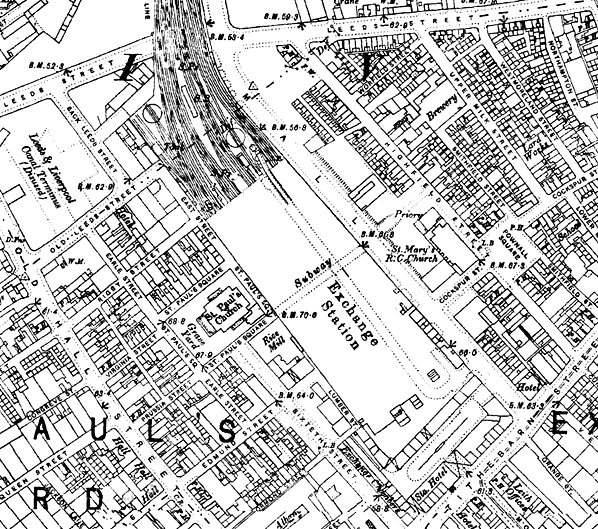
To minimise disruption to rail traffic the eastern side of the new station was built first alongside the existing station (on its east side). When the new station opened in part on 12th December 1886 (the eastern side) work could begin on the western side, and the remaining sections of the original station from 1850 were demolished. The new facilities opened completely 2nd July 1888. On 13th August 1888 the Exchange Hotel,which provided the frontage to the station, opened: it was owned and operated by the LYR and cost £140,000 to build.
 |
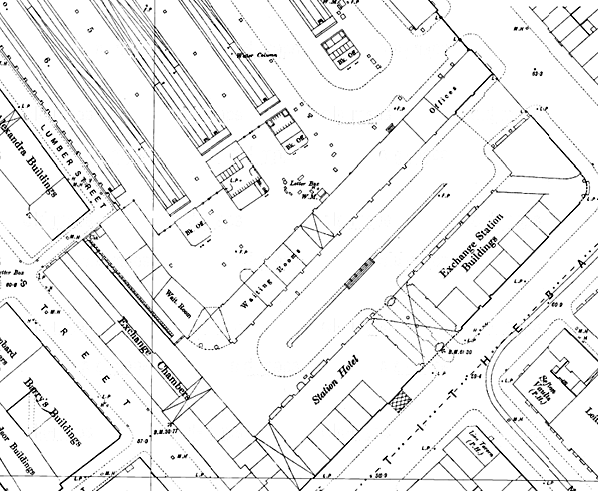
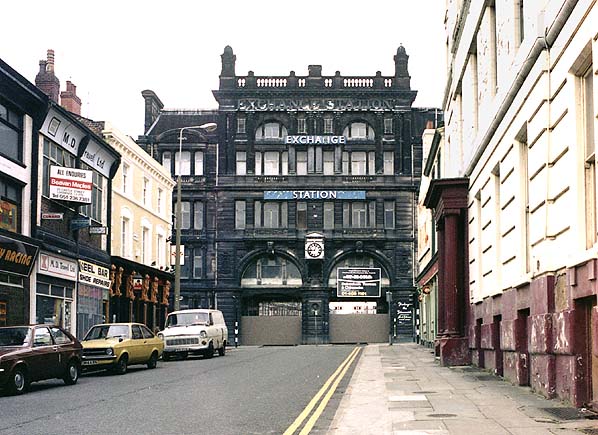
The station and hotel fronted directly onto Tithebarn Street. It was four storeys high and built of red sandstone. At its centre two archways formed the entrance to the station for pedestrians and cabs. To the left was the entrance and, to the right, the exit. Having passed through the arches and under the hotel passengers reached a cab circulating area surrounded |
by shops. Steps led into the main area of the station; either side of them there were brick-built offices, refreshment rooms, parcels offices and staff accommodation.
There were ten platforms beneath a ridged iron glazed roof that allowed light into the station. The platforms were numbered from the east side, platform 1 being the easternmost platform and platform 10 the westernmost. The platform faces were arranged as six ‘islands’. Between platforms 3 and 4 was a wide roadway for road vehicles to collect and deliver goods and parcels. They reached the roadway from a large entrance on the east side of the station, at the southern end of the platforms.
In the circulating area, south of the platforms, were two timber booking offices, one to the east and the other to the west. The western office sold tickets for local services whilst the eastern one catered for long-distance passengers.
| Beyond the platforms to the north two turntables were provided, one situated amongst the approach lines on the eastern side whilst the other was alongside the approach lines on the western side. Two signal boxes controlled the approach lines. Immediately north of the station was Liverpool Exchange No 2, with a brick base and a timber upper. Further north was Liverpool |
 |
Exchange Number 1 which was timber built and supported on legs above the running lines.
In 1888 Liverpool Exchange had 115 departures and 115 arrivals which the new facilities easily accommodated. An hourly express to Manchester Victoria was intended to compete with the London & North Western Railway (LNWR) - which operated from Liverpool Lime Street station, and since the 1840s had owned the original Liverpool & Manchester Railway of 1830. A third company, the Cheshire lines Committee (CLC), had began to operate fast express services between the two cities in 1874, so competition was stiff. The LYR had the longest route but offered a 40-minute journey for its fastest trains. In the latter part of the 19th century over 300 staff worked at Liverpool Exchange.
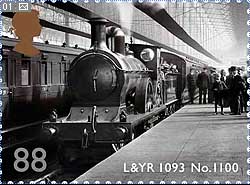 A Royal Mail postage stamp that was issued in 1988 shows an LYR locomotive at Liverpool Exchange station in the early 1900s. CLICK
 |
By 1900 so busy had the Southport line become, because of the spread of housing along the route, that there were 36 through trains in each direction. In addition there were more than 30 trains in each direction that ran only as far as Crosby. Southport traffic had increased to such a degree that it taxed the accommodation at Liverpool Exchange to the limit. The LYR was also concerned that it might lose business from the southern end of the line because municipal electric tramways were opening up on parallel routes. The solution proposed by Sir John Aspinall, the LYR General Manager, was to electrify the route to Southport and introduce multiple unit trains. Aspinall |
trains. Aspinall presented proposals to the LYR board on 28th May 1902, and in October of that year authorisation was given to create an electric route using a live rail to Southport and, beyond, to Crossens. Work began on 8th March 1903. At Liverpool Exchange platforms 6, 7, 8, 9 and 10were electrified. On 22nd March 1904 a partial electric service began, and from 5th April 1904 the Southport line passenger services went completely electric. A problem occurred at the main power station in Formby, and a full steam service had to be reintroduced on 11th April 1904. However it was rectified by 13th May and the electric operation was resumed.
The service was a great success. So popular was it that there were 119 departures from Liverpool Exchange. Many ran only to Crosby but 65 continued to Southport Chapel Street; seventeen of the 65 went as far as Crossens. On 3rd December 1906 electrification progressed along the Preston line as far as Aintree, and over the next few years it was extended twice until it reached Ormskirk on the 1st April 1913.
 |
On 1st January 1922 the LYR merged with the LNWR, but a year later on 1st January 1923 that company became part of the London Midland & Scottish Railway (LMS). The LMS also took over the LNWR, giving them control of Liverpool Lime Street station. They also had a third share in the CLC which remained a separate company. The other two-thirds of |
the CLC shares passed to the London & North Eastern Railway (LNER). However, the LMS ran trains from all three Liverpool main line termini. Despite this, competing services still ran between Liverpool and Manchester from all three stations, although the fastest LMS services went from Lime Street. (The services from Exchange were slowed to 45 minutes to ease the stress on the locomotives). With regard to long-distance services the LMS concentrated its Scottish expresses, Windermere, York and Newcastle services in Exchange.
On 30th June 1929 an excursion train from Hull collided with the hydraulic buffers at platform 4. Thirty-eight injured passengers were removed to hospital, but of these all except two were discharged the same day; Forty others complained of injuries or shock but were not sent to hospital. A report into the accident blamed the driver for entering the station at too high a speed.
| In 1939 the LMS introduced new electric rolling stock -later to be classed 502 – which was steel built, with automatic sliding doors. Work commenced on the installation of colour-light signaling at Liverpool Exchange at about the same time, but the outbreak of World War II, on 3rd September 1939, disrupted the project. Approximately half of the station had colour- |
 |
light signals by 1940 when the project was halted.
The Liverpool Blitz began on August 9th 1940. The city’s railways were a target for enemy bombers, and damage was caused to the approach lines to Liverpool Exchange. In December 1940 a viaduct north of the station received a direct hit and collapsed. No trains were able to run into the station, so extra services were provided from the CLC Liverpool Central to Southport Lord Street to convey commuters. Although the route was much longer, the extra trains helped, and they ran from 24th December 1940 until 5th July 1941. Wooden trestle bridges were built over the site of the collapsed viaduct to enable electric services to be restored. The line reopened for them within days, but no steam-hauled main line services were able to run into Exchange until 18th August 1941: they terminated at Kirkdale, passengers transferring to buses or trams. In May 1941 Liverpool suffered the worst raids of the war, and a section of the roof at Liverpool Exchange was badly damaged and had to be demolished. The roof section was at the north end of the station on the west side. After June 1941 the raids eased off, with last being on 10th January 1942. Train services at Liverpool Exchange did not return to normal until late 1942. In 1946 the colour-light signaling scheme was completed.
 |
On 1 January 1948 Liverpool Exchange became part of the nationalised British Railways (London Midland Region). At first services remained broadly similar to those in the LMS years. Electric commuter services remained frequent and busy, and longer-distance services to Manchester, Blackpool, east Lancashire, Yorkshire and Scotland ran from the station. |
On 2nd April 1951 the electric service to Aintree via Linacre Lane ceased. Only two stations closed as a result, and passengers could still reach Aintree on the direct route via Kirkdale; otherwise Liverpool Exchange remained very busy throughout the 1950s.
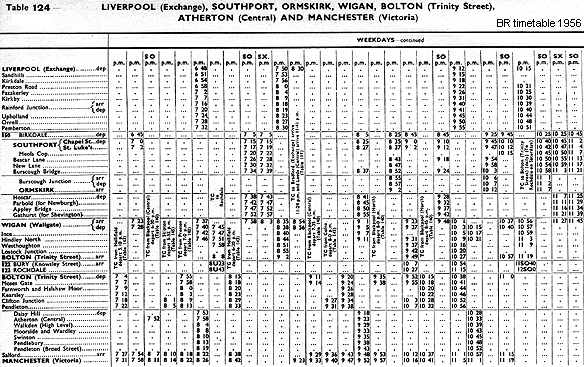
| In summer 1960 there were still weekday long-distance departures to Bradford Exchange, Leeds Central, Windermere, Glasgow Central & Edinburgh Waverley, Newcastle Central and Workington. Regular services operated to Rochdale, Blackpool Central, Preston, Wigan Wallgate, Bolton Trinity Street and to Manchester Victoria. High frequency electric services |
 |
ran to Southport and Ormskirk. In all there were 179 departures from the station. The first was a non-stop service to Preston with a connection to Glasgow leaving Liverpool Exchange at 1.45am. The last departure on weekdays was for Southport Chapel Street at 11:30pm.
One of the most outrageous proposals of the Reshaping of British Railways (Beeching) Report 1963 was the closure of the Liverpool Exchange to Southport commuter route, as well as the line to Wigan Wallgate via Rainford Junction. To transfer rush-hour passengers from the efficient and heavily used Southport route to road transport seems incomprehensible unless – as suggested by cynics – it was to provide an opportunity for the Minister of Transport to reject a proposal, demonstrating that closure was not automatic. Liverpool Exchange–Ormskirk–Preston was not earmarked for closure by Beeching, but was reviewed and reprieved in 1966. Official publication of the Wigan Wallgate line closure proposals lwas on 15 November 1963, and closure was eventually refused on 20 December 1967. No record has been found in Hansard of the enquiry into the proposed closure of the Liverpool–Southport line.
 |
In 1965-6 trains left Exchange for Southport every 20 minutes, with extra services at rush hour. This service interval applied on all days in summer, but the winter Sunday frequency was half-hourly. The Ormskirk off-peak service ran every 30 minutes, supplemented at rush hour, and an irregular service ran on to Preston. Nineteen trains left for Wigan Wallgate, including some |
for Leeds Central whose first stop was Wallgate.
On 5th March 1967 platforms 1, 2 and 3 were taken out of use. The tracks were soon removed and the area was infilled and used for car parking. This was probably due to the cessation of regular steam-hauled trains on local services. DMU’s had been introduced onto many of the non-electric services from 1960; DMU operation required fewer platforms.
By summer 1968 the Liverpool Exchange to Glasgow Central Sunday expresses were the only remaining scheduled steam-hauled passenger services in Great Britain. Many enthusiasts headed to Liverpool Exchange at this time to photograph and travel on the last services.
The last express services to Glasgow ran from Exchange on Sunday 3rd May 1970. Direct services to Preston finished the previous year. This left the station with only the electric services to Southport and Ormskirk and DMU’s to Bolton. The electric services still ran at a high frequency.
| On 1st April 1969 the Merseyside Passenger Transport Authority was formed under an Act of 1968 with responsibility for the co-ordination of bus, train and ferry services within the Merseyside area, through the Merseyside Passenger Transport Executive (MPTE). (This pre-dated the Metropolitan County of Merseyside which was created in April 1974.) The |
 |
MPTE branded the rail services within its area Merseyrail. The lines from Exchange to Southport, Ormskirk and Wigan Wallgate became part of the Merseyrail Northern Line - from Lime Street they became City Line and from Central Low Level they were Wirral Line. The Class 502 EMUs had Merseyrail applied to their coaches and the MPTE logo at each end near to the driving cabs.
The MPTE had a vision for the railways of the region that would see them transformed into a modern high-frequency system similar to the London Underground. Building upon the MALTS (Merseyside Area Land Use Transportation Study 1966) the MPTE obtained an Act in 1971 to build an underground link line between Exchange and Central stations and a loop from James Street (on the former Mersey Railway) via Exchange, Lime Street and Central stations back to James Street. The advantage for passengers using lines out of Exchange was that trains would serve Liverpool Central in the city’s shopping centre. A new underground station would be provided at Moorfields, on the south side of Tithebarn Street to replace Exchange station.
 |
On 6 May 1973 platforms 8, 9 and 10 were taken out of use so that a contractor’s base could be established for the construction of Moorfields station. A shaft was sunk at the site of the platforms to aid the works. The closure of these platforms left only numbers 6 and 7 electrified. Two platforms were insufficient for the electric services so the lines at platforms 4 and 5 were |
electrified. Southport services tended to use platforms 6 and 7, leaving 4 and 5 to the Bolton and Ormskirk services. The station took on a derelict air although efforts were made to keep the active parts of the station clean and tidy, and corporate blue was applied to the pillars at platforms 4, 5, 6 and 7. It made an interesting contrast to the faded London Midland Region colours on pillars adjacent to the car park where platforms 1, 2 and 3 had been.
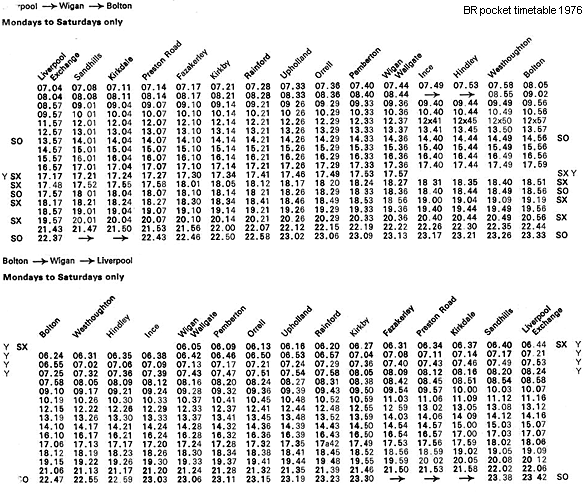
During the last year of passenger services there were fifteen weekday departures for Bolton. The first left Liverpool Exchange at 07:04 and the last at 21:43. On Saturdays there was an additional late departure for Bolton at 22:37. There were also fifteen arrivals from the Bolton line on weekdays, the first at 06:44, but it originated from Wigan Wallgate. The last arrival was at 22:06 on weekdays, but on Saturdays there was a Bolton train at 23:42. There was no Sunday service to Wigan Wallgate or Bolton.
| There were 56 departures for Ormskirk on weekdays. Thirteen of the trains had onward connecting services to Preston from Ormskirk. On Sundays there were 22 Ormskirk departures but no onward connections to Preston. The Southport line was the busiest with trains running at least every twenty minutes on weekdays from early morning to late evening. |
 |
The last departure from Liverpool Exchange was at 23.35 on Friday 29th April 1977: a special service to mark the station’s closure. It ran to Liverpool Lime Street - which lay less than a mile away - via Wigan Wallgate. Although the station officially closed the next day its booking offices remained open until Monday 2nd May, issuing tickets for the usual destinations, but on replacement bus services.
Both Liverpool Exchange No 1 and No 2 signal boxes were manned until Sunday 1st May 1977 although no trains actually ran. The signalmen were on duty to oversee asset recovery operations. Shortly after the last train had departed on the Friday night the approach lines to Exchange were disconnected at the point where the link line diverged.
Northern Line passenger trains served Liverpool Moorfields station from 3rd May 1977, the first departure from Moorfields being for Southport at 06:07.
 |
During the following weeks Liverpool Exchange was stripped of its remaining furnishings and track. The former main line platforms continued in their role as a car park for a couple of years until the trainshed was demolished. In the mid-1980s the station hotel was redeveloped as Mercury Court - an office complex. The frontage of the hotel was incorporated into the |
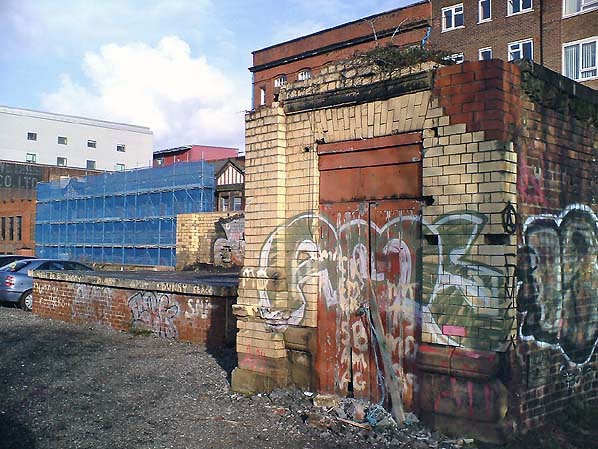
development, preserving the former main entrance to the station.The area of the trainshed and platforms became a car park. In 2010 remains of the former station, including side-walls and platform edging-stones, could still be seen
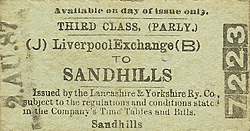
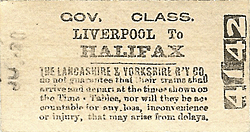
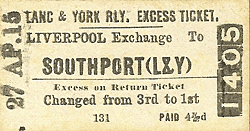
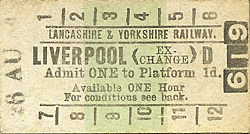
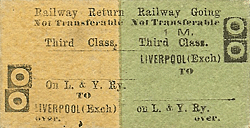
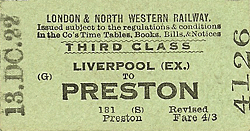
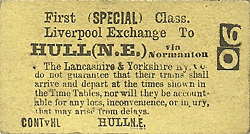
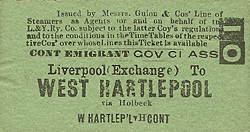
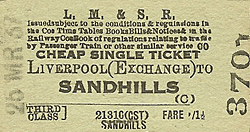
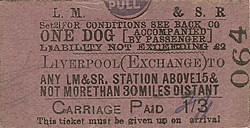
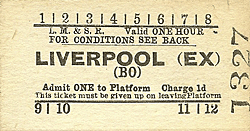
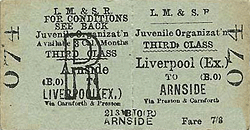
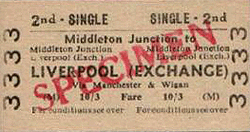
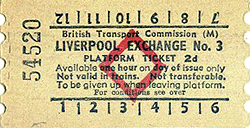
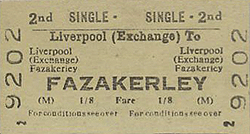
Tickets from Michael Stewart.
Sources:
See Also
Liverpool Moorfields
|

exchange_old35.jpg)
exchange_old34.jpg)
exchange_old39.jpg)
exchange_old36.jpg)
exchange_old43.jpg)
exchange_old69.jpg)
exchange15.jpg)
old21.jpg)
exchange_old23.jpg)
exchange14.jpg)
exchange18.jpg)

 Home Page