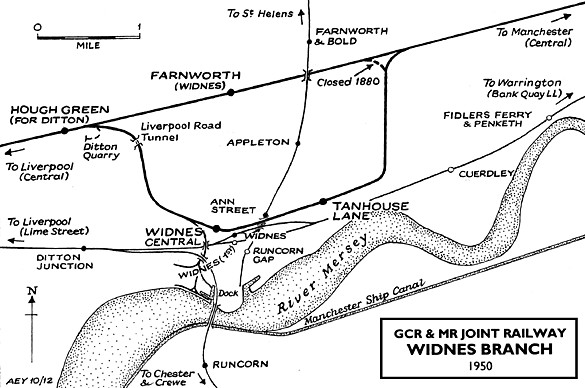
Notes: Tanhouse Lane station was located on the Manchester Sheffield & Lincolnshire Railway and Midland Railway Joint Railway (MSLR &MR Jt) Widnes Branch that connected to the Cheshire Lines Committee (CLC) Liverpool and Manchester line at Widnes East Junction (north-east of Widnes) and at Hough Green Junction (north-west of Widnes). The line had opened between Tanhouse Lane and Widnes East Junction on 3 April 1877 and between Tanhouse Lane and Hough Green Junction on 1 August 1879. When it opened the line had only one passenger station Widnes Central but 11 years later on 1 September 1890 Tanhouse Lane was opened to serve an area of expanding industries.
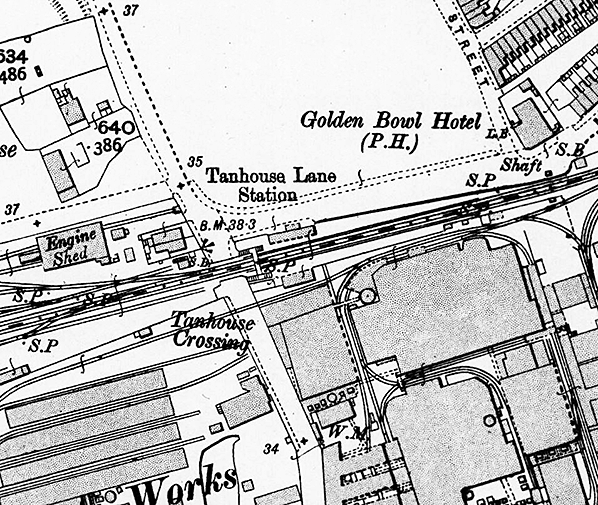
Tanhouse Lane station was located to the east of the level crossing that carried its namesake across the line on the south side of Moss Bank Road. The station had two platforms the main facilities being on the up (Manchester direction) platform. They consisted of a single-storey brick building with rectangular door and window openings. The pitched slate roof extended as a verandah over the platform and was supported by rather elegant wooden brackets. A surprising feature was found on the side walls, where exposed timber beams were used with brick nogging in herringbone patterns. On the down platform there was a complementary building of similar design.
A footbridge was located at the west end of the station which provided access between the platforms. It also provided pedestrians using Tanhouse Lane with a means of crossing the line when the level crossing was closed against them.
 The crossing was controlled by a Stevens & Sons signal box on the north side of the line, west of the crossing. The box was an all-timber structure raised up on an extended base to give the signalman a better view of the line. The box had a 22-lever frame and a miniature lever for the gate lock. The crossing was controlled by a Stevens & Sons signal box on the north side of the line, west of the crossing. The box was an all-timber structure raised up on an extended base to give the signalman a better view of the line. The box had a 22-lever frame and a miniature lever for the gate lock.
To the west of the crossing lay the extensive goods facilities that included extensive areas of sidings, a goods shed and a locomotive shed (the latter being just to the west of the signal box on the north side of the line).
Passenger services on the line were mostly operated by the CLC.
On 1 August 1897 the MSLR changed its name to the Great Central Railway (GCR) and the line became the GC&MR Joint Widnes Branch. At the ‘Grouping’ of the railway companies on 1 January 1923 the GCR became part of the London & North Eastern Railway (LNER) and the MR the London Midland & Scottish Railway (LMS) .The CLC retained its independence but its partners changed with the LNER holding two thirds of the shares and the LMS one third (The GNR having been absorbed into the LNER).
 On 1 January 1948 Tanhouse Lane became part of British Railways’ London Midland Region (BR[LMR]). The two passenger stations on the Widnes branch - as part of the Liverpool Central – Gateacre – Warrington Central ‘modification’ of services - were listed for closure in the Reshaping of British Railways ‘Beeching’ report of March 1963. The formal proposal to close ‘Liverpool Central – Manchester Central (Widnes Loop)’ was published on 11 July 1963, and the closure hearings ended on 5 February 1964. The last trains ran on Saturday 3 October 1964. On 1 January 1948 Tanhouse Lane became part of British Railways’ London Midland Region (BR[LMR]). The two passenger stations on the Widnes branch - as part of the Liverpool Central – Gateacre – Warrington Central ‘modification’ of services - were listed for closure in the Reshaping of British Railways ‘Beeching’ report of March 1963. The formal proposal to close ‘Liverpool Central – Manchester Central (Widnes Loop)’ was published on 11 July 1963, and the closure hearings ended on 5 February 1964. The last trains ran on Saturday 3 October 1964.
Tanhouse Lane station was demolished after 1965 and its site was developed with a weighbridge and car park which in turn had gone out of use by the 1990s. In 2014 the station site was a derelict piece of land awaiting development. The goods yard at Tanhouse remained in use until 2000 and was lifted in June 2008.
CLICK HERE FOR A DETAILED HISTORY OF TANHOUSE LANE STATION
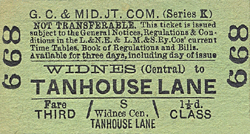
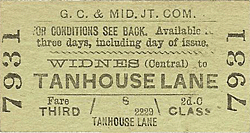
Ticket from Michael Stewart (except 668 Brian Halford) and route map by Alan Young
Sources:
- An Illustrated History of Liverpool’s Railways – P Anderson – Irwell Press 1996
- An Illustrated History of The Cheshire Lines Committee – P Bolger – Heyday Publishing Company 1984
- Bradshaw's Rail Times December 1895 - Middleton Press - 2011
- Bradshaws July 1922 Railway Guide - Guild Publishing - 1986
- British Railways (London Midland Region) Timetable 31st May to 26th September 1948
- British Railways (London Midland Region) Timetable 17th of Sept 1956 to 16th of June 1957
- British Railways (London Midland Region) Timetable 16th June to 9th September 1962
- Cheshire Lines Committee – Signal Box Register – M J Addison & J G Dixon - 1996
- Disused Stations – Lost Stations of North West England - P T Wright – Silver Link Publishing Ltd 2011
- Liverpool & Manchester, 2: Cheshire Lines - B Pixton - Kestrel - 2007
- LMS Time Table July 18th to September 11th 1932
- The St Helens Railway - J Tolston - The Oakwood Library - 1982
See Also
Widnes Central, Tanhouse Lane Goods
For other stations on the Liverpool
to Manchester CLC line click on the station name: Liverpool Central, Liverpool
St. James, Brunswick, Otterspool, Garston, Halewood & Manchester
Central.
|

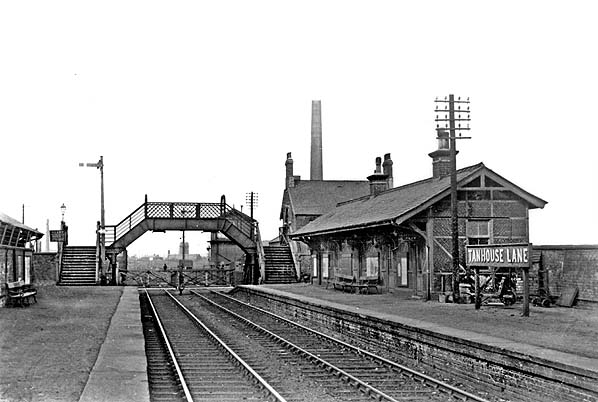 Tanhouse Lane station looking west from the down platform in May 1953.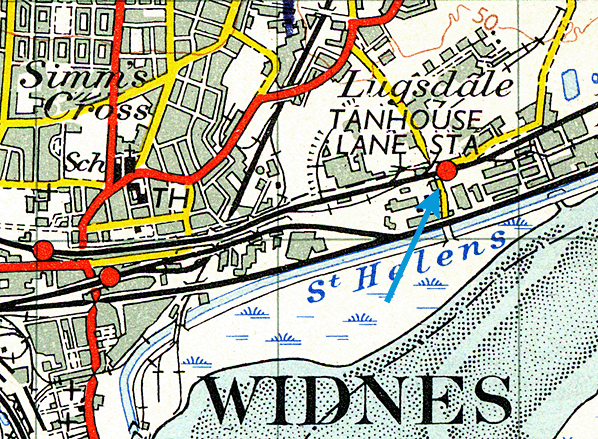
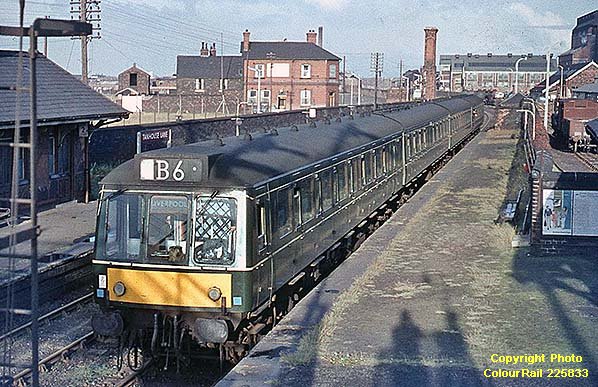 On the 29 June 1964 the 16:52 Irlam to Liverpool Central service is seen arriving at Tanhouse Lane station. The train is formed from a Derby built class 115 DMU.
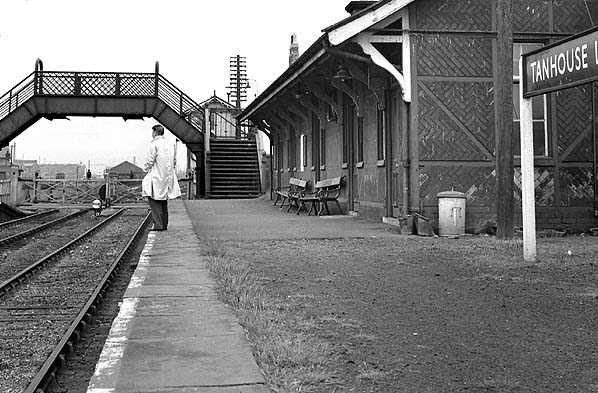 Looking west along the up platform at Tanhouse Lane in 1964. The main facilities are clearly seen to the right. Tanhouse Lane level crossing can also be seen beyond the station platforms. The extensive goods facilities at Tanhouse Lane lie to the west of the crossing.
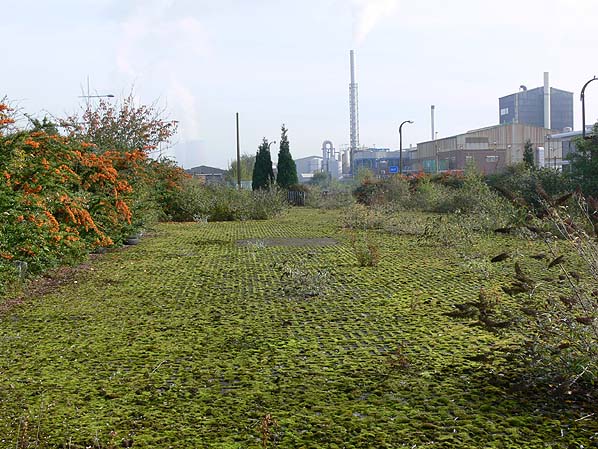 The site of Tanhouse Lane station looking east in October 2007.
 Home Page