|
Notes: The London Chatham & Dover Railway extended its line from Herne Hill across the Thames and into the City of London on 21 December 1864. Work on Ludgate Hill station was delayed following the collapse of its glass and iron overall (trainshed) roof during construction so initially trains ran into a temporary Ludgate Hill terminus to the south of the new station with an entrance on Little Earl Street.
In order to complete the construction of Ludgate Hill station as quickly as possible, a wooden truss roof supported on timber columns was built to replace the collapsed roof. It was quickly constructed and the service was extended into the still unfinished station without Board of Trade sanction on 1 June 1865.
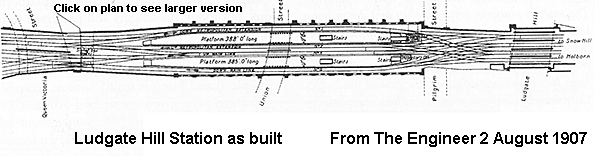
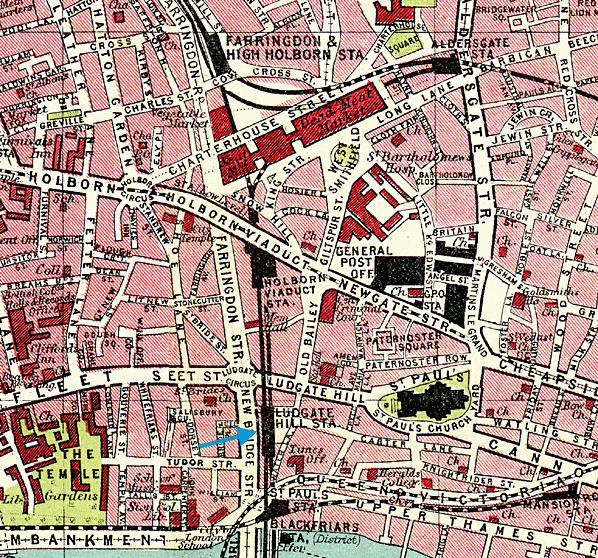
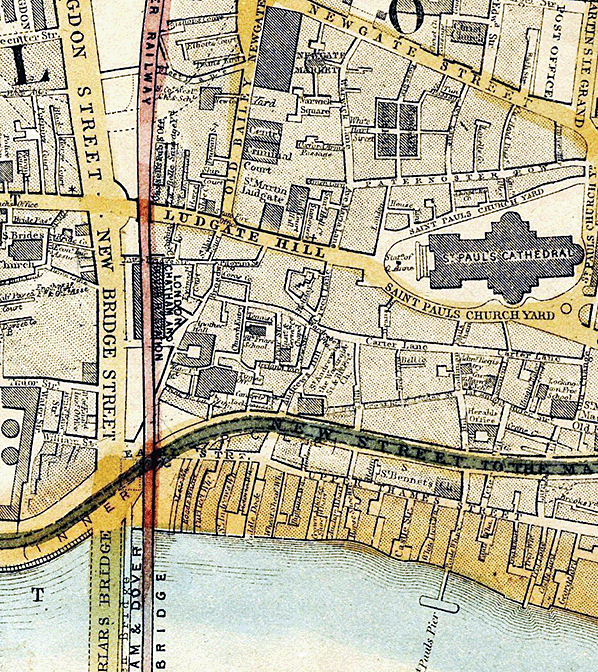
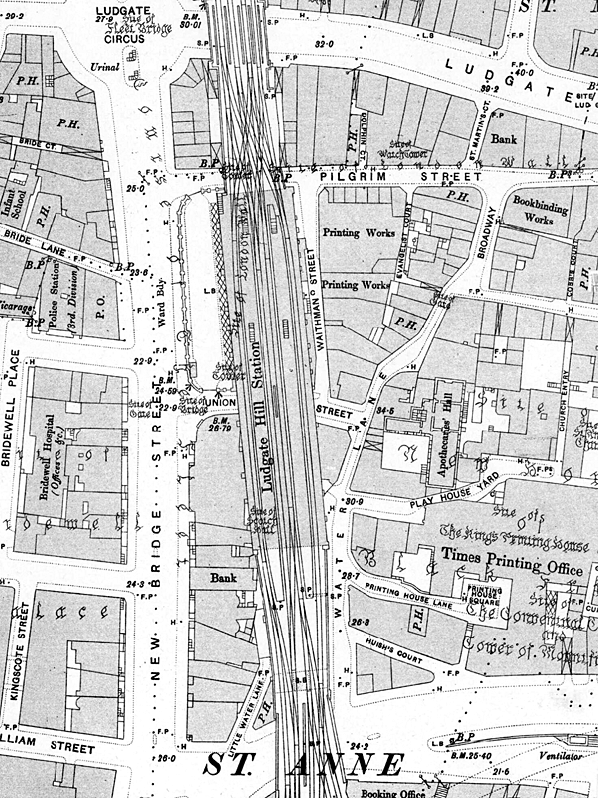
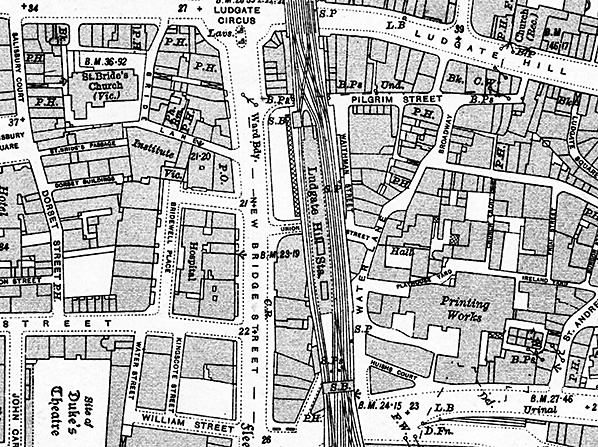
 Station facilities were not ideal, as the site was cramped and hemmed in by existing developments. The main building was sited at the rear of a forecourt on the east side of New Bridge Street. From here, narrow steps led up to two narrow island platforms on the viaduct. The platforms consisted of timber decking supported on low brick walls. The down platform serving the local lines on the west side of the formation was 388 feet in length and the main line platform on the east side was 3 feet shorter. Because of the cramped position on the viaduct, the platforms were only 17 feet wide at their widest point. At their north end, a second, narrower, flight of steps led to an exit on Little Bridge Street (Pilgrim Street from 1890). As the track north to a junction with the Metropolitan Railway had not yet been completed, Ludgate Hill was at this time a terminus. Station facilities were not ideal, as the site was cramped and hemmed in by existing developments. The main building was sited at the rear of a forecourt on the east side of New Bridge Street. From here, narrow steps led up to two narrow island platforms on the viaduct. The platforms consisted of timber decking supported on low brick walls. The down platform serving the local lines on the west side of the formation was 388 feet in length and the main line platform on the east side was 3 feet shorter. Because of the cramped position on the viaduct, the platforms were only 17 feet wide at their widest point. At their north end, a second, narrower, flight of steps led to an exit on Little Bridge Street (Pilgrim Street from 1890). As the track north to a junction with the Metropolitan Railway had not yet been completed, Ludgate Hill was at this time a terminus.
The opening of the new station was reported in The Illustrated London News on 10 June 1865: “The new station of the London, Chatham and Dover Railway, and of the Metropolitan Extension Railway, near the bottom of Ludgate Hill, was opened for traffic on Thursday the 1st inst., but is yet in a very unfinished state. The architecture of the facade has no great pretensions to dignity of style, but it presents rather a lively appearance, with its turrets at each corner and its decorations of parti-coloured brickwork above the arched doorways. The interior is convenient enough for the accommodation of the large passenger traffic, which may be expected to increase considerably upon the completion of the High-Level Crystal Palace Railway and Upper Norwood station, to be opened next month, in connection with the Metropolitan Extensions of this Company’s line at Camberwell.
The booking offices at the Ludgate Hill station are situated within a circular inclosure which stands in the middle of the spacious hall on the ground floor, one side being allotted to the Metropolitan Extension Railway (Brixton, Clapham, Battersea and Pimlico), while the other is devoted to the business of the main line, as well as of the Margate and Ramsgate portion, and through Continental traffic. The passengers, on alighting from the trains, may either descend the stairs to the doors opening into New Bridge Street, or, by another staircase, may emerge into a narrow lane which offers, at present, the readiest access to Ludgate Hill. When the houses yet remaining at the corner of Ludgate Hill shall be removed, a more suitable approach may be provided on that side, but it is likely that many of the passengers for the City will not alight at Ludgate Hill, but will go on by the line now under construction which is to join the London, Chatham and Dover with the Metropolitan Railway at Smithfield, thence passing on to Aldersgate and Liverpool Street.”
The extension towards the Metropolitan Railway was inspected by the Board of Trade on 19 August 1865 but Colonel Yolland found the work was incomplete and asked for numerous changes to be made and he doubted whether “the platforms are sufficiently wide for the traffic that may be expected.”
 Having completed the required changes a different Board of Trade inspector, Captain Tyler, returned to the station on 21 October and it was clear from his report that he was unhappy with the fact that the station had originally opened without Board of Trade sanction stating, "The present notice of the Company can only be taken to include that portion of the railway which extends from the north end of the Ludgate station to West Street (Connection with the Metropolitan Widened Lines). The portion from the original temporary station was opened some months ago without their Lordships’ sanction and is now used - although objectionable in several respects.” With numerous clearance problems noted, authority to open the extension was again refused. Having completed the required changes a different Board of Trade inspector, Captain Tyler, returned to the station on 21 October and it was clear from his report that he was unhappy with the fact that the station had originally opened without Board of Trade sanction stating, "The present notice of the Company can only be taken to include that portion of the railway which extends from the north end of the Ludgate station to West Street (Connection with the Metropolitan Widened Lines). The portion from the original temporary station was opened some months ago without their Lordships’ sanction and is now used - although objectionable in several respects.” With numerous clearance problems noted, authority to open the extension was again refused.
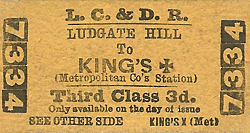
Once further remedial work has been completed, the Board of Trade eventually authorised the opening of the extension with the first northbound train leaving Ludgate Hill at 7.28am on 1 January 1866. On the same day, a station restaurant was opened in arches beneath the viaduct.
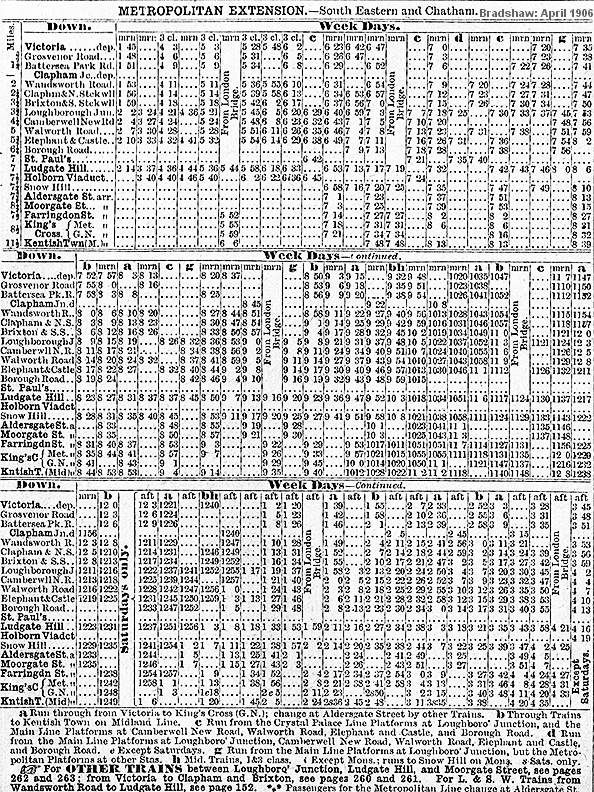
With the opening of the extension, passengers using Ludgate Hill increased rapidly, especially during rush hours as it was convenient for City workers. Apart from London Chatham & Dover services, it was eventually used by the Great Northern Railway, London & South Western Railway, Midland Railway and South Eastern Railway. However, because of ongoing rivalry between the LC&DR and the SER, the latter’s trains were not permitted to pick up passengers at Ludgate Hill, passengers could only disembark there.
 Ludgate Hill station was soon struggling to cope with the demand especially during rush hours. The opening of Holborn Viaduct helped relieve the pressure as far as main line services were concerned but the station was still struggling to cope with commuter traffic in peak periods. Even the opening of Snow Hill station on the through lines on 1 August 1874 did little to relieve the danger caused by large numbers of commuters using narrow timber platforms. In a further attempt reduce the demand on Ludgate Hill, the cash strapped LC&DR opened another station in the vicinity called St Paul’s on the south side of the river on 10 May 1886. Ludgate Hill station was soon struggling to cope with the demand especially during rush hours. The opening of Holborn Viaduct helped relieve the pressure as far as main line services were concerned but the station was still struggling to cope with commuter traffic in peak periods. Even the opening of Snow Hill station on the through lines on 1 August 1874 did little to relieve the danger caused by large numbers of commuters using narrow timber platforms. In a further attempt reduce the demand on Ludgate Hill, the cash strapped LC&DR opened another station in the vicinity called St Paul’s on the south side of the river on 10 May 1886.
Ludgate Hill had two signal boxes. The North box was at the Holborn end of the local island platform, and, in May 1886, had thirty-four levers, of which thirty were in use. The South box was built on a gantry above the tracks at the south end of the station. It initially had twenty-eight levers of which two were spare, but following the opening of St Paul’s station it was fitted with a new frame with forty levers.
In the February 1899 issue of Railway Magazine railway journalist Charles Rous-Marten was scathing about the conditions of Ludgate Hill in a five and a half page article in which he wrote, “Probably no railway station since iron roads were first invented has ever come in for such an avalanche of gorgeous and whole-souled abuse as has fallen of late upon that of the London, Chatham and Dover at Ludgate Hill”. He went on to describe his ideas for improving the station, "Inside, at present, there are four lines of rails and two narrow island platforms. The eastern platform serves the up and down main line, which, coming from Holborn Terminus, passes through Ludgate Station and then on through St. Paul’s Station to the South. The western island platform has to accommodate all the rest of the traffic. Occasionally during a press of traffic a train belonging to the western platform is passed over to the eastern one, but that is the exception.” He suggested that the two island platforms should be replaced with two side platforms which would only serve the local lines. He suggested extra width could be achieved by demolishing part of the station frontage and building one of the new platforms over the existing forecourt.
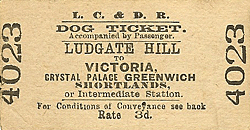 Early in the 20th century closure of the station was considered by the SE&CR. Due to the close proximity of St Paul’s and Holborn Viaduct they considered Ludgate Hill to be expendable even though many passengers preferred to use it. Eventually the SE&CR decided that rebuilding the station was a better option. The proposals were described in detail in The Engineer on 2 August 1907, ”For some considerable time past the traffic arrangements at Ludgate Hill Station have not been all that could be desired, and yet we fully appreciate that under the present conditions the management was not in a position to improve them. The fault lies in the design of the building. When the station was erected, no doubt it was capable of dealing with all the traffic that was likely to be expected there, but this has now so increased as to render the present building quite unsuitable. At certain times of the day the congestion of traffic is sorely felt, and this is particularly noticeable as on such occasions when large gatherings are attracted to the Crystal Palace. The entrances and exits are small, and at times are quite incapable of dealing efficiently with the traffic. There are two platforms, one of which is 385ft. and the other 388ft. in length, and both only 17ft. wide. They are island platforms, and the whole station is covered by an old wooden roof which has done service for about forty years. The station is the property of the South-Eastern & Chatham Railway Companies, which have no fewer than seven stations in the metropolitan area. We are given to understand that quite recently it was proposed to close the station altogether, but after due consideration of the proposal it was finally decided to retain it. The station is centrally situated, and it would have caused great inconvenience to many people had the directors decided to close it. The companies own no adjacent land, and any further extensions would have involved an enormous outlay - an outlay which would not have been commensurate with the benefits which the companies could have hoped to derive from it. Early in the 20th century closure of the station was considered by the SE&CR. Due to the close proximity of St Paul’s and Holborn Viaduct they considered Ludgate Hill to be expendable even though many passengers preferred to use it. Eventually the SE&CR decided that rebuilding the station was a better option. The proposals were described in detail in The Engineer on 2 August 1907, ”For some considerable time past the traffic arrangements at Ludgate Hill Station have not been all that could be desired, and yet we fully appreciate that under the present conditions the management was not in a position to improve them. The fault lies in the design of the building. When the station was erected, no doubt it was capable of dealing with all the traffic that was likely to be expected there, but this has now so increased as to render the present building quite unsuitable. At certain times of the day the congestion of traffic is sorely felt, and this is particularly noticeable as on such occasions when large gatherings are attracted to the Crystal Palace. The entrances and exits are small, and at times are quite incapable of dealing efficiently with the traffic. There are two platforms, one of which is 385ft. and the other 388ft. in length, and both only 17ft. wide. They are island platforms, and the whole station is covered by an old wooden roof which has done service for about forty years. The station is the property of the South-Eastern & Chatham Railway Companies, which have no fewer than seven stations in the metropolitan area. We are given to understand that quite recently it was proposed to close the station altogether, but after due consideration of the proposal it was finally decided to retain it. The station is centrally situated, and it would have caused great inconvenience to many people had the directors decided to close it. The companies own no adjacent land, and any further extensions would have involved an enormous outlay - an outlay which would not have been commensurate with the benefits which the companies could have hoped to derive from it.
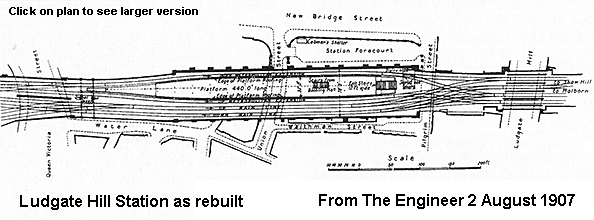
Briefly stated, the alterations will consist in replacing the two present platforms by one platform of the island type having ample proportions. All the main line express trains will run over the (lines laid on the former platform site) and no longer stop at Ludgate Hill. They will pass through to St. Paul’s or Holborn Viaduct. The station is not much used by main line passengers, and this new departure will not therefore cause any inconvenience. The traffic is mostly local, and is practically confined to the early morning business trains and evening traffic. The new platform will be 440ft. in length, and will have a breadth of 32ft. The platform will be covered by a roof of the umbrella type supported by central columns and will not quite extend to the full length of the platform. Another great improvement which is embodied in the new design is the size of the entrance and exit. The former is to be at least 3ft. wider than the present one.
The work upon the alterations has already commenced, but it will of necessity be a long and tedious undertaking. The difficulties which have to be overcome are numerous, and it must not be forgotten that the work will have to be carried out without seriously affecting the handling of the traffic. Indeed, it will be impossible to close the station except on Sundays. One of the chief difficulties which has to be overcome is that of making the existing floor waterproof. At present this is far from being the case, as anyone who has stood in the booking hall will know. It is the engineer’s intention to rectify this as the work proceeds. Another obstacle almost as difficult to overcome as this will be the rearrangement of the points at both ends of the platform. This entails much work. Then, again, there is the complete removal of one platform, and the building of another, and this also without interfering with the traffic, and finally there is the removal of the present roof and construction of another”
 Once the timber trainshed had been removed the main line island platform was demolished but before any further work could be done, the 70ft span that carried the line over Union Street and the booking hall had to be replaced. The surviving island platform was then rebuilt, widened and slightly realigned and the down local line was slewed over. The narrow stairways were widened and the supporting walls for the trainshed were reduced in height to around 14ft above track level. Progress was slow due to the need to keep the station open while work was underway; in order to achieve this a temporary timber platform was provided; by the end of the decade there was still much work to be done. Once the timber trainshed had been removed the main line island platform was demolished but before any further work could be done, the 70ft span that carried the line over Union Street and the booking hall had to be replaced. The surviving island platform was then rebuilt, widened and slightly realigned and the down local line was slewed over. The narrow stairways were widened and the supporting walls for the trainshed were reduced in height to around 14ft above track level. Progress was slow due to the need to keep the station open while work was underway; in order to achieve this a temporary timber platform was provided; by the end of the decade there was still much work to be done.
Unfortunately, the future of Ludgate Hill was beginning to look bleak even before rebuilding had been completed. The electrification of the Metropolitan District Railway in 1905, and the extension of electric tramcars over Blackfriars Bridge four years later, resulted in many commuters deserting the station in favour of these new and more efficient forms of transport at. The heyday of cross-London suburban trains was coming to its end, and the demand for Ludgate Hill started to diminish. Between 1907 and 1909, most of these services were withdrawn, leaving just those operated by the SE&CR and L&SWR.
Despite this reduction in demand, the work was completed and on 12 June 1912 the station was inspected by Major Pringle of the Board of Trade. His report stated, “The station has been completely remodelled. Formerly two island platforms existed, for Metropolitan Extension and Main Line trains respectively and a single roof spanned all the station roads. The main line platform (on the east) has been done away with, and the west platform (Metropolitan Extension) has been lengthened and widened. Formerly there was much congestion on this platform, especially in the morning and evening, owing to its narrowness. The length has now been extended from 388 to about 450 feet, and the maximum width increased from about 18 to 32 feet.
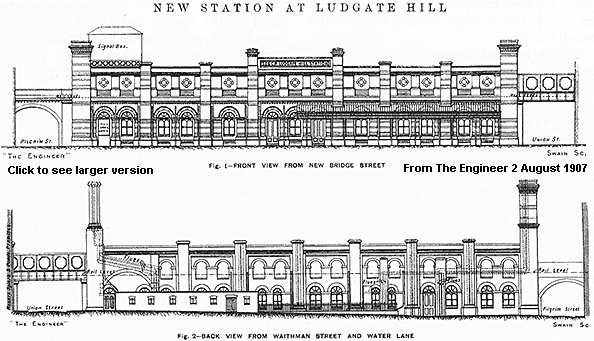
Passenger accommodation in the shape of a general and ladies waiting rooms, and conveniences for both sexes, have been provided. The means of exit, formerly inadequate during rush hours, has been immensely improved by the stairway being increased in width from 6 to 12 feet. There is a separate staircase for approaching the platform. The platform is provided with an umbrella roof extending for a length of about 300 feet. The arrangements generally represent a great improvement upon the old conditions, and appear to be adequate.” Major Pringle required a number of signalling refinements completed the new station was opened.
At track level, the station was provided with two buildings, the larger building closer to the south end of the platform comprised a porters’ room, a gents’ toilet and a ladies’ room. The second building included a general waiting room, a room for the ticket collector and an inspector’s office; it also had a book stall at its north end.
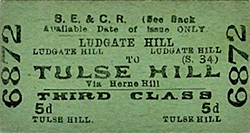 As much of the demand for Ludgate Hill had now been lost to other more convenient forms of transport it was soon clear that the station’s days were numbered. L&SWR trains were withdrawn in 1916 and after 1919 the station was only open during rush hours. The Wimbledon service was reinstated on 27 August 1923 but this only comprised four up workings in the morning and three down in the evening. After the line serving Holborn Viaduct was electrified in 1925, these were the only trains which continued using Ludgate Hill, and closure became inevitable. Also in 1925 a new row of shops was built on the station forecourt with access to the booking office along a passage way between them. As part of the electrification scheme, both Holborn Viaduct and St. Paul’s signal boxes were fitted with new power frames operating four-aspect colour lights. These were brought into use on 21 March 1926 and the two boxes serving Ludgate Hill were closed. As much of the demand for Ludgate Hill had now been lost to other more convenient forms of transport it was soon clear that the station’s days were numbered. L&SWR trains were withdrawn in 1916 and after 1919 the station was only open during rush hours. The Wimbledon service was reinstated on 27 August 1923 but this only comprised four up workings in the morning and three down in the evening. After the line serving Holborn Viaduct was electrified in 1925, these were the only trains which continued using Ludgate Hill, and closure became inevitable. Also in 1925 a new row of shops was built on the station forecourt with access to the booking office along a passage way between them. As part of the electrification scheme, both Holborn Viaduct and St. Paul’s signal boxes were fitted with new power frames operating four-aspect colour lights. These were brought into use on 21 March 1926 and the two boxes serving Ludgate Hill were closed.
The final blow came in 1929 following the electrification of the Wimbledon via Haydons Road line. The rebuilt platform at Ludgate Hill was now too short to take the new 8-car trains and the last train left the station at 1.50pm on Saturday 2 March, with official closure taking place from the following day. All former traffic was now handled by St Paul’s and Holborn Viaduct. Strangely the station restaurant in the viaduct arches remained open until 1938, outliving the station by nine years.
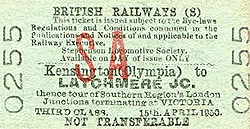
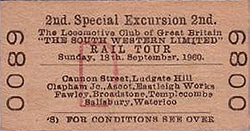
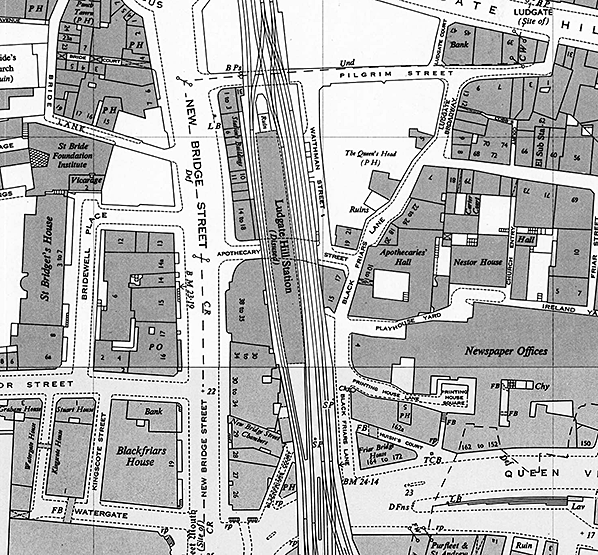
During WW2 the shops built on the forecourt were damaged during the blitz and were subsequently demolished revealing the former station entrance; new shops were built there in 1953/4. (Nos. 1 - 18 Station Buildings). Ludgate Hill remained intact complete with platform buildings and awning for many years. It was visited by a number of railtours, notably SLS 'London Junctions' 15.4.1950, RCTS (London Branch)
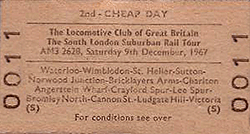
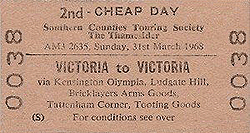
'Marylebone to Broad Street' , 10.10.1953, LCGB 'The South Western Limited' 18.9.1960, LCGB 'The South London Suburban Rail Tour' 9.12.1967 and Southern Counties Touring Society 'The Thamesider' 31.3.1968
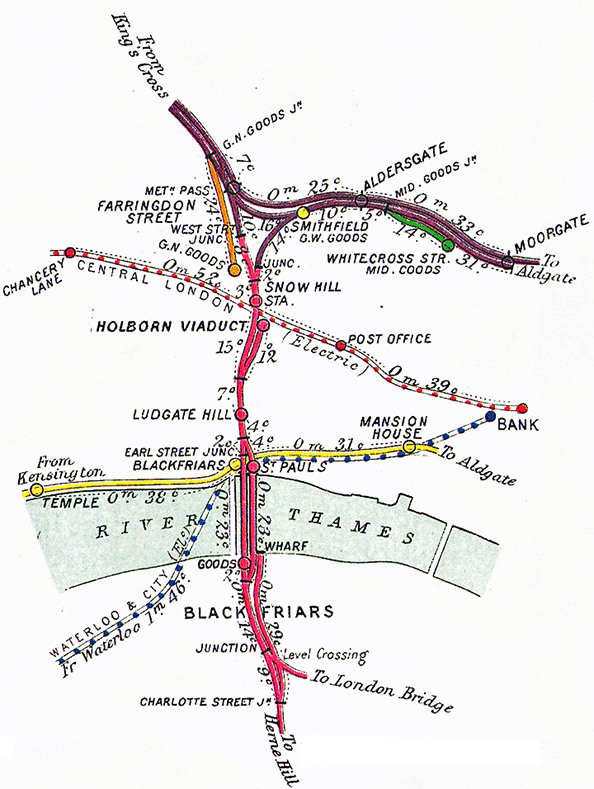
In c1960 the awning and platform buildings were demolished leaving just the ironwork that supported the awning for another year but this too was eventually removed leaving just the platform with a now open staircase at its north end. The platform was demolished in 1973 leaving a widening in the track where it had been. When visited by the author in December 1985 the top of the stairway had been excavated prior to relaying tracks through the station site for the reopening of Snow Hill tunnel in 1988. Two years later, Holborn Viaduct closed and the formation was re-aligned, so that trains leaving Blackfriars immediately descended on a steep gradient toward Farringdon. This occupied much of the former Ludgate Hill station site and took the tracks below street level, so that they passed beneath Ludgate Hill itself in tunnel. During this works the former Ludgate Hill station frontage was exposed for the last time when the shops on the former forecourt were demolished. Complete demolition of the frontage quickly followed and Ludgate Hill station was consigned to history. A new subterranean station called St Paul’s Thameslink with an entrance on Ludgate Hill opened 29 May 1990. The name was changed to City Thameslink in 1991 to avoid confusion with the St. Paul's Central Line station.
BRIEF HISTORY OF THE LC&DR's
'CITY LINE'
The Metropolitan Extensions Act of 1860 gave the London Chatham & Dover Railway access to the City, authorizing a 4.5-mile line from Herne Hill across the river to join the Metropolitan Railway at Farringdon Street.
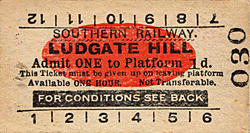
The 'City Line' was far more than the Chatham could cope with financially, but the possibilities for through traffic were vast. To the north the GNR and the Midland could be reached and to the south were the LB&SCR and L&SWR at Clapham Junction from where the GWR and L&NWR could be reached via the West London Line. All these companies were approached to partake financially and all eventually profited from the scheme gaining the right to work trains to their own goods and coal depots in South London. The line from Herne Hill to the Elephant and Castle was opened on 6 October 1862 and on to Blackfriars Bridge on 1 June 1864. Intermediate stations were initially provided at Camberwell, Walworth Road and Borough Road and later at Loughborough Junction.
The Thames was eventually bridged and by 21 December 1864 a temporary station at Ludgate Hill was in use, a permanent station being opened on 1st June 1865. It had two narrow island platforms but the station was rebuilt in 1910 with a single broader island platform.
On 1st January 1866, LC&DR passenger trains began running into the Metropolitan's Farringdon Street station and the connection was soon carrying a wide variety of passenger and freight services. Then, by an Act of 13 July 1871, the Chatham became committed to yet another project.
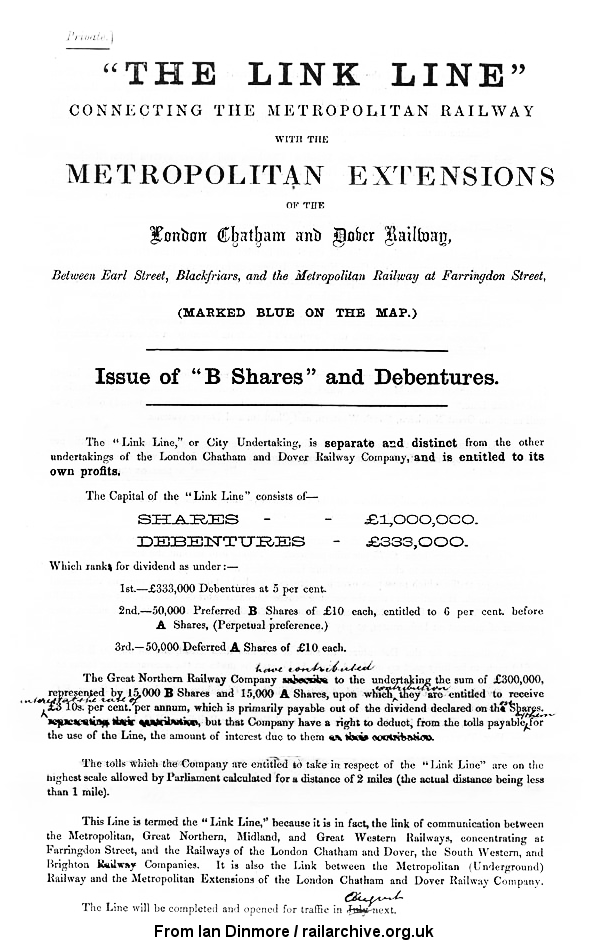
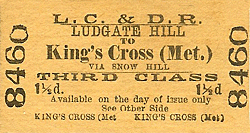
As Ludgate Hill was on a very cramped site expansion of the station wasn't possible. To overcome this a new station was planned. The nominally independent Holborn Viaduct Station Company (for the bankrupt Chatham was not allowed to raise capital) was authorized to build a 292 yard branch from the Ludgate - Farringdon line to a new terminus, complete with hotel, fronting on the new thoroughfare of Holborn Viaduct. It was opened on 2nd March 1874. On 1st August 1874 a low-level station, Snow Hill ('Holborn Viaduct Low Level' from 1912), was opened on the through line at the foot of the 1 in 39 incline in an attempt to relieve overcrowding at Ludgate Hill.
Finally, on 10th May 1886 a parallel bridge across the Thames was opened with, at the northern end, yet another new station, St Paul's, the original Blackfriars Bridge being closed. St Paul's was renamed Blackfriars on 1st February 1937. The existing layout was completed when the South Eastern Railway opened the Union Street spur on 1st June 1878 creating a through route into Charing Cross.
 The difficulties of inter-terminal transfer through the congested streets of mid-Victorian London assured considerable transfer traffic. All LC&DR mainline trains, including continental ones, carried a City portion attached or detached at Herne Hill. Eventually however the development of the underground network led to the withdrawal of the through services and the demise in the importance of Holborn and Blackfriars with a dramatic reduction in off peak services. Holborn retained very heavy parcels traffic, including continental, and three of its six platforms, too short for electric trains were utilised. The difficulties of inter-terminal transfer through the congested streets of mid-Victorian London assured considerable transfer traffic. All LC&DR mainline trains, including continental ones, carried a City portion attached or detached at Herne Hill. Eventually however the development of the underground network led to the withdrawal of the through services and the demise in the importance of Holborn and Blackfriars with a dramatic reduction in off peak services. Holborn retained very heavy parcels traffic, including continental, and three of its six platforms, too short for electric trains were utilised.
The first casualty on the line was Borough Road which closed on 1st April 1907 due to competition from the Northern Line. As an economy measure during WW1 through services from south of the Thames to Moorgate via the Smithfield Curve (opened 1.9.1871) were withdrawn on 1st April 1916 with Camberwell and Walworth Road stations closing two days later. Holborn Viaduct Low Level closed on 1st June 1916 and with it through passenger traffic on the City Line ceased.
Less than 700 yards separated Holborn Viaduct from Blackfriars. Ludgate Hill thus became increasingly redundant, especially after the through trains stopped. The intensive Ludgate Hill - Victoria services were withdrawn during the First World War. The Wimbledon trains were the last to call and with their electrification it was closed on 3 March 1929.
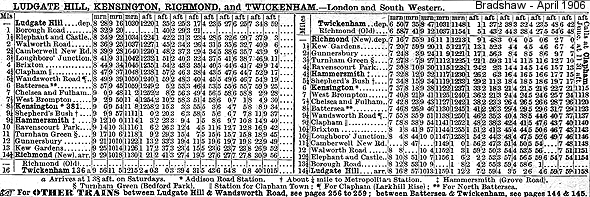
In 1902, 19.2 million passengers used Holborn, Ludgate and St Paul's. Use declined with the loss of the cross London traffic until electrification. The growth of L.C.C. estates in S E London and Kent increased traffic but this was not maintained and in 1960 they were back to the 1902 level with 88% of the traffic arriving or departing during the rush hour. The 'City Line' was still a vital north-south freight link with some 90 trains a day in 1962, but all regular freight and parcels services were withdrawn in 1969. Although disused for many years the Snow Hill tunnel was finally abandoned in 1971 and the track was lifted.
The Snow Hill tunnel was reopened in 1988 as part of the new Thameslink network which came into service in May 1990, initially as part of British Rail but private since March 1997. To coincide with the opening of Thameslink, Holborn Viaduct Station was closed on 22nd January 1990. The line into Holborn Viaduct over Ludgate Hill was removed and a new line built that drops down steeply from Blackfriars station into a new station called City Thameslink (opened 29.5.1990) beneath the former Holborn Viaduct Station. The station was originally called St. Paul's Thameslink but was renamed in 1991 to avoid confusion from St. Paul's station on the Central line.
The northern part of the Thameslink network replaced the 'Bedpan' service from Bedford to St Pancras and uses the existing Midland Main Line. In the south there are two branches. The main route runs through London Bridge to East Croydon and Brighton while the second branch initially ran into Guildford via West Croydon but has now been rerouted through Mitcham to terminate at Sutton.
Thameslink has become a significant commuter route serving the airports at Gatwick and Luton and carries around 40 million passenger journeys on the system annually.
Sources:
Tickets from Michael Stewart except 8698 & 6872 Mike Morant, Bradshaws from Chris Hind
Other web sites: Abandoned
Tube Stations - includes a cab ride from Farringdon - Blackfriars
To see the other stations on
the LC&DR's 'City Line' click on the station name: Loughborough
Junction, Camberwell,
Walworth Road,
Borough Road,
Blackfriars
Bridge, Blackfriars,
Holborn Viaduct,
Snow Hill/Holborn Viaduct
Low Level & Farringdon |

hill_old10.jpg)
hill_old24a.jpg)
hill_old11.jpg)
3.jpg)
hill_old9.jpg)
hill_old8.jpg) An aerial view facing north from August 1948, showing Blackfriars station straddling the Thames at the bottom, the closed Ludgate Hill station in the centre and Holborn Viaduct station at the top. The proximity of the three stations illustrates very well why Ludgate Hill was sensibly closed some two decades previously. Ludgate Hill's island platform is of course that which replaced the original and temporary two platforms of 1865. The platform canopy remains largely intact and would continue to stand, albeit with increasing dilapidation, until the early 1960s. The steam-hauled train passing through Ludgate Hill is something of a puzzle; some of its vehicles, from what little can be seen, appear to be vans and this suggests a parcels or perishables train. Whilst parcels traffic was a familiar sight at Holborn Viaduct, the train seen here is routed onto the Snow Hill line so is presumably heading for either Smithfield or the Widened Lines with onwards movement from there. At Holborn Viaduct station a suburban electric multiple unit of pre-war design and no doubt a 4SUB can be seen peeping out from within the trainshed. Other units, probably of the same type, can be seen in Blackfriars station and vehicles appear to be of the shorter 57ft underframe variety suggesting early conversions from steam-hauled stock. Running across the picture left to right and passing beneath the steam locomotive is Ludgate Hill, with several London Transport STL class buses in attendance. It is just possible to discern the frontage of Ludgate Hill station, to the immediate left of the platform canopy, and which was hidden for many years by other buildings facing onto New Bridge Street, lower left. Today the above scene has changed almost beyond recognition. Holborn Viaduct and Ludgate Hill stations have ceased to exist, while Blackfriars station has been much altered. Ludgate Hill, Fleet Street, Farringdon Street and New Bridge Street are of course still with us but in 2018 the only buildings instantly recognisable from this 1948 photograph are those with the concave corners at the bottom of Farringdon Street, overlooking Ludgate Circus. Click here for a larger version with a more detailed caption
An aerial view facing north from August 1948, showing Blackfriars station straddling the Thames at the bottom, the closed Ludgate Hill station in the centre and Holborn Viaduct station at the top. The proximity of the three stations illustrates very well why Ludgate Hill was sensibly closed some two decades previously. Ludgate Hill's island platform is of course that which replaced the original and temporary two platforms of 1865. The platform canopy remains largely intact and would continue to stand, albeit with increasing dilapidation, until the early 1960s. The steam-hauled train passing through Ludgate Hill is something of a puzzle; some of its vehicles, from what little can be seen, appear to be vans and this suggests a parcels or perishables train. Whilst parcels traffic was a familiar sight at Holborn Viaduct, the train seen here is routed onto the Snow Hill line so is presumably heading for either Smithfield or the Widened Lines with onwards movement from there. At Holborn Viaduct station a suburban electric multiple unit of pre-war design and no doubt a 4SUB can be seen peeping out from within the trainshed. Other units, probably of the same type, can be seen in Blackfriars station and vehicles appear to be of the shorter 57ft underframe variety suggesting early conversions from steam-hauled stock. Running across the picture left to right and passing beneath the steam locomotive is Ludgate Hill, with several London Transport STL class buses in attendance. It is just possible to discern the frontage of Ludgate Hill station, to the immediate left of the platform canopy, and which was hidden for many years by other buildings facing onto New Bridge Street, lower left. Today the above scene has changed almost beyond recognition. Holborn Viaduct and Ludgate Hill stations have ceased to exist, while Blackfriars station has been much altered. Ludgate Hill, Fleet Street, Farringdon Street and New Bridge Street are of course still with us but in 2018 the only buildings instantly recognisable from this 1948 photograph are those with the concave corners at the bottom of Farringdon Street, overlooking Ludgate Circus. Click here for a larger version with a more detailed caption Home
Page
Home
Page