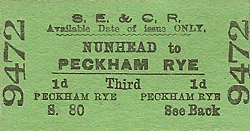
Station Name: NUNHEAD (1st site)


[Source: Nick Catford]


Date opened: 1.9.1871
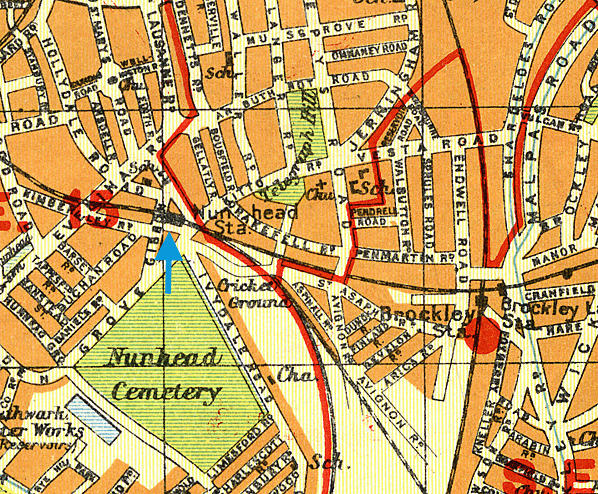
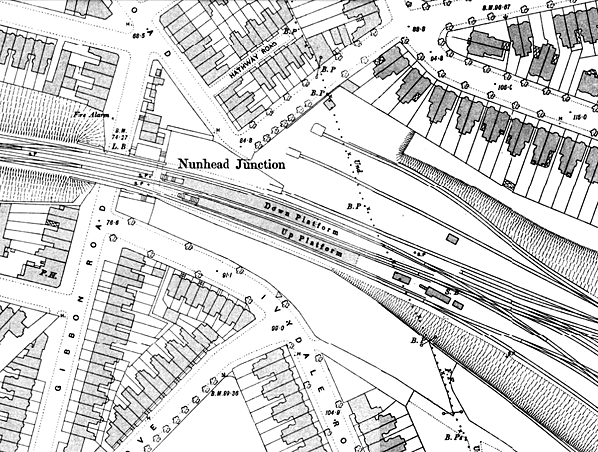
Location: On the east side of Gibbon Road
Company on opening: London Chatham & Dover Railway
Date closed to passengers: 3.5.1925
Date closed completely: 3.5.1925
Company on closing: South Eastern & Chatham Railway
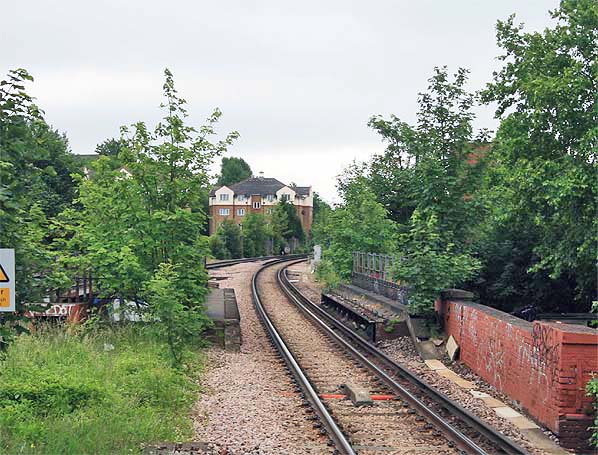
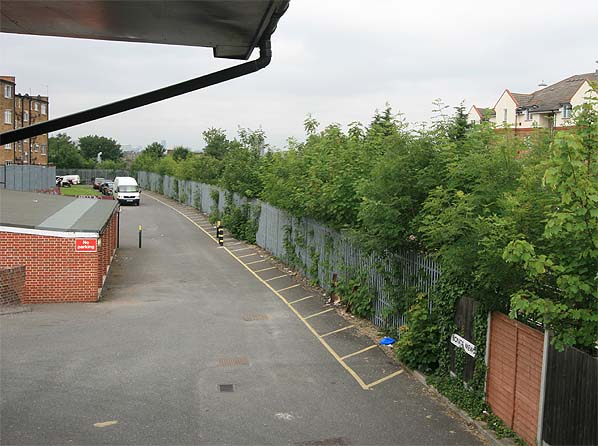
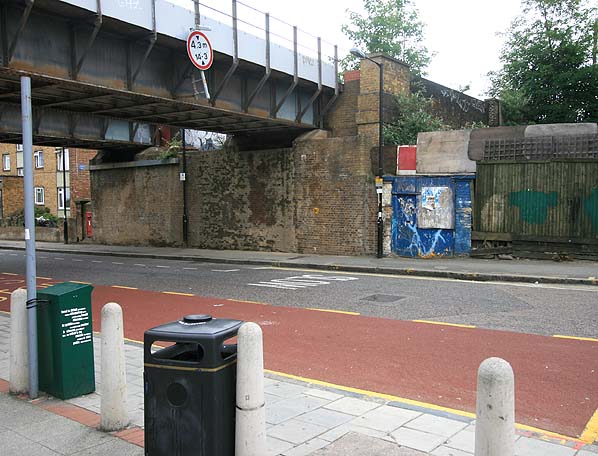
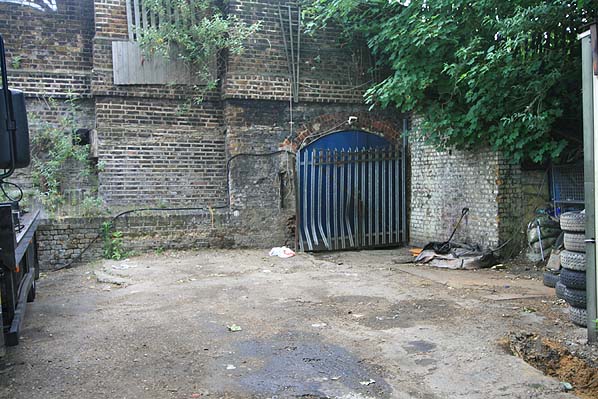
Present state: The station has been demolished. The line running through one platform is still in use. Bonita Mews runs through the site of the second platform. Two brick gate posts adjacent to the bridge over Gibbon Road might be an entrance to the station. There is a blocked subway beneath the line at the west end of the station site.
County: London
OS Grid Ref: TQ355760
Date of visit: June 2007

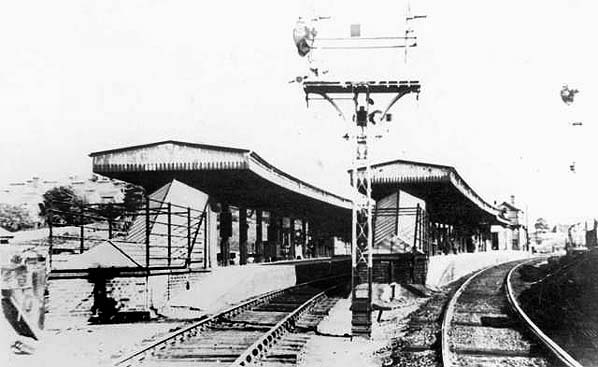
Notes: Nunhead station was sited on the east side of Gibbon Road, and consisted of two island platforms. The outer faces of these served the up and down lines, whilst the centre road, which had a platform either side, was used by both up trains and shuttle trains terminating at Nunhead. The station was sometimes known as Nunhead Junction.

The station was closed on 3rd May 1925 shortly before electrification of the Crystal Palace branch. It was replaced by a new Nunhead Station with a single island platform on the west side of Gibbon Road. Nunhead Station is still open today..

BRIEF HISTORY OF THE GREENWICH PARK BRANCH
The original plans for the Greenwich Park branch proposed a line from Nunhead through Greenwich terminating at the Royal Dockyard in Woolwich. With the opening of the South Eastern Railways extension from Greenwich to Woolwich in 1849 there was no longer a need to serve Woolwich and the London Chatham & Dover Railway were eventually authorised to build a 2m 18ch line between Nunhead and Crooms Hill, on the western side of Greenwich Park by an Act of Parliament in July 1863.

Financial problems delayed construction until 1871 when the branch opened as far as Blackheath Hill on 18th September with one intermediate station at Lewisham Road; a second at Brockley Lane was opened in June 1872. There was a regular 45 minute service although most trains shuttled between Nunhead and Blackheath Hill which was unpopular with
commuters who had to change at Nunhead to reach central London.

Despite disappointing receipts, the LCDR continued with their proposal to extend to Greenwich.  The original powers had lapsed and a new Act was required which was received in 1881. The company was still in financial difficulty and the extension wasn’t completed to Greenwich Park (Greenwich until 1900) until 1st October 1888. A substantial terminus was built in Stockwell Street and not Crooms Hill as originally planned because housing development had overtaken the railway.

The extension failed to attract additional traffic to the line which was unable to compete with SER's direct line from Greenwich into central London. Leisure traffic was more successful however with the branch providing a convenient route to Crystal Palace, a major tourist destination in South London.

With the amalgamation of the LCDR and SER in 1899, Greenwich was renamed Greenwich Park to avoid confusion and with the introduction of electric trams from 1908 it was soon clear that the line could never make a profit. A push-pull service was introduced in 1913 in an attempt to cut losses and by the start of WW1, a 20 minute peak hour service and 45 minute off peak service was being maintained. Both the Greenwich Park and Crystal Palace branches were closed on 1st January 1917 as a war
time economy measure; the Crystal Palace service was reinstated in 1919 but the Greenwich Park branch never reopened.

After closure, the line remained open for freight traffic as far as Brockley Lane and the section between Brockley Lane and Lewisham Road was used for carriage storage. There was a proposal to electrify the line and reopen it but this was quickly dropped

In 1927 Southern Railway refurbished the section of line between Nunhead and Lewisham Road as part of a scheme to improve freight operations in the locality; this involved building a spur to join the Mid Kent line between St. Johns and Lewisham, at the same time the track was reballasted and relaid reopening on 7.7. 1929. The remaining severed section of the branch from Lewisham Road to Greenwich Park was formerly abandoned by Act
of Parliament in 1929. The new loop line doubled the number of freight services in the area and it was electrified in 1935.

Passenger trains began using the loop on 30th September 1935, with a peak-hour service between Dartford and St. Paul's (Blackfriars) taking the pressure off the overcrowded services into Cannon Street and Charing Cross. This passenger services was withdrawn on 16th October 1939 as a war time economy measure but was reinstated on 12th August 1946.

Today the loop line forms an important part of Southeastern rail network with two trains an hour in each direction running between Dartford and Victoria.  Since the line reopened in 1929 there has been no suggestion that the two intermediate stations at Brockley Lane and Lewisham Road should be reopened.

Sources: London Railway Record Vols. 7, 8 & 11(April & July 1996 & April 1997) published by Connor & Butler

To see other stations on the Greenwich Park branch click on the station name: Greenwich Park, Blackheath Hill, Lewisham Road & Brockley Lane

BRIEF HISTORY OF THE CRYSTAL PALACE HIGH LEVEL BRANCH
The Great Exhibition in Hyde Park attracted just over six million visitors to the Crystal Palace between May and October 1851. After closure the structure was dismantled and in August 1852 the rebuilding began on a site at Sydenham Hill. The intention was to create a winter park and garden providing the finest display of rare plants and trees and to display replicas of the world’s finest statues; the reconstructed Palace was opened by Queen Victoria in June 1854. To cater for the expected huge influx of visitors the London Brighton & South Coast Railway (LBSCR) opened a station serving the area on 10th June 1854 but the station was not ideally sited and involved visitors walking along a 720ft glass covered colonnade. The station was called Crystal Palace but will be referred to hear as ‘Low Level’, a name it didn’t actually get until 1898.

The Crystal Palace and South London Junction Railway was authorised on 17.7.1862 to build a line from Peckham Rye to a large covered terminus alongside the Palace with a subway from one end of the station under the road into the grounds.

It was opened on 1.8.1865 from Cow Lane Junction east of Peckham Rye on the LBSCR to a terminus called Crystal Palace High Level; there were no intermediate stops with 19 trains a day running to and from Victoria, this was increased to 33 trains a day the following year. Two intermediate stations were opened later that year at Lordship Lane (1st September 1865) and Honor Oak (1st December 1865) and a further station was opened at Nunhead on 1st September 1871 to cater for a new housing development.

Despite the terminus being conveniently sited, the branch came too late as the Crystal Palace excursion traffic was already falling as the Palace failed to attract the expected visitors. In 1866 a fire destroyed the north transept of the Palace and it was never rebuilt and a strong and successful opposition to Sunday opening further damaged its commercial prospects.

The CP & SLJR was incorporated into the London Chatham & Dover Railway in 1875 and five years later the LBSCR merged with the South Eastern Railway to become the South Eastern & Chatham Railway. The district was beginning to develop and another intermediate station was opened at Upper Sydenham on 1st August 1884.

Despite more new housing in the 1880's and 1890's, the Crystal Palace High Level branch was poorly used as there was severe competition from the LBSCR lines, the three intermediate stations were all close to an LBSC station. The line's catchment area included cemeteries, very low density villa development and extensive open areas of the Dulwich College estate who had demanded restrictions prior to the building of the line imposing special architectural treatment of some of the railway structures. In 1908 there was further competition after the introduction of electric trams and later busses.

One of the last great occasions at the Palace was the Festival of Empire and Imperial Exhibition held between May and October 1911 with the LBSCR and the SECR competing for passengers at the High Level and Low Level Stations. In the same year, to celebrate the coronation of King George V, the ‘Kings Fete’ was held at the Palace on 30th June with 105 special trains bringing over 100,000 people to the Palace, 47 of them to the High Level Station. 

With manpower shortages during WW1, the High Level branch was expendable and the line was closed on 31.12.1916; it was reopened on 1.3.1919 to take advantage of the traffic generated from the demobilization centre at the Palace. Initially there was only a service to St. Paul’s (now Blackfriars) but the London Bridge service was reinstated from 9.7.1924.
The service to the Low Level Station from London Bridge had been electrified in 1912 and the High Level line was included in the SECR electrification proposals of 1920 but nothing was done until the formation of the Southern Railway in 1923. As part of the electrification Nunhead Station was resited a short distance to the west on 3rd May 1925 and

signalboxes at Nunhead Bank, Lordship Lane and Upper Sydenham were closed with only Crystal Palace and Honor Oak remaining in use. A sub station was built at Upper Sydenham with a shaft down to the Penge tunnel below providing a power cable connection. The third-rail electric service started on 12.7.1925 with a 20 minute service on weekdays from St. Paul’s.

There was some modest growth after electrification but traffic remained disappointing. A traffic census taken in February 1926 showed that the 53 departures from Crystal Palace High Level between 6.05 am and 11.22 pm carried only 703 passengers (less than one rush hour train load for the busiest London lines).

On 30th November 1936 the Palace was destroyed by fire attracting crowds far larger than any seen there for very many years and prompted the last special train for a Palace event with a train being provided for sore-eyed spectators in the early hours. After the fire, pleasure traffic dropped to virtually nothing and when the service was reduced as war time measure in 1940 the remaining passengers began to drift away to other Southern stations, trams and buses. From 6th January 1941 the branch was worked as a shuttle to and from Nunhead but due to the wartime manpower shortage the line was closed on 21.5.1944.

After the war, the line reopened on 4.1.1946 when the shuttle service was reintroduced with some peak hour trains to and from Blackfriars. Passenger numbers didn't improve however with many trains during the day running almost empty. With all the stations and the cabling requiring substantial repairs and renewal and no hope of traffic improvement and with more convenient facilities readily available, the line's fate was sealed. Closure was announced in January 1954 with the last electric train running on 18th September that year and the daily freight carrying domestic fuels to the yards at Honor Oak and High Level from Herne Hill ceased at the same time; this was the first permanent closure of an electrified line. On the following day a final steam excursion ran into High Level from Richmond.  

Dismantling of the High Level branch proved a slow business occupying much of 1956 and early 1957.  Once this had been completed the entire railway land between Nunhead and Crystal Palace was bought by the London County Council who passed it on to local councils for housing and open space development.  Although all of the station sites have now been lost under new housing much of the remainder of the route can still be traced forming a five mile railway trail known as ‘From the nun’s head to the screaming Alice’. Both portals of the Paxton and Crescent Wood tunnels survive as does the ornate Coxes Walk footbridge which crosses the line south of Lordship Lane station site.     

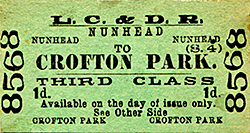
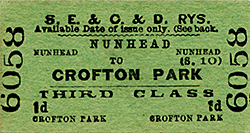
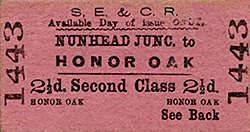
Other web sites: Abandoned Tube Stations .  Tickets from Michael Stewart & Brian Halford   

To see other stations on the Crystal Palace High Level branch click on the station name: Nunhead, Honor Oak, Lordship Lane & Upper Sydenham


Nunhead Station in 1921
Copyright photo from John Alsop collection


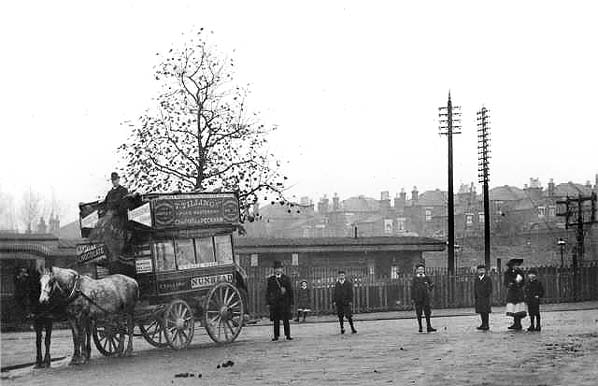
Nunhead Station in the early 20th century

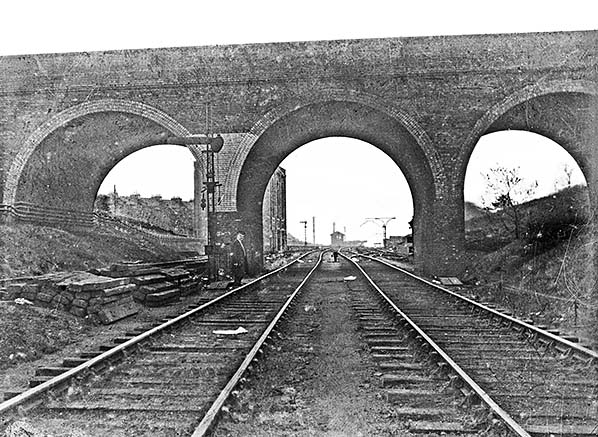
Looking east towards the site of the first Nunhead Station in June 2006. The station was sited beyond the bridge where the line comes out of the curve. Seen from the second Nunhead Station.
P
hoto by Nick Catford

Looking west at the site of Nunhead Station in June 2007. One platform was sited where the road now runs, the other platform was behind the fence on the right.
P
hoto by Nick Catford


Click on thumbnail to enlarge


[Source: Nick Catford]


Home Page
Last updated: Tuesday, 20-Apr-2010 16:11:12 BST
© 1998-2007 Disused Stations