[Source: Nick Catford]
market_old12.jpg) This engraving showing a flourishing Stratford Market appeared in the Stratford Almanack in 1888, nine years after the market open. The layout of the market is clearly seen with a long shed with raised warehouses either side either side of a wide roadway. Two railway line serve the other side of the warehouses allowing quick transfer from road carts to railway wagons. There is a glimpse of the first Stratford Market station on the far left. Click here to see children's author and illustrator Fred Apps drawing of the Fruit and Vegetable Market. Engraving from Stratford Almanack 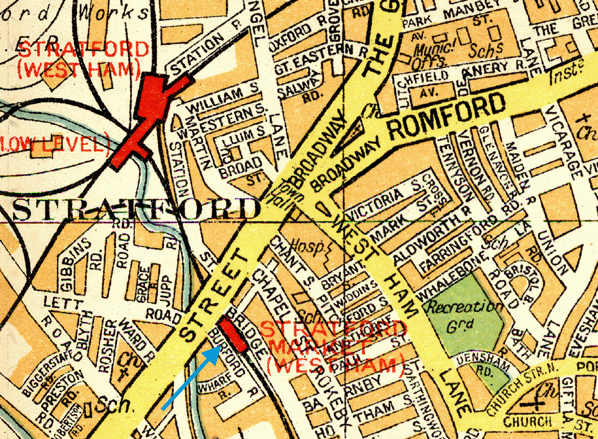 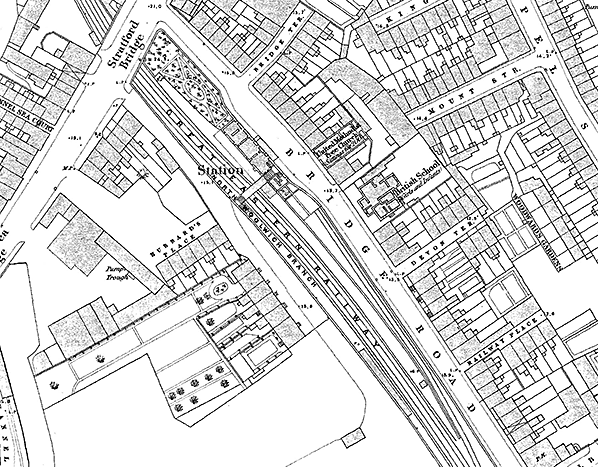 1868 1:1056 OS Town Plan. This map shows the layout of the station as built. The main station building fronts onto Bridge Road with the road widening to form a narrow forecourt. There is a short canopy in front of the entrance. The building opposite on the corner, adjacent to the use of passengers. The room layout of the station building is clearly shown. An elaborate footbridge spans the platforms with one end inside the station building. Two facing flights of stairs lead up to a landing from where another flight at right angles leads up to the bridge. A canopy is shown over the platform stretching the full length of the building. What appears to be a gents' toilet is sited at the south end. There doesn't appear to be any kind of waiting room or shelter on the opposite (up) platform although there is a long building towards the south end. A siding runs behind the south end of the down platform up to the station building. Click here for a larger version. 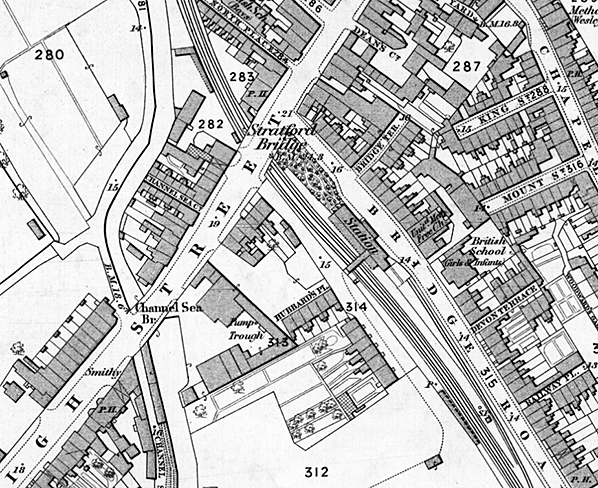 1869 1:2599 OS Map. This is produced from the same survey as the Town Plan above but showing less detail. Note the formal garden on Bridge Road between the station and the High Street. 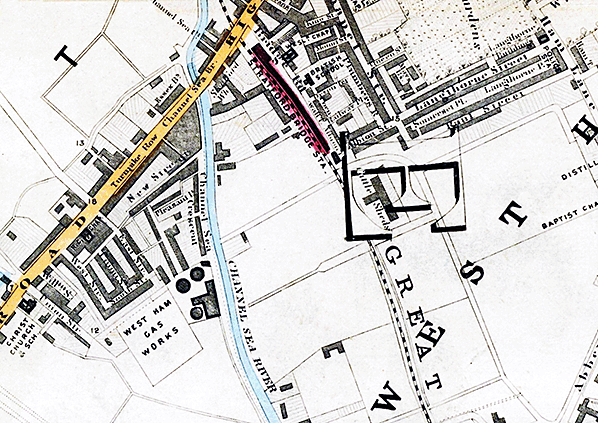 1872: Stanford's Map of London and its Suburbs. Click here for a larger version. 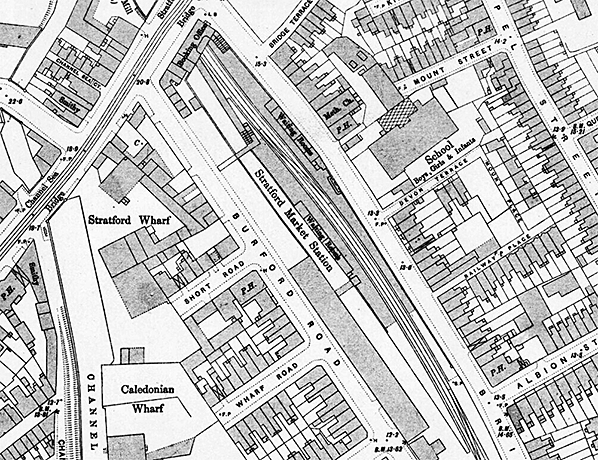 1895 1:1056 OS Town Plan. This map shows Stratford Market station after rebuilding in 1892 but before the goods lines were laid. The street level building only houses the booking office, the other buildings to the south were constructed at the same time as retail outlets; at least two were coal merchants' offices. The staggered platforms are clearly seen; the up (west) platform stopping fifty feet short of the High Street bridge. There are stairs to the down (east) platform from the booking office but because of the platform stagger the up platform is reached by a ramp leading to a flight of steps. At the bottom of these steps there is a second entrance from Burford Road. A path from Burford Road crosses over the as yet un laid goods lines to reach another set of steps down to the platform. further south along the up platform there is a second bridge over the goods lines giving direct access from the platform to the GER print works which is the long building on the east side of Burford Road. The two blocks of waiting rooms, which are also staggered, are shown on the platforms. To the south of the down platform waiting room an entrance onto Bridge Road is shown. Click here for a larger version covering a large area including Stratford Market and coal depot. 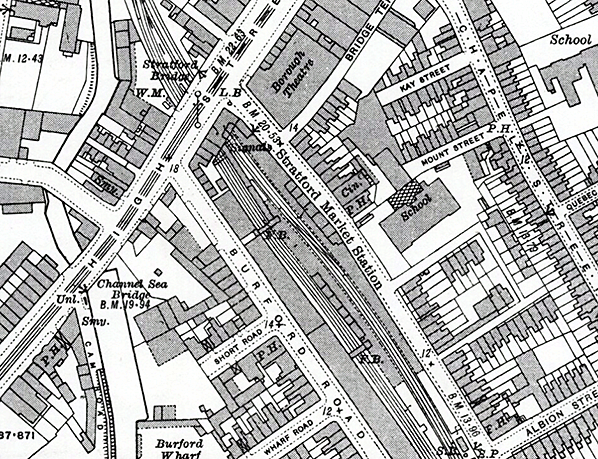 1916 1:2599 OS Map. The only apparent difference between this map and the 1895 map is the addition of the goods lines which have now been laid.
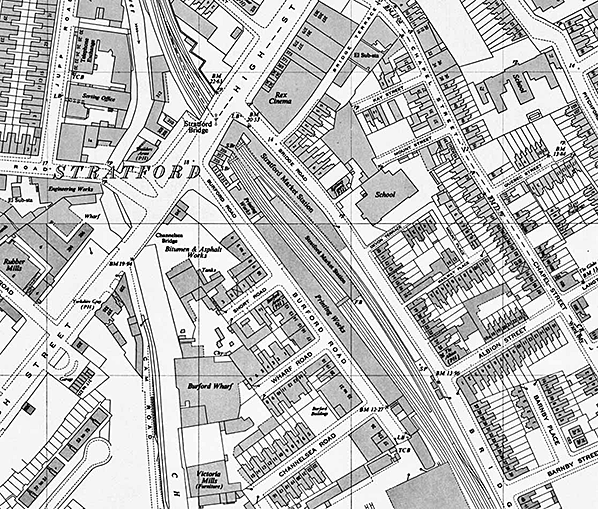 1951 1:2500 OS Map. Little has changed. The entrance to the up platform from Burford Road has closed and the bridge over the goods lines and steps down to the platform have been demolished. The signal box at the south end of the down platform has been demolished. Its closure date is not known. Click here for a larger version. 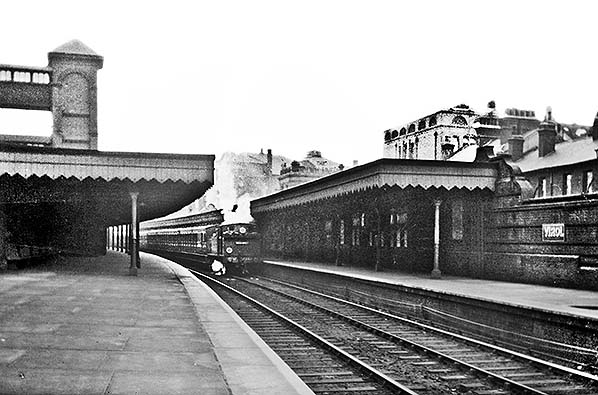 A circa 1930 view of an apparently deserted Stratford Market station. The train has proved difficult to identify. The carriages, or at least the first few, appear to be 6-wheelers and the locomotive's number, visible on the bufferbeam, appears under magnification to be No.7345 and thus is a J67 0-6-0T. This locomotive, which went on to become BR No.68507, is on record as having its Westinghouse brake equipment removed and a vacuum ejector fitted in February 1930. The locomotive seen above is still Westinghouse fitted so assuming it is indeed No.7345 the photograph will date from no later than February 1930. As with other old photographs, the train's destination has proved difficult to interpret. The locomotive carries two colour-coded headcode discs and although the colours cannot be identified the disc positions suggest a Fenchurch Street service. To confound the issue further, the destination board is unreadable. The second word, however, appears to be 'Junction' but in abbreviated form. The problem with this is that no trains from the North Woolwich line are known to have terminated at any station with Junction in its name. Services on the North Woolwich branch at this time ran to and from Palace Gates, Victoria Park, Stratford Low Level, Chingford and Fenchurch Street. There was also a Stratford (presumably Low Level) to Beckton service. The GER colour-coded headcode system was used in the Norwich area but was otherwise confined to the London area. There were over 200 code variations, which were described in an appendix to the Working Timetable, including some for trains of other companies venturing onto GER metals and vice versa. After the LNER was formed, that company drastically simplified the system and this further confuses the issue in the above photograph. Stratford Market station appears to have been relatively free of enamel advertisements but one such can be seen to the right. Advertisements for Virol could once be seen everywhere and the product was a malt extract supposedly beneficial to children and invalids. At that time the word 'invalid' referred to any sick person and not just to persons confined to wheelchairs, on crutches or similar. Virol advertisements also bore smaller wording beneath the Virol name which told who precisely might benefit from the product. Usually aimed at children, typical wording was 'School Children Need it' and 'Anaemic Girls Need It'. Quite what was recommended for anaemic boys is unclear. One such statement can just be discerned at the bottom of the advertisement seen above but its precise wording cannot be determined. Copyright photo from Stations UK market_old5.jpg) Stratford Market station seen from the High Street in August 1937. The offices of C.W.Tanner and Cornwalls Coal Merchants can be seen to the right of the station, and the Boro printing and bag works on the corner of Burford Road. Note the large sign pointing down Burford Road that says L.N.E.R. fruit & Veg market 200yds. To the left of the station is the Rex cinema. The Rex began life in 1896 as the Borough Theatre and Opera House and was a Jacobean style building designed by Frank Matcham. It's appearance was significantly altered in 1933 to the form seen above when taken over by Essell Cinemas. At the same time the building was altered internally, being given an Art Deco auditorium seating 1,889 and a Wurlitzer organ. It reopened as the Rex Cinema on 5 November 1934 but the following year was taken over by ABC (Associated British Cinemas). So it remained until closure on 11 January 1969, following which it went the way of many other cinemas by becoming a bingo hall, until 1974. Thereafter followed a brief period once more as a cinema, then the building stood derelict until 1996 when, some alterations aside, it was largely restored to its 1934 condition. Subsequently it was used for a variety of purposes; concerts; nightclub etc., until October 2007 when it again closed due to its owners going into receivership. Reopened yet again in 2009 as the Rex Music Arena, this venture also failed and the building saw only occasional use until 2012 when it became Sync London, a restaurant, nightclub and special events venue. Now owned by Newham Council, it is believed to have closed yet again in 2013 and its status, as of March 2016, is unclear. Photo from North Woolwich Old Station Museum (Now closed) market_old14.jpg) Stratford Market and sidings seen from the air in June 1952. The Channelsea River runs along the west side of the site. The market is located in the long building wityh vehicle access through the centre shed with two covered sidings either side for loading produce from the tenants warehouses located within the shed. 12 sidings fan out alongside the shed; these will accommodate from 400 to 500 wagons. There are also four cart-ways, varying from 40 to 70 feet in width, and carts can back up against 200 trucks at one time. Coal wharves are seen to the left of the market sidings. The large building near the bottom right is the Victoria Stone Works which is served by a single siding. Bottom left is the West Ham gas works with two aerial cableways across the Channelsea River to a terminal in the yard which is served by two sidings. See a picture of the gas works here. Stratford Market's street level building is seen in the top left corner but the station itself is largely obscured by the LNER print works. Reproduced with the kind permission of Simmons Aerofilms Ltd. Click here for a larger version. market_old1.jpg) Stratford Market station looking south from the down platform c1950s. The stairs up to the station building are immediately behind the photographer/ My this time the only signage on the platforms are the LNER running in boards one of which is seen above the seats. There are three on each platform. The station was originally fitted with enamel 'tablet' signs but these may have been suspended from the canopy and removed when the canopy was dismantled as a safety measure during WW2. On the opposite platform the brick tower is a stairway up to a high level bridge over the goods lines; this gave direct access from the station to the LNER printing works. Photo from John Mann collection 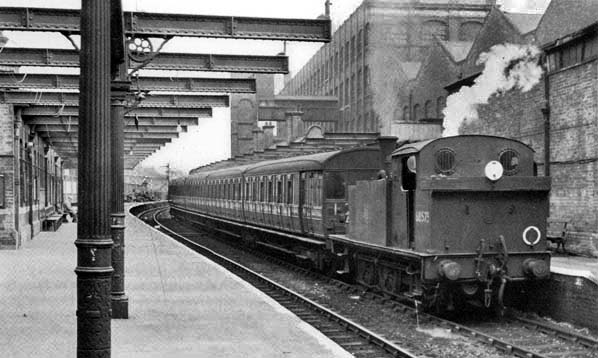 Class J67 0-6-0T No.68575 at Stratford Market with a North Woolwich - Palace Gates service on an unknown date in the 1950s. The train is an articulated set and appears to be a Quint-Art (5-car). The J67 class began life as GER class R24 and was one of several Holden 0-6-0T types of broadly similar appearance. Built for light passenger, branch and suburban passenger work, some types became extinct in LNER days but others such as the J67, together with the rebuilds which became J69, soldiered-on well into BR days. They had been ousted from London suburban duties by the N7 class from 1925 onwards and thereafter found employment on pilot and branch line work. However, classes J67 and J69 still occasionally appeared on suburban passenger work in the London area of what had become the Great Eastern Section of BR's Eastern Region. Invariably this was to deputise for non availability of a larger locomotive such as an N7 and this would have been the reason for the appearance of No.68575 at Stratford Market. The disc above the locomotive's buffer was a colour-coded route indicator; the outer circle was white while the centre varied in colour according to route. The system, which originated with the GER, was complex and colours further varied according the whether a train was operating over an entire route or just part of a route. The final member of class J67 bowed out in 1958 while the J69 rebuilds lasted until 1962. No.68575 herself lasted until October 1960. Note the high level bridge over the goods lines on the right giving direct access from the up platform to the former LNER print works. The works was declared redundant after nationalisation and closed three years later. Photo from John Mann collection market_old6.jpg) Looking north along the up platform at Stratford Market station c1950s. The steps up to the booking office are seen at the end of the down platform. The up platform, which was slightly staggered, had a ramp. The building on the right is the Railway Tavern pub which was opposite the original entrance to the station and the building to its left is the Rex cinema, formerly the Borough Theatre and Opera House. Both buildings are extant. Photo from John Mann collection market_old13.jpg) The broad central arcade at Stratford Market in 1954. On either side there are platforms, and on these are the offices and warehouses of more than 50 tenant firms. The unique feature of the design is that immediately behind these warehouses are railway lines permitting the trucks consigned to the various firms to be brought to the proper point. From these trucks the commodities are carried direct to the warehouses or to the carts which draw up in the road alongside the platforms. A number of mainly pre-war vehicles can be identified in this view. In the foreground the truck on the left is an Austin K series and appears to be a K30. Its registration is AJD, a London registration, tells us it dates from November 1939. The vehicle to its right is a Bedford W. Its registration is AAY which dates the vehicle to November 1936. The bodywork style of van immediately behind tells us it's a Fordson E04C 5cwt. These were also pre-war and based on the Ford Model Y car. Production of the E04C continued until 1948, after which it became the Ford E494C which was based on the, then, Ford Anglia of the 'sit up and beg' Popular/Prefect/Anglia range. Production finally ended in 1954. Fordson, a name more familiar on farm tractors, was used by Ford for its light commercial vehicle range but was dropped in 1948, Behind the Ford is an Austin GP4, better known as the Austin A40 Devon Countryman. It was the estate version of the A40 Devon saloon and also came in van and pickup versions. Production of the Countryman version appears to have continued until as late as 1956. Photo from Jim Lake collection market_old8.jpg) Stratford Market station looking north from the down platform in 1957. At the end of the up platform the covered ramp is seen, this was required because of the stagger between the two platforms. It led to a flight of steps down to the platform alongside a second entrance from Burford Road. There was also a second entrance to the down platform from Bridge Road. Because of the platform stagger the waiting rooms and canopies were also staggered as can be clearly seen in this view. Photo from John Mann collection market_old16.jpg) Stratford Market station building in 1957, shortly before closure. Unlike on the platforms which appear to have retained LNER signage, there was no doubting the British Railways ownership from the front of the building. The sign above and between the doorways says 'British Railways Stratford Market'; it would have been double sided and illuminated. The two lamps with white shades over the doorways were of an LNER style and could be found across that former company's network. At extreme right can be seen Charrington's coal offices and to the left of that a rather uninviting cafe, its sign being partially obscured by the lamp post. To the right of the station doorways is what appears to be a tobacconists kiosk. On the road, the lorry has proved difficult to identify but is probably an Albion. It has 'suicide doors' and lacks a step ring on the front wheel, both were features of Albion lorries at the time. The car at the extreme left appears to be a Standard 8 and one of the more upmarket versions with two windscreen wipers and windows which wound up and down rather than slid. While this may sound comical today, at one time cost cutting measures such as providing only one windscreen wiper were taken very seriously and could mean the difference between owning and not owning a car. The basic Standard 8 was a ridiculous car nevertheless; it had a boot but no boot lid (another cost cutting measure) and access was from inside the saloon. All very inconvenient, especially when passengers occupied the rear seats which had to be tipped forward. Note the overhead wires for trolleybuses. Stratford was served by several trolleybus routes, among which was the 569 (Aldgate - North Woolwich) and 669 (Stratford - North Woolwich) which to a degree competed with the railway service. London Transport's trolleybus routes in the Stratford area were converted to motor bus operation in 1959/60. London's last trolleybuses, operating from Fulwell and Isleworth garages, bowed out on 8 May 1962; a very sad day as many who remember these splendid, clean and quiet vehicles will testify. For those who wanted to go to the cinema to actually watch a film, the Rex, in 1957, was showing Their Secret Affair; supposedly a comedy and starring Susan Hayward and Kirk Douglas.
Photo by TS Keep from JE Connor collection market_old15.jpg) The Bridge Road entrance to Stratford Market station seen from the up platform in 1957. No the distinctive waiting rooms with tall chimneys and Dutch gables. The original entrance was between the Railway Tavern and the Borough Theatre and Opera House, both of which are seen in this view.
Photo by TS Keep from JE Connor collection market_old10.jpg) Displaying a colour-coded route disc on its upper lamp bracket, an unidentified N7 0-6-2T waits at Stratford Market with a Quint-Art set bound for North Woolwich. The date of the photograph is unknown but the presence of what appears to be railway enthusiasts may indicate near to closure if not on closure day itself. The structure on the left was the steps up to the high level bridge to the LNER print works. Some station signage is visible and an enlargement of the photograph suggests it was of pre-BR and possibly GER origin. Another period item, albeit a mundane one, is the metal dustbin on the left. These bins with their heavy lids could once be seen everywhere but today are as rare as railway enthusiasts wearing Columbo style raincoats. Behind the wall on the right runs Bridge Road and many of the residential and industrial buildings visible no longer exist. The ornate building right of centre was the Railway Tavern public house and despite its Art Deco appearance it dated from the mid-19th century. A Charrington's pub, it later became Reflections nightclub and closed its doors for the last time in 2005. The building still stood in the summer of 2015 but in derelict condition. The Quint-Art train sets, of which none survive, lived long enough to see diesel traction and for a time these increasingly antiquated sets presented an odd sight behind brand new diesel locomotives on the Palace Gates service. Photo by TS Keep from JE Connor collection market_old9.jpg) Looking south from the south end of the up platform in May 1957. The demolition material on the platform and the running-in board which appears to have been painted out suggest that it may be a short while after closure. A North Woolwich service is seen on the left. Two locomotives are seen in the distance, both appear to be on the goods lines. The fruit and vegetable market building is seen on the right. Two sidings passed through the shed and terminated where the truck is seen. Photo from John Mann collection market36.jpg) Driver' s view of the approach to Stratford Market station from the south in August 1965. The fruit and vegetable market building is seen on the left. Photo by John Webb market30.jpg) Stratford Market's street level building was boarded up and out of use in 1966 One of the shops alongside the building is still occupied by a coal merchant, Charringtons. The coal depot 200 yards away, round the corner in Burford Road was still open at this time. The Rex cinema is showing 'Where the Spies Are' a romantic cold war comedy starring David Niven. All the buildings shown in this view still stand today and are largely unaltered. Photo by JE Connor market33.jpg) Inside the street level building at Stratford Market in 1966. An old LNER sign that would have been mounted in the building has found a new use blocking up a broken window. The sign indicates trains to Fenchurch Street, Stratford, Victoria Park and Palace Gates to the right and trains to Woolwich and Albert Dock to the left. Albert Dock is any station on the Gallions branch. This sign would have been removed from 8 September 1940 when the Gallions branch closed and the Fenchurch Street service was withdrawn. After that date trains only served the North Woolwich to Palace Gates line until closure of the station in 1957.
Photo by JE Connor market32.jpg) Looking south at the degraded platforms from inside the station building in 1966; the platform edge was removed shortly after closure. The bottom of the ramp down to the up platform is seen on the right. The Railway Tavern is seen on the far left with the LNER printing works on the right. The top of the main hall at Stratford Fruit and Vegetable Market can just be made out in the distance
beyond the printing works. Photo by JE Connor market4.jpg) The rear of Stratford Market station building seen from Bridge Road in June 1968. The openings for the stairs down the the down platform (right) an d ramp to the up platform (left) are clearly visible having been hastily bricked up following removal of the steps and ramp. Signalling at Stratford Market was complex with two gantries seen here. North of Stratford Market the tracks all merged into a short double-track section which then split off into goods sidings, the line into Stratford Low Level and the connection with the Shenfield main line. At one time there were also a number of crossovers. The gantries were located south of the bridge for sighting purposes as the bridge and station building obstructed drivers' view. Photo by Nick Catford market5.jpg) The south end of the up platform at Stratford Market station in May 1968. Following closure of the station in 1957 the front facing and some of the infill was removed. The rear brick facing alongside the slower goods lines was left in place at the south end of the up platform and is seen here. The former LNER printing works seen here closed in 1951 but has remained in industrial use ever since. It now provides workshop and office space for a number of small firms and businesses. Photo by Nick Catford market6.jpg) Looking north at the site of Stratford Market station in November 1975. The full length of the degraded platforms is clearly visible. Photo by Nick Catford market8.jpg) The rear of Stratford Market station building seen from Bridge Road in November 1975. The building was in use as an office at this time. New windows have been fitted in the bricked up access points to the platforms.Some of the signals seen in the 1968 picture above have gone, this is due to track rationalisation north of the bridge. Photo by Nick Catford market31.jpg) Looking north at the remains for Stratford Market station from a passing North Woolwich service in May 1979. market14.jpg) Looking north along the up platform at Stratford Market station in December 1983. The boundary wall was also the back wall of the waiting room. It was lowered after the demolition of the waiting rooms. Note the bricked up circular windows along the length of the wall. This wall was demolished during the conversion of the line to DLR operation Photo by Nick Catford market13.jpg) Looking north along the degraded up platform at Stratford Market station in December 1983. The brick facing at the back of the platform remains in place but the front facing and much of the infill has been removed. The goods lines are rusty and clearly out of use at this time. Photo by Nick Catford market15.jpg) A view looking south from the signal gantry in front of the Stratford Market station building in December 1983. Not much has changed since Jim Connor took his view (above) from a similar viewpoint in 1966. (apart from the addition of a second tower block in Stephens Road, Plaistow). The stagger in the two platforms is apparent with the up platform finishing 50 feet short of the High Street bridge. The brickwork at the end of the platform is the bottom of the ramp down from the station building. The lighter section of wall on the left was the back wall of the waiting room, it is lighter because it wasn't open to the weather. Photo by Nick Catford market16.jpg) Stratford Market station frontage in December 1983. The building was renovated during circa 1970 and received a coat of khaki pant. It was named Coronet House (359 Stratford High Street) and let out as offices. The coal depot in Burford Road had closed by this date and Charrington's coal office has also gone and is occupied by some kind of video outlet. The 'to let' sign in the window had been there for more than eight years. The Rex cinema closed in 1969 reopening as a bingo hall. After reverting briefly to a cinema it closed in the mid 1970s and the building was derelict at this time. Photo by Nick Catford market22.jpg) A Cravens Class 105 passing through the closed Stratford Market station with a North Woolwich service in October/November 1984. Stratford depot had a handful of DMUs for working North Woolwich and Romford - Upminster line. Stratford also once had some Metro-Cammell 79xxx units as well as the Rolls Royce Lea Valley sets which became Class 125. The Cravens sets replaced the 79xxx Metro-Cammells. Note the ground signals which appear to have replaced the semaphores seen in the pictures above. The remnants of the up platforms seen in the 1983 pictures above has now been removed. The dark area on the right was the end of the platform and the bottom of the ramp down from the station building. Photo by Ian Baker market34.jpg) The fire brigade attended an incident at Stratford Market station c1990. As only a turntable ladder is visible in this view it is unclear if it was a fire. Jim Connor remembers smoke blackening above the windows around this time. The station has again been repainted and has been a Martial Arts Centre although it appears empty in this view. The Rex cinema is still empty at this time and now has an advertising hoarding above the entrance. It stood empty until 1996 when it was restored to its 1934 condition. In 1999, Richard Parkinson a doorman at the Stratford Rex was shot dead as concert-goers arrived for a gig by the Jamaican reggae artist Beenie Man. Photo by Petros Williams market39.jpg) The entrance to Stratford Market at the end of Burford Road in December 1990. By this date all produce leaving the market went by road. The market relocated to Temple Mills on 13 May 1991 to make way for the new Jubilee Line Stratford Market Depot. Photo by Petros Williams 28.jpg) Stratford Market station building seen from the north side of the High Street bridge in May 1996, during the construction of the Jubilee Line extension. The station building was also being renovated at this time. All the paint seen in the pictures above, has been removed. Restoration of the Rex cinema to its original 1934 condition started in 1996. Photo by Tim Brown from his Flickr photostream market20.jpg) Looking north at the site of Stratford Market station in December 2006 a few days before the North Woolwich line closed, The North Woolwich line was electrified in May 1985 and the last remains of the platforms were cleared away during the construction of the Jubilee Line (hidden by the wall) in the second half of the 1990s. Photo by Nick Catford market21.jpg) The rear of the Stratford Market station building in December 2006. The building was substantially refurbished by Newham Council who own the building in 1995/6. New windows were fitted throughout the building and the rather badly bricked up entrances at the top of the stairs and ramp down to the platforms are no longer visible with new brickwork blending in with the old. Photo by Nick Catford market35.jpg) Stratford High Street station looking north from the northbound platform in November 2010, 10 months before the station opened. The station appears to be more or less complete but all signs are covered. Photo from TFL Flickr Photostream 24.jpg) Stratford High Street DLR station looking south from footbridge on 1 September 2011, the day after the station opened. Photo by Sunil Prasannan reproduced from Wikipedia under creative commons licence 26.jpg) The distinctive canopies at Stratford High Street station were designed by Broxap, supplies of street furniture. The company built the canopies at Stratford International and Stratford High Street where they supplied five canopies, one on each of the platforms, one on the footbridge, an entrance canopy to the north of the station and a cycle canopy to the south of the station. Note the first train is bound for Beckton. Beckton was one of the destinations reached from Stratford Market station until the Beckton branch closed on 29 December 1940. The distinctive canopies at Stratford High Street station were designed by Broxap, supplies of street furniture. The company built the canopies at Stratford International and Stratford High Street where they supplied five canopies, one on each of the platforms, one on the footbridge, an entrance canopy to the north of the station and a cycle canopy to the south of the station. Note the first train is bound for Beckton. Beckton was one of the destinations reached from Stratford Market station until the Beckton branch closed on 29 December 1940.Photo from Broxap market27.jpg) A DLR service bound for Stratford International waits at Stratford High Street station
in September 2012. Photo from Coast House Archive. Reproduced from Geograph under creative commons licence market28.jpg) Looking north towards the old Stratford Market station building from the footbridge at Stratford High Street station in December 2012. The new DLR station was sited a short distance south of the High Street to allow the track to straighten having come round a curve under the bridge. The platform are linked to the entrance in Bridge Road by a raised walkway seen on the right. A jubilee Line train is seen on the left.
Photo
from Coast House Archive. Reproduced from Geograph under creative commons licence
Click on thumbnail to enlarge
 Home Page Home Page
|

 Notes: Stratford Bridge station opened with the North Woolwich line on 14 June 1847. The station was provided with two facing platforms. The station building was on the down (east) side with a forecourt and entrance on Bridge Road. A short canopy was provided over the entrance, and on the platform side there was a canopy stretching the full length of the building. A footbridge from within the building gave access to the up platform, but the Ordnance Survey map for 1869 (reproduced below) shows no building opposite the booking office although a long building is shown near the south end of the platform. GER records show two waiting rooms were provided on the up platform in May 1881. A siding ran behind the south end of the down platform up to the station building.
 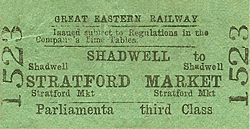 Following the opening of the market, Stratford Bridge station was renamed Stratford Market on 1 November 1880. In 1892 the station was rebuilt to accommodate two additional lines on the up side for freight traffic. The contract for building the new station was awarded to A.J. Bateman of Ramsey, Hunts at a cost of £9322.4.10. The platforms were rebuilt with a slight stagger, with the down platform butting up to the High Street bridge and the up platform finishing 50ft short of the bridge. The original entrance on Bridge Road was closed and the building was demolished. A new single-storey building with an attic was constructed on the bridge over the tracks on the High Street. It had moulded red-brick dressings, a hipped, tiled roof with finials and a pair of gabled brick dormers with moulded brick detailing framing a smaller central dormer. The entrance bay had a pair of circular-headed entrances with three tall windows to either side with moulded brick detail. The building just housed the booking office and stationmaster’s office with covered stairs to the down platforms. Because of the distance between the building and the north end of the up platform a 50 foot ramp was required to reach the steps down to the platform. There was additional access along a short path in Burford Road which led to a bridge over the goods lines and another flight of steps alongside the steps from the booking office. There was a range of seven small retail premises, one in the building and six alongside on the west side. These ran for a short distance along Burford Road and are contemporary with the building; they included coal merchants' offices. In the 1930s, two of the merchants with offices here were C W Tanner and Cornwalls. Access to Stratford Market and the goods and coal depot was 200yd along Burford Road.
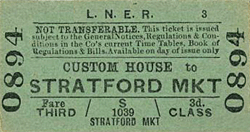 The GER built a 4-storey print works in Burford Road in 1893, and much of their printing requirements including posters, timetables and tickets was handled there. On the up platform there was a tower with steps up to a high-level walkway over the goods lines providing direct access between the works and the station. The works continued in LNER hands after the 1923 Grouping, with 61 million tickets being printed in 1932 when a report was prepared for the LNER Board on whether to concentrate all ticket printing at Stratford. The works were declared redundant after the railways were nationalised in 1948 and closed three years later. In recent years the building has found a new lease of life, and now provides workshop and office space for a number of small firms and businesses.
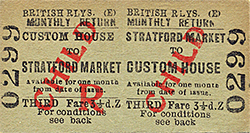
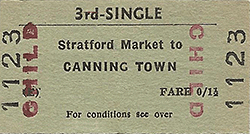
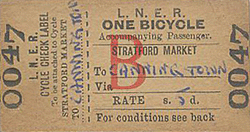 The 1912 trade directory lists H J Hotson, stationmaster at Stratford Market. The station was renamed Stratford Market (West Ham) in 1898, reverting to Stratford Market in 1923. Initially the station was well used as trains running into Fenchurch Street via the spur line from the North Woolwich did not call at Stratford Low Level. During the 1930s the following services called at Stratford Market: Palace Gates – North Woolwich, Victoria Park – North Woolwich, Stratford Low Level – North Woolwich, Chingford – North Woolwich, Fenchurch Street – North Woolwich and Stratford - Beckton. Stratford Market signal box was abolished in 1933 and probably quickly demolished. The box was known as Stratford Market Southern Junction.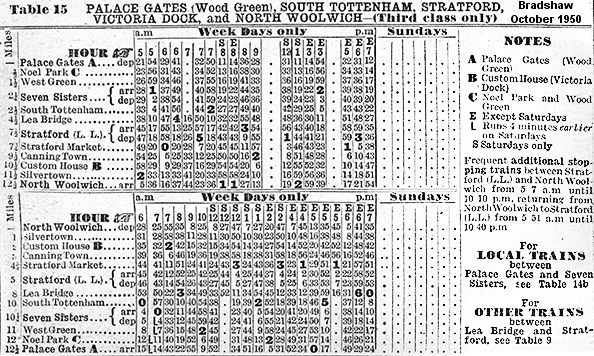
 The line through the station site to North Woolwich closed from 9 December 2006 for works to start on conversion to DLR operation. The government gave the go-ahead for the extension of the Docklands Light Railway from Canning Town to a new station at Stratford International in October 2006.The extension would meet the growing demand for public transport in the Lower Lea Valley area of east London, and also provide access to 2012 Olympic Games venues. For much of its length, the new line would utilise the North Woolwich line paralleling the Jubilee line. The only new section was the line to Stratford International which followed a former freight line. One of the seven stations (four reopened and three new stations) on the extension was to be at Stratford High Street on the site of the former Stratford Market station.
 BRIEF HISTORY OF STRATFORD
- NORTH WOOLWICH
BRIEF HISTORY OF STRATFORD
- NORTH WOOLWICH  After completion, the North Woolwich Railway was bought by
the E.C.R. in 1847 and the 21 mile line was opened on 14th June,
1847, together with a curve to the main line at Stratford, enabling
through trains to be run between the Eastern Counties terminus
at Shoreditch and North Woolwich. There were two intermediate
stations at Stratford Bridge (later Stratford Market) and Barking
Road (later Canning Town).
After completion, the North Woolwich Railway was bought by
the E.C.R. in 1847 and the 21 mile line was opened on 14th June,
1847, together with a curve to the main line at Stratford, enabling
through trains to be run between the Eastern Counties terminus
at Shoreditch and North Woolwich. There were two intermediate
stations at Stratford Bridge (later Stratford Market) and Barking
Road (later Canning Town). In 1850 the Victoria Dock Company was authorised by Act of
Parliament to construct a dock east of Bow Creek and immediately
north of the railway. The entrance to the dock cut across the
railway and to avoid disruption to traffic the North Woolwich
branch was diverted around the north side of the dock, to rejoin
the original line about three-quarters of a mile west of the
terminus. A station was opened on the new line at Custom House.
The original line was retained to provide railway connections
to the numerous factories which sprang up along the river bank
crossing the entrance to Victoria Dock by a swing bridge; it
was known as the Silvertown Tramway.
In 1850 the Victoria Dock Company was authorised by Act of
Parliament to construct a dock east of Bow Creek and immediately
north of the railway. The entrance to the dock cut across the
railway and to avoid disruption to traffic the North Woolwich
branch was diverted around the north side of the dock, to rejoin
the original line about three-quarters of a mile west of the
terminus. A station was opened on the new line at Custom House.
The original line was retained to provide railway connections
to the numerous factories which sprang up along the river bank
crossing the entrance to Victoria Dock by a swing bridge; it
was known as the Silvertown Tramway.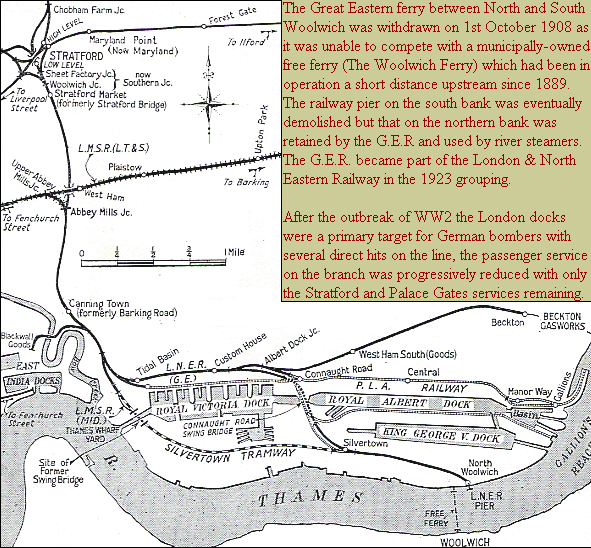
 After the war passenger numbers were in decline with commuters
finding the busses and trolleybuses more convenient; freight
traffic was initially less affected but road haulage was beginning
to make significant inroads. Passenger trains continued to run
between Palace Gates and North Woolwich with short workings
to and from Stratford Low Level. Stratford Market Station closed
in 1957 and weekend services were withdrawn shortly afterwards.
The service between North Woolwich and Palace Gates was withdrawn
in 1963 and by the mid 1960's freight traffic had dwindled away
to almost nothing and one by one the local goods depots were
closed with the final blow coming in the late 1960s with the
rapid decline of their docks.
After the war passenger numbers were in decline with commuters
finding the busses and trolleybuses more convenient; freight
traffic was initially less affected but road haulage was beginning
to make significant inroads. Passenger trains continued to run
between Palace Gates and North Woolwich with short workings
to and from Stratford Low Level. Stratford Market Station closed
in 1957 and weekend services were withdrawn shortly afterwards.
The service between North Woolwich and Palace Gates was withdrawn
in 1963 and by the mid 1960's freight traffic had dwindled away
to almost nothing and one by one the local goods depots were
closed with the final blow coming in the late 1960s with the
rapid decline of their docks. 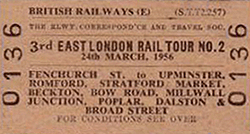 The line between Stratford and Dalston Junction had not seen
a passenger service since 1943. New stations at Hackney Wick
& Hackney Central were provided and all the stations between
Stratford & North Woolwich were rebuilt. At North Woolwich
this included the closure of the 1854 Grade II listed building.
A new entrance building was provided on the south side of the line and the track re-laid into the southern platform to serve
it. A new station provided at West Ham for interchange with
the District Line.
The line between Stratford and Dalston Junction had not seen
a passenger service since 1943. New stations at Hackney Wick
& Hackney Central were provided and all the stations between
Stratford & North Woolwich were rebuilt. At North Woolwich
this included the closure of the 1854 Grade II listed building.
A new entrance building was provided on the south side of the line and the track re-laid into the southern platform to serve
it. A new station provided at West Ham for interchange with
the District Line.
 There are proposals to hand much of this section of the line
over to
There are proposals to hand much of this section of the line
over to market_old_thumb11.jpg)
market_thumb37.jpg)
market_thumb39.jpg)
market_thumb1.jpg)
market_thumb2.jpg)
market_thumb3.jpg)
market)thumb7.jpg)
market_thumb38.jpg)
market_thumb9.jpg)
market_thumb10.jpg)
market_thumb11.jpg)
market_thumb12.jpg)
market_thumb23.jpg)
market_thumb17.jpg)
market_thumb18.jpg)
market_thumb19.jpg)
market_thumb29.jpg)
thumb25.jpg)