Brasted Station Gallery 1 c1900 - c1950s old1.jpg) This scene is absolutely typical of its time, circa 1900, with staff posing for the camera with items such as sack barrows. The technology of the time (this image would have been on a glass slide) required people to stand perfectly still for several seconds. Any movement, however slight, would result in a spoiled image. The gentleman on the right may well have been the stationmaster, who had a house just to the south of the station. This house still stands today, albeit in altered and extended form. Gas was yet to arrive at Brasted as, on the right, is an oil lamp. What appears to be a suspended lamp can just be made out beneath the canopy but it is too indistinct to attempt to describe. The colour scheme of SE&CR (and its constituents) stations remains something of a mystery and it would appear there was no standard scheme. Brasted's canopy as seen above clearly bore a two-tone scheme, as did Westerham, giving the impression one might be able to purchase an ice cream as well as a railway ticket. A little investigation, however, suggests the colour scheme may have been brown and buff. Note the track with its sleepers covered by ballast, this was another feature typical of the time. Oddly, the impression given above is of rails on baulks with longitudinal ties at intervals. Some sources claim Brasted never had a single box or signalling but as the above view shows this is incorrect. The box was clearly of Stevens design and a lower quadrant signal can just been seen ahead of it. The box was probably abolished by circa 1930 and thereafter the goods yard, located to the east of the station and south of the running line, was accessed by ground frame. The bridge in the distance is thought to be that carrying Brasted Hill Road over the time. Today, a modern bridge carries this road over the M25.
Photo by FG Benson 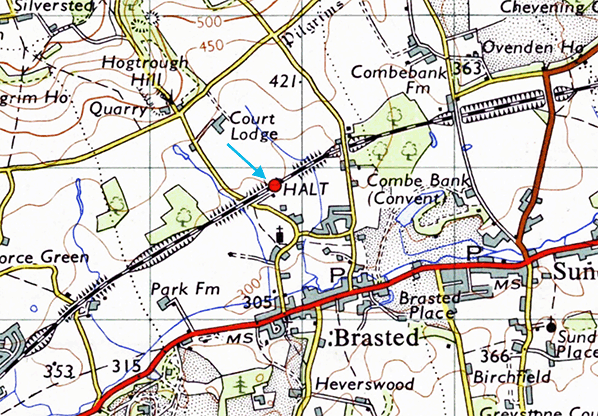 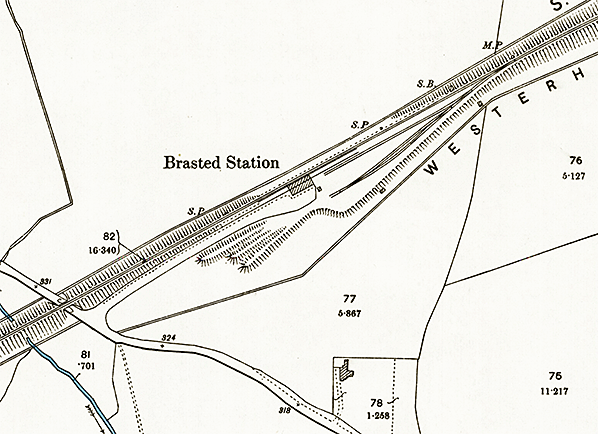 1896 1:2,500 OS map shows the layout of the station as built. Initially the goods yard had two sidings, that to the south being a loop. Access to the goods yard is controlled by a signal box on the north side of the line just to the west of the entrance to the goods yard. Although the station master's house was built in 1883 it is not shown on this map. The three fingers at the west end of the goods yard are probably spoil dumped during the construction of the line.
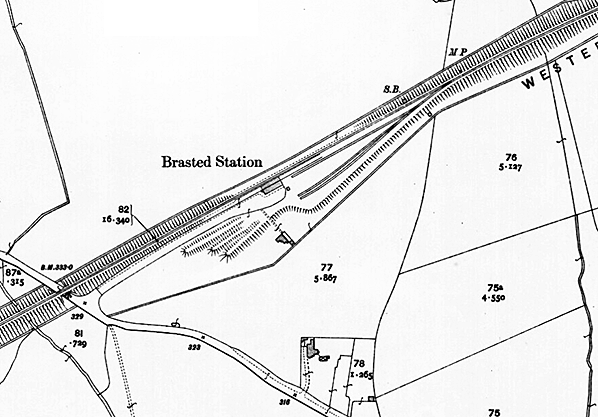 1909 1:2,500 OS map. The points at the west end of the loop siding have been removed and the loop extended to form a parallel siding. The station master's house is now shown opposite the station building with a path leading to it.
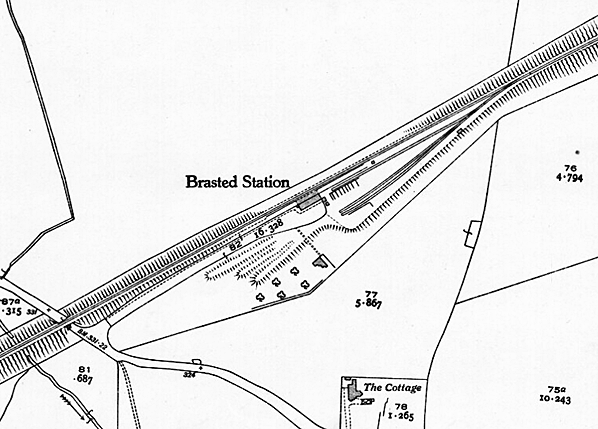 1939 1:2,500 OS map. A short dock and coal bins are now shown although it is likely they were there from an earlier date. The signal box has gone, this was probably abolished circa 1930 and replaced by a ground frame on the down side to the east of the entrance to the goods yard. A small building has appeared just to the east of the platform. This is the lamp room; prior to the appearance of the building lamps had been stored in the station building.
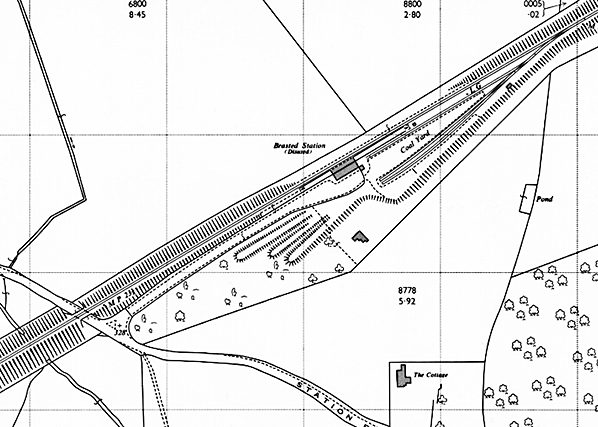 1964 1:2,500 OS map. The line is now closed but the station is still largely intact while the Westerham Valley Railway Association try to raise funds to purchase the branch. Although there were no longer any trains, the coal yard remained open with coal arriving by road. The coal bins are no longer shown. New bins would soon be built further east in the yard. The road from the village is now
identified as Station Road. old6.jpg) A general view of Brasted station, looking towards Dunton Green, circa early 1930s. In the right background a goods van can be seen while on the left the, then, usually neat strip of land has become rather untidy. In the distance the signal box appears to be still present but the up starting signal has apparently gone, suggesting the photograph was taken around the time the signal box was abolished.
photo from John Mann collection old45.jpg) The date of this view is unknown but there are a few clues. The gas lamps of the type seen above were replaced by the Southern circa 1935 and the signal box, which stood in the far distance, has gone. Note the lamps have moved from behind the fence to the back of the platform. The date the signal box was removed is something of a mystery. It was present circa 1910 and gone by 1933. The original timber fencing seen in the the first picture was replaced by the metal railings in the 1930s so the picture must date from the early 1930s. There is no 'way out' sign beneath the near end of the canopy so presumably at this time the way out was through the building. The gas lamp has proved difficult to identify. It is similar to the Sugg's Windsor style but with a crowned, as opposed to pointed, finial. Close examination of the lamp under magnification suggests the burner is of an early incandescent mantle type, these devices being more or less perfected towards the end of the 19th century. The general tidiness, including the clipped hedge, of the station will be noted. At one time the station garden, opposite the platform, had the Brasted name laid out with painted stones and this feature is present to the right of the telegraph pole
Photo from John Mann collection old3.jpg) A fascinating view from 15 April 1933 and something of a rarity as it shows a tender locomotive in normal passenger service on the Westerham branch. The locomotive is Class O1 0-6-0 No.1048 and the outside framed tender associated with this class is clearly visible. This locomotive went on to become British Railways No.31048 and she survived until 1960, being latterly allocated to Dover. The train is a 2-car ex-LB&SCR set but it is not known if it was a push-and-pull set or a conventional set and the window(s) in the brake end do not confirm either way as the fitting of such windows, for the benefit of the guard, was once common practice. What is certain is that the train above is not operating in push-and-pull mode as the locomotive, in common with the rest of its class and indeed tender locomotives as a whole, is not so-fitted. It is possible No.1048 was deputising for a failed tank locomotive. Note that the front coupling, a screw type, is hooked-up out of the way; an example of tidiness not often seen. On the right, gas has now arrived at Brasted but the casement-type lamp is difficult to identify. It bears some hallmarks of the Sugg's Windsor pattern but the finial appears wrong for that model. Examination under magnification, however, suggests the finial has received some damage. The enamel advertisement on the end of the building is for Ovum. This was a brand name for chicken feed by Joseph Thorley Ltd. These advertisements came in several forms but that seen at Brasted had the name 'Ovum' at the top and in the middle was a shield device resembling a sack and bearing a rather colourful depiction of hen sitting on an egg. On the egg was the wording 'Ovum Thorley's Poultry Spice'. Left and right of this device were the words 'Healthy Poultry' and 'Abundance of Eggs' respectively. At the very bottom was the words 'For Poultry'. Thorley's office was located at King's Cross and the firm closed down in 1959 after around a century of trading. On the left, the station name was set out in painted or whitewashed stones on the grass bank.
photo from John Mann collection old43.jpg) Class R 0-4-4T No.31675 at Brasted with one of the ex-steam railmotor push-and-pull sets. The photograph is undated but is from between August 1949, when this locomotive received its BR number, and October 1952 when she was withdrawn having spent a lengthy period at Tonbridge shed. The R class originated with the LC&DR and was perpetuated by the R1 class, intended for the former SER section of what became the SE&CR. All were built by Messrs Sharp, Stewart & Co. Clearly visible on the front of the locomotive are the various pipes for air, vacuum, train heating plus the three thinner air pipes for the push-and-pull control apparatus. A similar pipe arrangement was fitted to Class H but the left hand (referring to the image above) push-and-pull air pipe was not always visible as it was stowed higher up beneath the bufferbeam when not in use. Visible above is the SR 'target' nameboard which was later to mysteriously disappear, leaving just its wooden backboard on the lamp standard
Photo
from John Mann collection
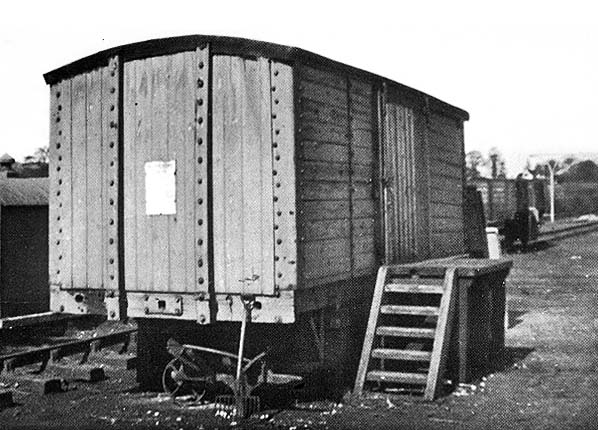 Brasted had no conventional railway goods shed, just two of what one might call 'huts' plus this grounded goods van body. This van is usually referred to as being ex-LB&SCR; this is not true. The keen-eyed may notice the vertical end planking and position of the bodyside strapping are not Brighton* features. The van was in fact one of a small batch built by the Metropolitan Railway Carriage & Wagon Co. (later to merge into what became Metro-Cammell) in 1878 for the SER. It was withdrawn and grounded in 1919 and moved to Brasted sometime during the 1930s and there it remained until 1965. The van retained its underframe and 'W' irons (the frames in which the axle boxes are mounted). Presumably this was to help protect the wooden body from damp, ground water and rodents but it necessitated the somewhat precarious-looking steps and platform as seen above. What became of the van body is not known but it was probably broken-up on site. *A shorter and more convenient often-used name for the London Brighton & South Coast Railway. Brasted had no conventional railway goods shed, just two of what one might call 'huts' plus this grounded goods van body. This van is usually referred to as being ex-LB&SCR; this is not true. The keen-eyed may notice the vertical end planking and position of the bodyside strapping are not Brighton* features. The van was in fact one of a small batch built by the Metropolitan Railway Carriage & Wagon Co. (later to merge into what became Metro-Cammell) in 1878 for the SER. It was withdrawn and grounded in 1919 and moved to Brasted sometime during the 1930s and there it remained until 1965. The van retained its underframe and 'W' irons (the frames in which the axle boxes are mounted). Presumably this was to help protect the wooden body from damp, ground water and rodents but it necessitated the somewhat precarious-looking steps and platform as seen above. What became of the van body is not known but it was probably broken-up on site. *A shorter and more convenient often-used name for the London Brighton & South Coast Railway.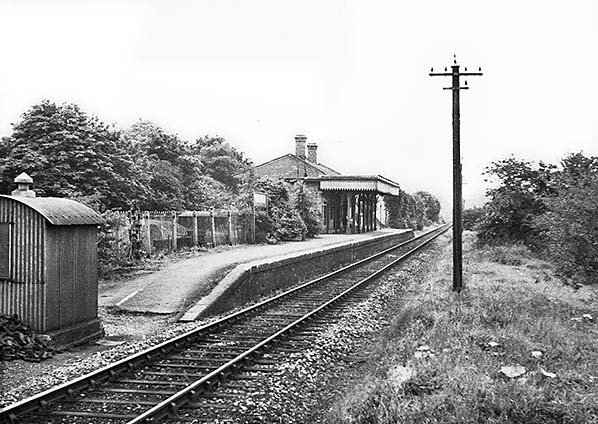 Brasted, looking towards Westerham, on an unknown date but during BR days and after the station was downgraded to an unstaffed halt in 1955 if the maturing undergrowth is anything to go by. The object on the roof of the corrugated hut, left, was probably a ventilator. The hut was a lamp room, it appeared at the station after 1909, lamps having previously been stored in the station building.
Photo from John Mann collection old14.jpg) Class H No.31279 propels away from a somewhat forlorn-looking Brasted while operating duty 306. The date is unknown but this locomotive resided at Tonbridge between June 1958 and June 1959 so will be within that one year window. The train is one of the ex-railmotor sets, 481 or 482, which is right for the this period. These two sets were also withdrawn during 1959 but by then had spent a short while on the Grain / Allhallows services. With this in mind and with the above view seemingly taken during the summer, the photograph most likely dates from August or September 1958
Copyright photo from Colour Rail 308975 old15.jpg) Class H No.31279 pauses at Brasted with a service for Dunton Green. This view likely shows the same train as in the other view of this locomotive thought to have been taken in 1958. The dark patch on the smokebox door is deduced to be a shadow
Copyright photo from Colour Rail 309255
old8.jpg) A view of Brasted from a train on 25 October 1958. The train is formed of one of the ex-LB&SCR sets but its direction of travel is not known. On the right a coal merchant's lorry is seen. It belongs to P Hawksfield and Son, a Dover based coal merchant with an office in Rochester. There are also a couple of open wagons in the goods yard. The Southern 'target' nameboard is quite prominent in this view but rather less prominent are passengers.
Photo
by David Pearson
old2.jpg) An undated trackside view of Brasted station looking towards Westerham on a damp and dismal day in the 1950s; one passenger is waiting on the platform for the next train to Dunton Green or Westerham. The car on the right is a Morris of the Oxford, Isis and Cowley 1200 range and was first introduced, as the Oxford Series II, in May 1954. When the station became unstaffed in September 1955, the building was locked and a new entrance was created by utilising an existing gate in the fence at the west end of the station building with a new 'Way Out' sign being suspended from the canopy. We can therefore date the image to no earlier than September 1955. A Southern 'target' nameboard can be seen on the nearest lamp standard and, unlike Chevening Halt, the station was gas lit. The lamps themselves appear to have been of the same Sugg 'Littleton' type as installed at Westerham. Out of interest,the Morris Oxford Series II was also produced under licence in India as the Hindustan Landmaster and in 1957 the tooling for the Oxford Series III was sent to India and the car emerged as the simpler-styled and well-known Hindustan Ambassador. Production continued until as late as May 2014, some sixty years after the above photograph was taken and around half a century after the Westerham branch ceased to exist.
Photo by JL Smith from John Mann collection old17.jpg) On 26 July 1959, Class H No.31518 working duty 304 approaches Brasted with a service for Westerham, the driver having closed the regulator as the train coasts towards the station. The train is one of the ex- railmotor sets, either 481 or 482, and is in red livery. It would appear a couple of passengers are anxious to alight from the train. This locomotive would go on to operate the final push-and-pull services on the branch just over two years later, but with Maunsell set No.610.
Photo by Chris Gammell old11a.jpg) Brasted looking towards Dunton Green sometime in 1960. A fair amount of activity is evident; apart from the group of people on the platform, others appear to be heading for the station from the cars on the right. The car on the extreme right is a Rover P4; a rather splendid range of cars often referred to as 'The Working Man's Rolls Royce'. The photograph is a little vivid and colours somewhat misrepresented. The station building appears rather more buff than it actually was and the Rover was probably in what Rover called ' Shadow Green', a rather restrained greyish-green colour
old12.jpg) The BR Southern Region running-in board seen here in 1960, making it perfectly clear that (from 19 September 1955) Brasted was a halt and no longer a station. This sign had been mounted on top of the original board which is visible in several post closure views. It is not known if this BR sign was of the familiar stove-enamel type or if it was conventionally painted. Given that it was no more than five years old at the time it was photographed it does not appear to have weathered very well, suggesting it was painted. Southern green was notorious for weathering badly and not just in coastal areas where its resilience was especially bad. On the left the ex-LB&SCR van body which sat for many years at Brasted can be seen. It survived closure of the branch and was wheel-less yet retaining its underframe. It was removed in 1965. A close-up view of the van appears elsewhere in these pages/
Copyright photo from Colour Rail 106096
old18.jpg) In March 1960 Class H No.31519 departs Brasted with a Westerham service. The Westerham branch was to outlive No.31519 as she was withdrawn from Tonbridge shed in February 1961. In that same year a number of other class members were push-and-pull fitted for use on services centred upon Tunbridge Wells West and Oxted, so the push-and-pull gear from No.31519 may well have ended up fitted to one of those. The locomotive had only intermittent periods at Tonbridge shed and as a result was one of the less photographed members of the class on the Westerham branch. The train is one of the ex-LB&SCR push-and-pull sets, probably either 731 or 732. Many of these older sets of pre-grouping origin were painted in the red livery seen above and which was rather more pleasing to the eye than the varnished unlined malachite green of the later sets.
Photo from David Glasspool collection old19.jpg) A further view from March 1960 showing No.31519 propelling a service to Dunton Green away from Brasted. This is one of the very few views showing the goods yard fan at the east end of Brasted station site. The signal box once stood at a spot on the up side and behind where the train is in this view. Subsequent to its abolition, siding access from the running line was via ground frame but it is out of view in this image. As recorded elsewhere, the goods train, in BR days at least, ran in the early morning before the commencement of passenger services and then late at night after the final passenger train of the day had ran. The goods locomotives were the same ones which took up, or came off, the branch passenger service but a number of different locomotives would do a stint on the branch during the course of the day.
Photo from David Glasspool collection old7.jpg) A Class H tank and push-pull, to use the Southern's term for this method of operation, set arrives at Brasted with a Westerham-bound service in May 1960 as what looks like two children wait on the platform. The set is probably No.723, which is known to have been on the branch at this time. Despite Brasted becoming an unstaffed halt almost five years earlier, signage and posters remain giving the impression of a staffed station. The 'target' sign on the lamp post on the right has however been removed leaving just the wood it was screwed to. With closure likely perhaps someone grabbed a souvenir before they were gone! The Southern Railway had devoted some attention to the station in the mid-1930s, the most obvious of which is the replacement of the gas lamps with the Sugg 'Littleton' type and swan-neck brackets as per Westerham. On the right a length of the distinctive Southern Railway wrought iron fencing or, if you prefer, railings can be seen. The telegraph pole carries a line to the station building but it is not known if a telephone was still present after the station became unstaffed.
Copyright photo from John Alsop collection old13.jpg) On 27 May 1961 an unidentified Class H tank departs Brasted for Westerham, the station by this time being an unstaffed halt. The surge of alighted passengers is conspicuous by its absence. The train appears to be one of the Maunsell sets. The usual trimmings of this fairly remote rural location can be seen; the way out; the Southern Railway fencing; the Littleton gas lamp with Southern swan-neck bracket and nameboard. This particular nameboard is rather curious as towards the end of the line's existence the 'target' nameboard appears to have vanished leaving the wooden backboard to which it was screwed. This is apparent above. Today, the chuff of the Class H exhaust and panting of the Westinghouse pump has given way to the noise of the M25 and its cars with drivers on their mobile phones, Eddie Stobart lorries going efficiently about their business and drab-looking Asda lorries which seem governed not to exceed 50mph. Where the locomotive is seen is now and emergency access point onto the M25. On 27 May 1961 an unidentified Class H tank departs Brasted for Westerham, the station by this time being an unstaffed halt. The surge of alighted passengers is conspicuous by its absence. The train appears to be one of the Maunsell sets. The usual trimmings of this fairly remote rural location can be seen; the way out; the Southern Railway fencing; the Littleton gas lamp with Southern swan-neck bracket and nameboard. This particular nameboard is rather curious as towards the end of the line's existence the 'target' nameboard appears to have vanished leaving the wooden backboard to which it was screwed. This is apparent above. Today, the chuff of the Class H exhaust and panting of the Westinghouse pump has given way to the noise of the M25 and its cars with drivers on their mobile phones, Eddie Stobart lorries going efficiently about their business and drab-looking Asda lorries which seem governed not to exceed 50mph. Where the locomotive is seen is now and emergency access point onto the M25.Copyright photo from Colour Rail 197522A Click here for Brasted Station Gallery 2: 1961 - Last Day old5.jpg) Looking east along Brasted's platform sometime in 1961 with the platform edge newly repainted. Observers often pick up on work such as this being done just prior to a station closing but it was mere coincidence and nothing to with alleged attempts to bolster any supposed deficit; those determined to close a railway or station being quite capable of doing that without the help of a tin of paint. Sharp-eyed readers may notice the cable running from the telegraph pole (out of view to the left) to station building has gone by this time but a bracket and insulators for telephone wires had appeared on the rear corner of the building. It can be seen above the car, which appears to be an Austin A40 or perhaps an 1100. The rails are well polished but then the Westerham branch enjoyed a good service, generally hourly in each direction. Beyond the far end of the platform a hut can be seen, it was originally a lamp room in the days when Brasted was oil lit. Brasted had another 'hut'; an ex-SER van body, which sat behind the station building and out of view above.
photo from John Mann collection old4.jpg) Class H 0-4-4T No.31308 pauses at Brasted with a service to Dunton Green on 3 August 1961, two months prior to closure. At the far end of the train, the by-then-usual Maunsell set, the figure leaning out and looking back along the platform was probably the guard. With Brasted being an unstaffed halt by this time, train crew would have had sole responsibility for ensuring all was well before the train continued on its way. This, of course, was the procedure at all unstaffed stations and remains so today but CCTV and power-operated doors have changed the nature of the task. To the left of No.31308 grass and weeds are growing. When the station was staffed this area was neatly maintained (see the circa 1900 and 1933 views) and the subsequent neglect was one of the drawbacks of unstaffed halts. Permanent way staff, however, generally kept track neat and tidy for reasons of drainage.
photo from John Mann collection
old48.jpg) Brasted station from the top of the approach road in September 1961, the month prior to closure. The notice on the fencing, left, is unfortunately impossible to read other than the second line which says 'Station', beneath which is an arrow pointing to the right. Behind the notice, the gas lamp bears the wooden backboard which once supported the 'target' nameboard which disappeared sometime in the late 1950s/early 1960s. The 'way out' gate adjacent to the building is something of a mystery in that it is not known precisely when it was installed. Photographs from the 1930s suggest fixed fencing was in place but the gate was present before the station became an unstaffed halt in 1955. The 'way out' sign was a later addition and appears to have been of Southern Railway origin. The goods yard is in the right background. It had no conventional goods shed, just a collection a three small sheds and one of which was the well-known ex-LB&SCR goods van body. Following closure the fencing in front of the goods yard was moved forward to the near end of the station building. Although by no means clear, the fencing as seen above appears to have included a gate across the back siding which extended a little further west than the other two sidings.
Photo from Jim Lake collection old26.jpg) Here is Class H No.31518 at Brasted with the 11.57 service to Westerham on the 28 October 1961, the final day of service. This locomotive had come onto the branch in place of No.31324 sometime during the morning, these changeovers being normal practice. At this stage in the game, No.31518 was yet to receive the patriotic decorations it bore for the final run of the push-and-pull service - duty 239. For reasons unknown, this locomotive always seemed the have a clean smokebox numberplate whereas others were often so grubby as to be difficult to read.
Photo
by Ian Nolan from his Flickr photostream
old40.jpg) One of several images showing Class H No.31518 at Brasted in the morning on the final day of service, 28 October 1961. On this occasion she carries the 'Flyer' inscriptions but has yet to receive the flag and bunting seen below. The goods yard, right background, appears to be quiet, perhaps
because it was a Saturday. Photo by from John Mann collection old9.jpg) Our old friend, Class H No.31518, is seen at Brasted on 28 October 1961 with the 1.08pm service to Dunton Green on the final day of the service. On this occasion the locomotive has some bunting around the smokebox to compliment the Union Flag. Numerous photographs exist showing No.31518 with flag but less often with the bunting. Perhaps it dropped off somewhere along the way. The 'Flyer' inscription on the smokebox door is also familiar but less well known is that the right hand side tank was also suitably inscribed. One suspects this was applied at Westerham, the right hand side of the locomotive being the platform side at that station. The train is, of course, Maunsell set No.610. Close examination of this image shows the driver or fireman fiddling with what looks like another length of bunting on the side of the cab.
Photo by David Pearson old27.jpg) No.31518 again from a different angle for the final push-and-pull services on 28 October 1961. Just visible is the 'Flyer' inscription on the side of the tank. This appeared only on one side of the locomotive and is suspected of having been applied at Westerham. Note that, as ever, the track was maintained in tidy condition including the ballast shoulders. The one-time station 'garden' on the far left had, however, seen better days. Work on it would have ceased after Brasted became an unstaffed halt in 1955.
Photo
by Ian Nolan from his Flickr photostream
old41.jpg) One of several images showing Class H No.31518 at Brasted on the final day of service, 28 October 1961, with Maunsell set No.610. The locomotive now carries the Union Flag but the bunting has yet to appear - or perhaps it had but had dropped off somewhere along the line.
Photo by from John Mann collection old31.jpg) Brasted station forecourt on the final day of service, 28 October 1961. Our old friend Class H No.31518 waits at the platform with the final push-and-pull train on the branch. On this occasion the locomotive is adorned with both Union Flag and bunting. The 'way out' sign appears to have been a BR version, the previous incumbent having appeared to have been a Southern Railway type despite, photographs suggest, it not being fitted until sometime during the 1950s (the sign was not present in a 1952 view which has been seen but is not reproduced here). The estate car is either a Ford Squire or Escort. Both were based upon the Ford 100E saloon, with the Squire being the posh version and the Escort being the more basic and thus cheaper version. The vehicle can be seen lurking in several last-day views of Brasted. To the left of the a drop-handlebar bicycle can be seen, perhaps it conveyed the young lad seen beneath the 'way out' sign to the station. Drop-handlebars had been around since the 1930s but they became popular from the 1960s onwards, especially with young people as they gave a sporty look and dispensed with that embarrassing 'district nurse sit-up-and-beg' image. Behind the fencing, right background, is what appears to be the ex-SER van body.
Photo
by Ian Nolan from his Flickr photostream
old16.jpg) Class H No.31518, is seen at Brasted on 28 October 1961 - the final day of the service. On this occasion the locomotive has some bunting around the smokebox to compliment the Union Flag. Numerous photographs exist showing No.31518 with flag but less often with the bunting. Perhaps it dropped off somewhere along the way. The 'Flyer' inscription on the smokebox door is also familiar but less well known is that the right hand side tank was also suitably inscribed. One suspects this was applied at Westerham, the right hand side of the locomotive being the platform side at that station. The train is, of course, Maunsell set No.610.
Photo from Jim Lake collection old30.jpg) A final view of No.31518 as it propels Maunsell set No.610 past the east end of the Brasted goods yard with the 1.08pm service to Dunton Green on the last day of service. The loading gauge, right, is of the necessarily standard design insofar as the actual gauge is concerned but the bracket is of a rather unusual design which seems to have been peculiar to the South Eastern. However, no further details are known. A gauge of the same design was to be found at Westerham. The purpose of loading gauges were to ensure wagons had not been loaded to the point where they could not safely pass structures such as bridges, tunnels and so forth. The man standing on the right, apparently preparing to take a photograph, is clearly well within the loading gauge limits.
Photo by Ian Nolan from his Flickr photostream 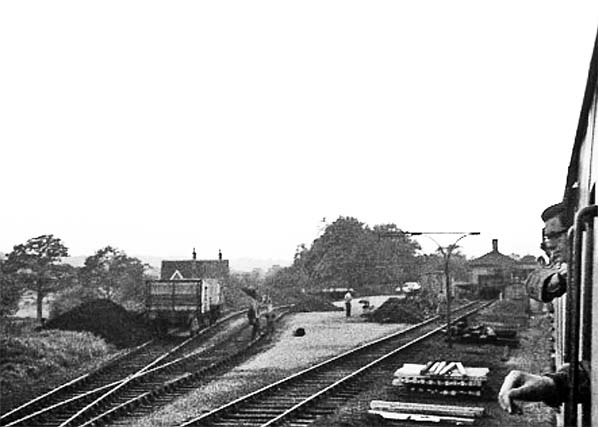 Approaching Brasted, Westerham bound, and passing the goods yard. The train appears to be BR MkI stock; that and the number of people visible strongly suggests this view was taken on the final day of service, 28 October 1961. The two sidings on the left were those once connected at their outer ends to provide a loop. A wagon can be seen behind the station platform on No.1 siding. The building in the background is the station master's house.Copyright photo from Colour Rail 197522A Approaching Brasted, Westerham bound, and passing the goods yard. The train appears to be BR MkI stock; that and the number of people visible strongly suggests this view was taken on the final day of service, 28 October 1961. The two sidings on the left were those once connected at their outer ends to provide a loop. A wagon can be seen behind the station platform on No.1 siding. The building in the background is the station master's house.Copyright photo from Colour Rail 197522AClick here for Brasted Station Gallery 2: Last Day - 1963 old28.jpg) A further view of Brasted taken on 28 October 1961 but this time from a refreshingly different viewpoint shortly after the departure of the 1.08pm service to Dunton Green. We are looking towards Westerham with Brasted station in the centre distance and the goods yard, such as it was, on the left. The yard consisted of three sidings; No.1 running beneath the loading gauge (visible in the centre of the image) while Nos.2 and 3, far left, were once connected at their far ends to form a loop thus allowing goods locomotives to run round or deposit their wagons and leave the yard. At some point in the early 20th century the far points were removed and the two roads became a pair of ordinary single-ended sidings. This was the reason for the rather peculiar method of goods operation. The branch goods ran non-stop to Westerham in the early hours and then tripped any wagons for Brasted back to this location. The brakevan would be left on the running line while the locomotive pushed the wagons into the yard. This done, the locomotive then collected the brakevan and propelled it back to Westerham. With brakevan stabled in the yard at Westerham, the locomotive then took up passenger service, the stock having been stabled overnight at Westerham. Late at night, after the end of the day's passenger services, the locomotive (by then a different one) would then work the goods back to Dunton Green, collecting wagons from Brasted on the way. On the last day of service, a different arrangement was required; the wagons seen above would have been collected by a locomotive sent down the line for the purpose after the last passenger train had ran but precise details of this movement are not known. Brasted yard was controlled, after the abolition of the signal box (date uncertain but before 1933), by ground frame and token key. In the image above the frame was located behind and to the left of the camera. The frame controlled the points from the main line, on which the photographer is standing, and the trap points seen on the left. The rodding for the latter can be seen on the right. All other points in the yard were operated by local levers. See the various maps for details of the yard. A number of, presumably, enthusiasts can be seen in the yard and behind them is the shed utilised from an old SER van body
Photo by Ian Nolan from his Flickr photostream old29.jpg) A further last day of service view of Brasted, looking towards Westerham. No.1 siding terminated behind the platform on the left. The siding was later provided with coal staithes.
Photo by Ian Nolan from his Flickr photostream old24.jpg) Set 277 again, this time with the D1 No.31739 in charge as it approaches Brasted with the 3.01pm service from Dunton Green on 28 October 1961. This train had taken over the branch service that afternoon from the push-and-pull train and the D1 and Q1 locomotives alternated. While one was on the branch, the other loitered at Dunton Green. When railways closed, a strengthened train was often, but not always, provided for the final service or final few services but the arrangements for the final day of the Westerham branch were most unusual. Even more unusual when considering set 277, normally 10-car but reduced to 7-car for the occasion, was far too long for the branch platforms. BR were usually very good at arranging such things but, of course, most of this ability and flexibility went out of the proverbial window with so-called rail privatisation. Back at Brasted we see the points and fan of the goods yard. Comparing this view to the March 1960 view taken from a little further back. Note the trap points, right of centre. These would be required to be set in the open position at all times other than when a train required access to or from the main line. Brasted goods yard was to see just one more use, to remove any wagons present, if any were present, and if so this was likely done late at night on the same day. Normally the up goods was the job of the push-and-pull locomotive after its passenger duties had finished for the day but on the final day a light engine would have been sent down the line from Dunton Green for the purpose.
Photo by John Cramp from 30937 Transport Photograph Database Flickr photostream old21.jpg) This noticeboard stood at the bottom of the station approach at its junction with Station Road. Note, at the top, the word 'Southern' on the BR 'hotdog' logo as used for BR station totems, on printed matter and so forth. The practice of placing the name of the BR region in a 'hotdog' was common to all regions but the Southern Region made particularly widespread use of it. The poster on the left was the statutory closure notice which became all-too-familiar a few years later. These notices told of which line and / or stations on that line were closing and whether to passengers, freight or both. The heading 'Closure of Westerham Branch Railway Line' may seem to state the obvious but the inclusion of 'Railway Line' was also a legal requirement but precise wording varied according to local circumstances. For example, 'Withdrawal of Railway Passenger Train Services' might appear if a line was closing to passengers but remaining open for freight or sundry traffic. General wording was also precise to the point of, as in the case of the Westerham branch, stating which stopping places were halts and which were stations. The official date of closure was invariably the Monday of the following week; in the case of the Westerham branch this was Monday 30 October 1961. The rest of the information on these posters gave alternative arrangements for goods and parcels plus details of alternative bus services, including the names and telephone numbers of the bus companies concerned. Just readable above is the full details of the London Transport Executive, the then legal title of London Transport. The poster on the right advertises cheap trips to various seaside towns in Kent and in those days 'cheap' meant precisely that. Often these cheap trips were treated as excursions but used ordinary service trains, usually with specified times for the outward journey but with the return valid on any train. The poster seen above is obviously one poster on top of another, with one or the other having been damaged. The artwork was of the rather simple style, relative to the colourful posters of old, which came to symbolise the BR of the 1960s. The photograph was taken on 28 October 1961, the final day of passenger and freight services on the Westerham branch.
The view from Station Road up the approach road to Brasted Halt on the final day of service, 28 October 1961. The board displaying the closure notice seen in another image was out of view to the left. The golden colour of the trees tells us it was not just autumn for the Westerham branch. This road still exists and is now and emergency access route to the M25 motorway.
Photo by John Cramp from 30937 Transport Photograph Database Flickr photostream old20.jpg) On the final day of service, 28 October 1961, Bulleid Q1 No.33029 slows for the stop at Brasted on its way to Dunton Green with the 4.23pm ex-Westerham. This was the weekend in 1961 when the clocks were put back one hour to GMT so fortunately for photographs an extra hour of snapping away in daylight was still to be had on Saturday 28 October. Station Road is to the right and passes under the bridge, while the station approach road is hidden from view by the trees. The Brasted station noticeboard is seen alongside Station Road at its junction with the station approach road.
Photo by John Cramp from 30937 Transport Photograph Database Flickr photostream old22.jpg) Readers should by now need no hint that this view dates from the final day of service, 28 October 1961. The train is the 3:50pm ex-Dunton Green and is seen here near Brasted with set 277 behind Bulleid Q1 No.33029. The Bulleid Q1 was an austerity locomotive built solely for use on the Southern Railway during the Second World War. The Southern, it must be remembered played a crucial role in wartime transport serving as it did the Kent ports. Introduced in 1942, a total of 40 were built with construction split equally between Brighton and Ashford Works. Said to have been the most powerful 0-6-0 type ever to have run in Britain, the type was devoid of many embellishments such as running plates and splashers. Wheels were of the Bulleid Firth Brown type. Boiler casing was in three sections of differing dimensions as can be seen above and in cross-section resembled the cross-sectional profile of Bulleid's coaching stock. Be that as it may, the design of the Q1 boiler casing came about partly because of the type of lagging used (lagging is located between outer casing and boiler proper) which in this case is believed to have been fibreglass. Behind the bufferbeam the two inside cylinders can just be made out and the two smaller cylinders above them are the valve gear. Not immediately obvious in the above view is the steep slant at which the valve gear was set. When new, the class was originally given Bulleid's peculiar numbering system and 33029 began life numbered C29, with the C representing three driving axles. This was simple enough but the larger the locomotive the more odd the system became. The Bulleid Pacifics (4-6-2) for example had a 21C XXX system with the 'XXX' being the actual number. 21C represented 2 leading bogie axles, 1 trailing pony axle and three driving axles. The final members of the class bowed out in 1966 with No.33029 herself going in January 1964. One, the first of the class No.33001 (C1 when new), survived into preservation. One irony, given that the class was of wartime origin, is that they had a slightly German look about them. This was most noticeable when viewed from the front and rear
Photo by John Cramp from 30937 Transport Photograph Database Flickr photostream old35.jpg) Brasted station looking towards Dunton Green in 1962. The bare tree on the right plus the weed-free track suggests the winter of 1961/2. Of course, at this time the Westerham branch was considered as merely 'taking a holiday' as the ultimately abortive preservation scheme was getting underway and the 'Railmobile' was still to trundle into Brasted from Westerham (the Railmobile appears to have been confined to the Westerham - Brasted section). The politics behind construction of the M25 are complex, while history likes to say that, following the Chevening bridge saga, parts of the railway route were required for the M25. However, had the preservation scheme succeeded the motorway would have had to have been slightly rerouted so use of the railway route cannot have been imperative. Costs were the answer; with the railway route being in state ownership less land purchase was required. Had the preservationists succeeded, the Westerham branch would almost certainly have run under a Light Railway Order with speeds limited to a maximum of 25mph. Quite what impression would have been created by the required commuter trains ambling along at no more than 25mph alongside, in part, the M25 does not take much imagination.
Photo
by Terry Tracey
old49.jpg) Brasted station viewed from the approach road. At first glance it might not be obvious that the station was closed but it had done so eleven months previously, this view being from September 1962. The giveaways are the missing gas lamp, the absence of the small notice which was once on the left hand side of the building and the absence of the noticeboard once fixed to the fencing at the back of the platform. Between closure and the bulldozers moving in some sixteen years later, the peace was disturbed only by the appearance of the 'Railmobile' and the ongoing presence of coal merchants in the former goods yard.
Photo by Ben Brooksbank old46.jpg) A snowy Brasted seen here after closure and possibly during the winter of 1962/3. The former lamp room beyond the platform would continue to stand for a number of years, as would the ex-SER van body just visible on the right. After closure in 1961, BR removed smaller fittings including the Brasted Halt running-in board. This exposed what was possibly the original board with individual letters as seen above. Closer views of this board can be seen elsewhere among these pages and show its construction which, although ornate, was something of an overkill. Possibly the method of construction allowed for differing lengths of station name but the lettering as seen above looks a little silly
on such a large board. Photo
by from John Mann collection
old47.jpg) A further view of a snowy Brasted taken possibly during the winter of 1962/3. The station has lost its fittings but the wooden backboard for the 'target' remains in the lamp standard. The car on the right appears to be a MkII Ford Consul. There is somebody in the driving seat, perhaps waiting
for the photographer. Photo
by from John Mann collection
old33a.jpg) The bridge just west of Brasted station in 1963, two years after closure but when the track was still in situ. Station Road is to the left and the station approach road climbs up the hill to the right. The rather crude sign bears the letters 'WVRA', Westerham Valley Railway Association. The Railmobile must have startled those unaware if its existence as it trundled across this bridge, especially as it apparently had to be driven back to Westerham in reverse. Today there is no trace of this bridge, the site being occupied by the much wider bridge carrying the M25. No doubt, however, the occasional Ford Consul or Hillman Imp (the cars used for the Railmotor trials) still passes the site en route to and from classic car shows. The bridge just west of Brasted station in 1963, two years after closure but when the track was still in situ. Station Road is to the left and the station approach road climbs up the hill to the right. The rather crude sign bears the letters 'WVRA', Westerham Valley Railway Association. The Railmobile must have startled those unaware if its existence as it trundled across this bridge, especially as it apparently had to be driven back to Westerham in reverse. Today there is no trace of this bridge, the site being occupied by the much wider bridge carrying the M25. No doubt, however, the occasional Ford Consul or Hillman Imp (the cars used for the Railmotor trials) still passes the site en route to and from classic car shows.Click here for Brasted Station Gallery 2: 1963 - September 1967 old25.jpg)
Sometime in 1963 the Railmobile arrives at Brasted from Westerham. Motive power on this occasion was the Ford Consul, SJG 142, with soft-top down despite it apparently being a damp day. It is likely the Railmobile was stationary and the car's soft-top folded back only to allow a more clearer photograph of the arrangements at Brasted. On the track ahead is not what at first glance looks like a second trolley but a structure built on the track to facilitate positioning of the car.The various films made at the time were very clever regarding what was and what not shown. One thing not shown was what happened following arrival at Brasted; for example, it is possible the structure on the track was never used and thus was merely for show. On the one hand it is difficult to see what the car could have done once driven onto the platform and on the other, the Railmobile trolley only had rollers at one end (its Westerham end) so at Brasted it would not have been possible to turn the car and drive it forwards to return to Westerham. Therefore the Railmobile must have returned to Westerham whilst being driven in reverse! Unloading the car and then physically lifting and turning the trolley may have been possible providing those doing the lifting had eaten their three Shredded Wheat but, as this would necessitate turning the trolley by the same means at Westerham, it is highly unlikely. It seems BR gave consent only for the Railmobile to run between Westerham and Brasted. If this be the case, BR would almost certainly have required some form of physical boundary or bufferstop and the structure on the track may have served this purpose. The various impracticalities of the Railmobile have been touched on elsewhere but it is worth reminding readers that at least one film shows the trolley moving after the car driving wheels had stopped revolving, indicating the wheels had locked and trolley was sliding along the rails. Therein lies one of the fundamental problems with lightweight railway vehicles. The solution might have been a much heavier trolley but that in turn would require a more powerful car which itself might be heavier and so it would go on until the final result ended up more akin to a conventional railway vehicle which would require proper railway skills to operate. On that basis alone we think we can say 'case rested'
old36.jpg) Brasted station building and forecourt area in 1965, some four years after closure and looking in the direction of Dunton Green. Although there is much evidence of dereliction with smashed windows and weeds, this side of the station was rather less derelict than the track side. Brasted station building was similar to that at Westerham but a little narrower and, of course, orientated differently being on the south side of the line. Both were 70' in length as built but that at Westerham was later extended. This building and that at Westerham were deliberately constructed with economy in mind, unlike on many railways where solid and rather grand structures were provided with, often, nods to the local gentry. Nevertheless, Westerham branch buildings served their purpose perfectly adequately.
Photo by Chris Jenner old38.jpg) A disused Brasted station sometime in 1965 when the track was still in situ, looking towards Westerham. Since closure in 1961 the only rail vehicle, if that is what one may call it, to visit Brasted was the Railmobile but by this time even that had probably spluttered its last. After closure, as with elsewhere on the branch, fittings had been removed but, left, Brasted's distinctive running-in board remained. This comprised individual letters, probably of metal, screwed to a backboard which resembled the style of the canopy valance. One might be forgiven for wondering if the board was indeed once a section of valance but close examination shows it was to a slightly different design. Not immediately obvious above is a lamp standard, minus lamp, standing in front of the bushes directly ahead of the camera. The scene above is decidedly rural, Brasted station stood at what was then a fairly remote spot to the north of the village it served. Today traffic of the M25 roars through this location, no doubt watched by unmarked police vehicles with a plethora of cameras - a far cry from the days of the little push-and-pull trains.
Photo by Chris Jenner old37.jpg)
The Station Road bridge just west of Brasted station, seen here in 1965. The station is in the distance but obscured by undergrowth. The telegraph pole, to the left of the track in the distance, stood opposite the station building. The M25 motorway bridge now occupies this spot but the main bulk of the bridge is a little to the left. Tracklifting started at the east end of the branch in the summer of 1965 so it's possible lifting had begun at Dunton Green by this time.
Photo
by Chris Jenner
18.jpg) An undated view of Brasted station looking towards Westerham. Compare this view to that from 1965 taken from the same spot but with the track still in situ. Above, some sleepers can be seen dumped on the right while sleeper indents are clearly visible in the ballast in front of the platform. Track lifting began at the Dunton Green end and worked back to Westerham. It is known that by no later than 1965 the cutting at Chevening had been infilled but it is possible tracklifting between Chevening and Westerham waited a little longer but in any event all track had certainly gone by 1966. In view of the above image suggesting the track had been lifted recently a date of 1966 seems likely. The infilling of Chevening cutting seems to have been treated with some urgency which, given that Chevening is close to Dunton Green, may explain why track lifting commenced at Dunton Green.
photo from John Mann collection
19.jpg) Looking east towards the forecourt side of Brasted station taken at the same time as the picture above. The fencing on the right seems to have been installed after closure and part of it is of the familiar Southern Railway style so may been removed from another part of the station site. On the left, the familiar shape of the rear of the road vehicle tells us it is a Morris Minor, or Morris 1000, van. Behind the van lurks another form of transport, a bicycle one of them probably belongs to the photographer. Readers are reminded that Brasted station officially became a halt in 1955 but the term 'station' is used in these image captions for convenience and continuity.
photo from John Mann collection 20.jpg) A further 1966 view of a derelict Brasted station from the trackside. In the years since closure the fencing on the right had clearly taken a battering. Beneath the canopy is what appears to be a suspended sign. It is a piece of wood that once held one of the Southern Railway 'target' signs'
photo from John Mann collection 11.jpg) In September 1967, we are looking along the length of Brasted's platform towards Westerham. The trackbed shows evidence of use by road vehicle. Platform edge stones are still in situ but the encroaching grass and weeds behind them would likely soon put a stop to that.
Photo by Nick Catford 8.jpg) Brasted in September 1967 looking north-west towards Dunton Green. At the far end of the platform the lamproom hut still stands. The platform surface would appear to have had a cobbled surface opposite what had been the way out after September 1955.
Photo by Nick Catford 7.jpg) Brasted in September 1967 looking towards Dunton Green. At the far end of the platform the hut still stands. The photographer certainly chose some inclement days for his photographs.
Photo by Nick Catford 9.jpg) The rear of the station building and the now-fenced former goods yard at Brasted in September 1967. The nearest window on the rear of the building has been covered with what looks like corrugated iron sheeting. This would seem to be a pointless move as the other window, left, appears to have left the interior open to the elements. Note the car tucked in between lorry and station building. In the right background can be seen some hoppers. These would have been kept filled from a coal stockpile for discharging into lorries. The coal merchant operating from the yard at this time appears to be G Bowser Ltd. George Bowser also had an office in Westerham High Street and also became a
local coach operator. Photo by Nick Catford 10.jpg) By September 1967 Brasted's original running-in board, which had been hidden behind the BR version, had become quite dilapidated. It is likely the letters seen here are actually impressions left by the letters rather than the actual letters. One of Bowser's coal lorries is seen in the background. By September 1967 Brasted's original running-in board, which had been hidden behind the BR version, had become quite dilapidated. It is likely the letters seen here are actually impressions left by the letters rather than the actual letters. One of Bowser's coal lorries is seen in the background.Photo by Nick Catford 13.jpg) On a wet day in August 1968 the photographer takes advantage of Brasted's canopy as he looks towards Westerham. Despite dilapidation generally, the area beneath the canopy appears to be quite sound. It is strange to think that today, when some people rush to Facebook to post in disgust about a train being one minute late, many people forget that in 1974 there were many still-open stations in no better, if not worse, condition than Brasted was at that time.
Photo by Nick Catford 31.jpg) Looking north-east at the east end Brasted's platform c1970 with the station building behind the photographer. At this time the lamp room beyond the end of the platform still stood. Laying in the undergrowth left of centre is what appears, under magnification, to be odd lengths of rail. When the Westerham branch was lifted, the work began at Dunton Green and worked back to Westerham. This, of course, necessitated the use of road vehicles to take equipment to the work site and to remove the scrap. When this method was used, rails had to be cut into short lengths for ease of removal. Very often odd lengths were simply left on-site for some unknown reason'
Photo from DK Jones collection 12.jpg) For comparison with the similar 1974 view, this was the scene on an apparently wet day in August 1968. Signs of decay are already apparent on the roof of the station building. In the former goods yard can be seen a lorry, possibly a Bedford, and a Mini van. It is not known if the occupiers of the goods yard used any part of the station building although it is hard to believe they didn't.
Photo by Nick Catford 14.jpg) Thirteen years after closure, this April 1974 view shows Brasted being taken over by undergrowth and with the roof, at least, of the building becoming very dilapidated. The former goods yard, right background, appears to be still in commercial use. As was often the case with derelict railway stations and other such sites, there is evidence of what we now call fly-tipping. The object on the platform looks like an old wash boiler or top-loading washing machine.
Photo by Nick Catford 15.jpg) Another April 1974 view looking north-east along Brasted's platform. By this time it would be difficult to recognise this as a railway station albeit a disused one. There are two giveaways; the Southern Railway fencing, left, and the exposed length of platform edging, bottom right. The station building is in front of the photographer, the top of the canopy can just be made out.
Photo
by Nick Catford
16.jpg) Again in April 1974, looking towards Westerham from the overgrown trackbed. Although the building was very dilapidated by this time, the canopy has survived very well. The long overdue coat of paint will never come, however.
Photo by Nick Catford 17.jpg) Brasted station in April 1974 from the approach road and showing the dilapidation rather better. It is surprising the largely wooden station building was not set fire to by the local naughty boys, this sort of vandalism being by no means a modern thing. Vehicles include a MkI Ford Cortina, three lorries one of which is a Bedford while sitting in the shade on the right is what appears to be a Mini van or pickup. The latter version of the Mini was always relatively uncommon and is extremely rare today. The goods yard is still in use by a coal merchant and it was common for goods yards to continue in such use long after the railways which once served them closed. One of the lorries is identified as belonging
to G. Bowser Ltd. Photo by Nick Catford 34.jpg) The Station Road bridge just west of Brasted station in April 1974. Undergrowth had by this time obscured any view of the station which had existed previously. Within three or four years this scene would be swept away and ultimately replaced by the motorway bridge which stands today.
Photo by Nick Catford 23.jpg) A 1975 view of the by-then decrepit Brasted station. The former goods yard was still in use by coal merchants. On the left, some of the Southern Railway fencing still stands while nature has taken over the trackbed with a vengeance.
Photo
by Brian Halford
24.jpg) A walk on the wild side in 1975 leads us onto the platform at Brasted. In the foreground the cobbled area in front of what had been the way out from the platform can be seen. Considering that by this time the wooden station, which stood at a quite exposed spot, had seen over a decade of dereliction it had survived remarkably well. This was all to change within a couple of years, however.
Photo by Brian Halford 25.jpg) Peering through the undergrowth along Brasted's platform sometime in 1976. By this time parts of the canopy valance were coming adrift, perhaps harpooning, the Omen style, unsuspecting explorers on the platform. The undergrowth on the trackbed, right, has taken hold fairly quickly, presumably the removal of the ballast, which seems to have occurred a year or so after the track was lifted, was the cue seeds needed to take root.
Photo by Ian Baker 27.jpg) Brasted in 1976, this time viewed from across the trackbed and showing rather less undergrowth. The object laying on the trackbed and resting on the platform is unidentified. Brasted in 1976, this time viewed from across the trackbed and showing rather less undergrowth. The object laying on the trackbed and resting on the platform is unidentified.Photo by Ian Baker Click here for Brasted Station Gallery 2: August 1968 - 1976
29.jpg)
A February 1977 view along Brasted's platform. The rather muddy mess on the right suggests this view was taken around the time when preliminary work of the motorway had just begun. A felled tree can be seen laying on the trackbed in the distance.
Photo by David Jones from Flickr photostream 30.jpg) A further view from February 1977, this time looking north-east towards Dunton Green. The undergrowth which had previously engulfed the trackbed has been cleared. The station building had become effectively disused from September 1955 when it became an unstaffed halt but it remained in a reasonable state of repair for a decade or so afterwards. This view shows how deterioration had set in following just over a decade of total disuse, with signs of settlement also being apparent. On the up side of the trackbed, the familiar telegraph poles still stand. Across the country, these poles can still be found hidden among the undergrowth alongside abandoned railways.
Photo by David Jones from Flickr photostream 26.jpg) This is looking north-east towards the remains of Brasted station in May 1977 during preliminary work for the construction of the M25. Station Road is a little way behind the camera.
Photo by J Woods from Alan Young collection 3.jpg) Spring 1977 and it is all change at Brasted as preparations are underway ahead of the building of the M25; the station is seen from the platform side and looking towards Westerham. As indicated by the continued presence of the canopy, the platform still existed at this time and the preparations for the M25, foreground, have been built-up more or less to platform level. This would have been done to provide a wider and roughly level surface as in railway days there was a slight bank along the south side of the track.
Photo
by Nick Catford
4.jpg) Brasted looking towards Westerham in spring 1977, viewed from the contractors access road. Evidence of tracked vehicles, bulldozers etc., can be seen on the ground, as can evidence of off-road vehicle tyres. On the left, part of the platform and what appears to be the ramp can be seen and at this point still slightly above ground level. In the left background the two posts which might initially be assumed to be the posts which once supported the running-in board appear, under magnification, to be of some other origin. In any case, the posts as seen above look to be too far back to have been connected with the running-in board. The pole on the right may be the remains of the telegraph pole visible in several earlier images. It must have still been in use for one purpose or another when the photograph was taken, otherwise it would have been removed.
Photo by Nick Catford 5.jpg) A further spring 1977 view of Brasted, this time from further back and showing what was ongoing at the site rather better. The wider strip of land in the foreground is what was to become the carriageways of the M25. Brasted village is a little way beyond the trees on the left. In the right background the site access coming in from what had been the station approach road can be seen; this is still in use as an emergency access point for the motorway. The station master's house was several yards away behind the trees and far enough back to have been unaffected by the motorway works, noise and
dust no doubt excepted. Photo by Nick Catford 6.jpg) A further view of the station building from the approach road, also during the spring of 1977. A degree of caution is advised with these 1977 images. It is easy to assume the building was in the process of being demolished, especially given the pile of debris ahead of the camera, but in all probability the building was simply falling apart on its own and perhaps aided by vibrations from contractors plant. Close examination of the remains of the roof around the nearest chimney shows what looks like evidence of fire damage. If so, the fire must have been small as the basic fabric of the largely wooden building was still intact. In any event, bulldozers ultimately removed all traces of the station
the following year Photo by Nick Catford 2.jpg) A final view of the station in spring 1977. The coal merchant is still in business in the former goods yard. Note the gate into the coal yard has been moved back to its original position at the east end of the station building. On the right is what looks like a road trailer of some description, perhaps in use as an office and mess by contractors.
Photo
by Nick Catford
21.jpg) An April 2007 view of Brasted station site seen from the top of the approach road with the M25 just visible far left. This is a similar viewpoint to the picture above. The station building sat where the young trees are directly ahead of the camera but a little to their left. The former goods yard, beyond the gate in the distance. Although fenced and secure it is derelict and appears to have been out of
use for many years Photo by Charles Bruce 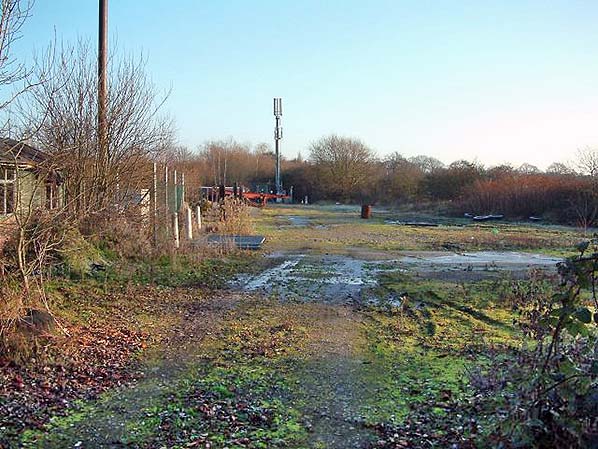
Looking north-east across the site of Brasted goods yard sometime in 2013. The station was to the left but the wooden building visible on the left was probably not of railway origin and does not appear on any large scale maps. The mast in the background tells us the site is still used for communications but of an entirely different kind to trains. The remains of coal bins can be seen on the left in front of the phone mast. These are later bins, the original goods yard bins were roughly where the wooden hut is now seen. The small goods dock was on the right.
35.jpg) The site of Brasted station looking east in April 2014 with the M25 on the left. The building would have been where the dense clump of trees stands, with the motorway hard shoulder occupying the former trackbed. The top of the station approach road would have been where the car stands on the right, the Ford Squire seen in the 28 October 1961 view of the station forecourt having long since disappeared.
Photo by Nick Catford 40.jpg)
Looking south-west through the site of Brasted goods yard in January 2016. The station was in the right background, beyond the hut. The M25 is behind the trees on the right. The timber post on the right are the remains of a later set of coal bins built some years after the station closed. The original bins were where the wooden building is now seen. The building is something of a mystery. It is now in much worse condition than in the 2013 picture above and will probably soon collapse. It appears to be an old building but is likely to have been re-erected here at some time after closure of the railway. It does not appear on any large scale maps up to 1985 so might post-date the coal yard at this site. After the coal merchant left the site was used to store vintage cars for some time.
Photo
by Nick Catford
Click on thumbnail to enlarge
 Home Page Home Page
|
 Notes: Brasted station which was sited at the end of a 200 yard approach road, was built during a time of financial restraint and the station building was of timber construction to keep costs to a minimum. Brasted was provided with a single platform without a passing loop on the down (south) side of the line. The single-storey building was 70ft in length and was of tongue-and-groove timber construction beneath a hipped slate roof with two brick chimneystacks. It stood on a low brick base. A flat canopy with a deeply fretted valance stretched the full width of the platform and the full length of the building; it was supported on seven timber columns with brackets. There was a small sloping canopy over the entrance to the booking office on the forecourt side of the building to provide some weather protection to passengers arriving by cab. The building included the booking office (which gave access to the ladies rooms), stationmaster's office, gents' toilet, lamp room and an ashes room. The building was very similar to that at Westerham but with a slightly reduced width and was very typical of South Eastern Railway station buildings of the 1880s.
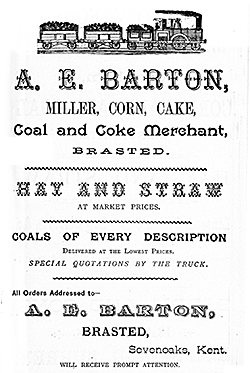
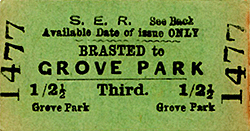 The yard was not provided with a goods shed but from an early date there was a small corrugated metal store with twin double doors just inside the entrance to the yard. In the 1930s this was supplemented by an old LBSCR van body left on its ‘W’ irons with some wooden steps leading up to the sliding door. Access to the goods yard was though metal gates at the east end of the station forecourt. The yard was not provided with a weighbridge. The 1939 OS map reproduced below show shows coal bins and the end of the siding behind the platform and a short loading dock at the end of the back siding. These are not shown on earlier maps but this isn't necessarily evidence that they weren't there earlier. At some time the original oil lighting was replaced by gas lighting on new wrought iron standards in front of the fence at the back of the platform. The lamps were similar to the Sugg's Windsor style used at Westerham but with a crowned, as opposed to pointed, finial.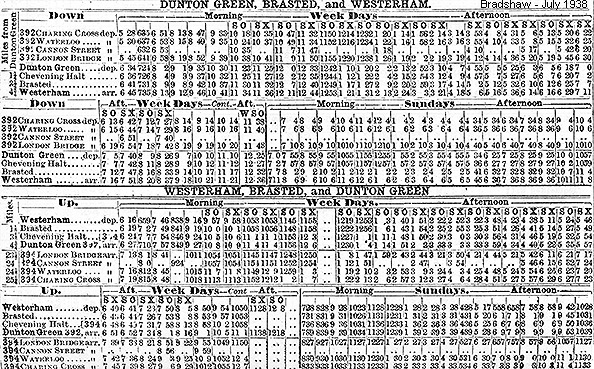
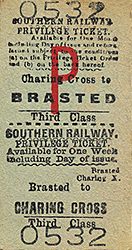 Today on the approach to Brasted station, the course of the former branch comes in on the south side of the motorway. At the station site itself the east end of the platform is to the south of the hard shoulder, the platform building is just behind the hard shoulder but the west end of the platform is in the middle of the westbound carriageway and within 200 yards the line has crossed over onto the eastbound carriageway. It then follows the northern hard shoulder for 400 yards before crossing back over the motorway to the south side. The station approach road has been re-laid and now forms an emergency access route to the motorway and beyond the drive to the station master's house is 'authorised vehicles only'. The goods yard is still fenced and gated although no longer secure. After the departure of the coal merchant the yard was used to store vintage vehicles for a while (hence the multiple padlocks on the gate) but is now derelict. The remains of post-railway coal bins can be seen and a very dilapidated large wooden building stands just inside the gate. This may date from before closure of the line although it doesn't appear on any maps up to 1985 so it may have been acquired second hand and re-erected at the site..
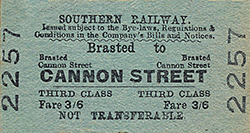 The SER opposed the extension to Oxted and, if it was built, they refused to have anything to do with the line. To avoid antagonising them, the fledgling company withdrew the second stage of their scheme in return for an agreement with the SER to provide the rolling stock and work the line for 50% of gross receipts with a minimum of £2,500 per year being guaranteed by the Westerham Valley directors. With this agreement in place, the Westerham Valley Railway Bill was put before Parliament in the session beginning 22 March 1876.
 Despite unusually bad weather slowing work in the autumn of 1880, by the following February construction was in an advanced state but was then hampered by heavy falls of snow. The bad weather and saturated soil inevitably increased construction costs and by the time the line was completed these had risen to £70,000. At that time, it was assumed that the line would eventually be extended to Oxted which was only four miles distant. An extension would, however, involve steep gradients and heavy engineering, and the it was never built.
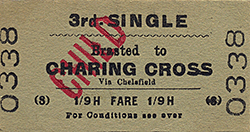
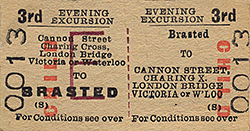
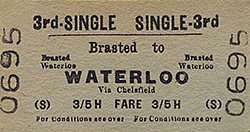
  Once the formalities and celebrations were over, the line settled down to a relatively eventless existence. An engine shed was provided at Westerham for the use of locomotives staying at the station overnight. Initially, the normal public service, which commenced the following day, ran only from Westerham to Dunton Green where passengers wishing to travel to Charing Cross (via Cannon Street) would have to change, although not all branch trains made a connection with a London service. Only stopping trains to London were available with an average journey time of 1½ hours to cover the 25¼ miles to Charing Cross. This was not breathtakingly fast but an improvement on the three hours previously taken by stagecoach. There were 11 trains in each direction on weekdays and eight on Sundays. By the end of the year, the weekday service had improved with the addition of an extra mid-evening down train and on Wednesdays a late evening train that arrived at Westerham at 12.46am. This allowed people to spend an evening out in London departing from Charing Cross at 11.40pm. At the same time, the Sunday service was reduced to only five trains: two of those trains taken out were connecting services with two non-connecting services being retained!
 Motive power on the branch was generally provided by a Cudworth Class 118 2-4-0 dating from 1859. A number of these locos were allocated to Tonbridge shed during the period. The Cudworths were later replaced by James Stirling's Class Q 0-4-4Ts. At the turn of the twentieth century No.336 was allocated to Westerham sub-shed and generally provided the branch service.
  Apart from the regular passenger trains, there was one goods train leaving Westerham each day, and suddenly the potential for local nurserymen to sell their produce in London’s Covent Garden Market was a reality. Other goods conveyed included beer from Westerham’s two breweries, timber, livestock and locally-made agricultural implements. The incoming goods trains brought coal and building materials that were not locally available. Westerham had its own limeworks, producing mortar, also a brick-and-tile works and a timber and coal merchant - Hortons - conveniently sited alongside the railway with extensive yards and coal bins.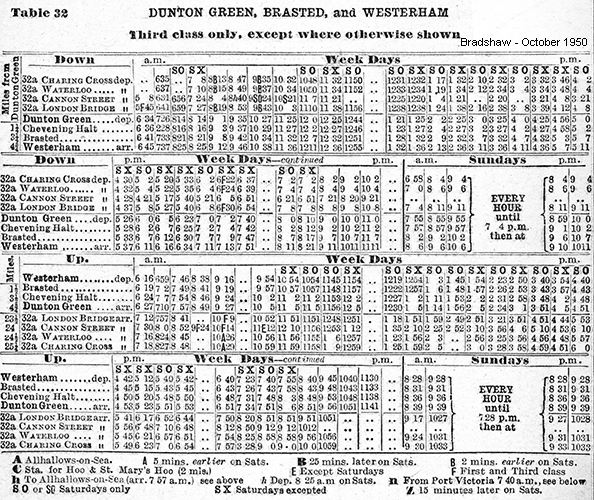
 The Westerham Herald for 5 January 1907 carried this report: ‘To compete with the S.E. Railway - Oxted Station in under 12 minutes! Utterly disgusted with the present inadequate railway service between Westerham and London, and more especially with the local steam railcar service, a petition has been drawn up and has been numerously signed by users of the line in this neighbourhood, praying the company to reinstate the ordinary train. Failing this last resource a practical solution of the difficulty is suggested, namely, a regular motor bus service between Westerham and Oxted, by which means London can be reached under an hour.’
 In 1917, the practice of running Charing Cross trains via Cannon Street ceased but this did little to improve the general punctually of suburban services, which was, at this time appalling due to bottlenecks caused by too few tracks trying to accommodate too many trains. To try and alleviate this, a programme of electrification was proposed by the SE&CR. Stage 1 of the electrification included Charing Cross and Victoria to Orpington; and Stage 2 included Orpington to Tonbridge and the Westerham branch. This electrification by the SE&CR never came, and when electrification was eventually introduced by the Southern Railway it extended only as far south as Sevenoaks and Westerham never saw electric trains; this probably hastened the eventual demise of the line.
 The early years of the ‘Depression’ initially brought a cut in services in an attempt to save money. A number of trains during the middle of the day were cut out, as were the late evening trains, There were no losses to the Sunday timetable and the service was, in fact, improved somewhat with five trains running through to Orpington. The reduction of weekday trains was, however, short-lived. The electrification of the line between Orpington and Sevenoaks came in 1934 and a new timetable came in to operation with a half-hourly service to London. The off peak trains on the Westerham branch were reinstated with an hourly off peak service connecting with alternate electric trains at Sevenoaks.
  The railcar was designed for use on the Devils Dyke branch near Brighton, but it could not cope with the steep gradients and the brakes were inadequate for the return journey. On 2 March 1936 it was transferred to the London East Davison where it was given a second opportunity to prove itself on the relatively flat Westerham branch. To work the branch, the Sentinel would come up on the 7.23 am Tonbridge to Dunton Green and take over from the push-and-pull then, at 2.12 pm it would run back in traffic to Tonbridge for servicing. Branch trains in the afternoon would once again be in the hands of an R1, then at 5.00 pm the Sentinel would work 'passenger' back from Tonbridge to Dunton Green to work Westerham services for the rest of the evening, helped out by an R1 during the tea-time rush when two trains were required on the branch. The Sentinel was unreliable and it was even less popular than the rail-motors, and its stay on the Westerham branch was short with the line reverting to the trusted R1s within a few months.
 The Southern Railway was nationalised on 1 January 1948 and became the Southern Region of British Railways. The 1950 branch timetable had 22 down trains on Monday to Friday with 20 on Saturday. There were also 22 up trains but only 21 on Saturday, which was much the same as the pre-war service but without the additional late night service on Wednesday. The Sunday service was somewhat reduced with 15 down and 14 up trains.
  In February 1956 the Kent Coast Electrification scheme was approved. Once completed, this would leave the branch as an isolated steam-operated adjunct of a modernised main line. Despite the operating economies that had been instigated in 1955 the line was reported to be losing £11, 600 per annum. BR made no attempt to investigate further ways of cutting costs and closure was announced in April 1960. On 12 June 1961, scheduled electric services commenced via the ex-SER route to Dover (although the full electric timetable did not commence until 18 June 1962). Despite this, the Westerham line continued to operate, but the end was inevitable.
 The final day dawned bright and sunny with large numbers of enthusiasts and photographers arriving at Dunton Green for a last opportunity to travel on the branch. Morning trains were worked by Class H 0-4-4T No.31518 with the usual two-coach push-and-pull set. The locomotive was adorned with a Union Jack, and the inscription ‘Flyer 1881-1961’ was chalked on the smokebox. To cope with the high demand, BR put on a 6-coach corridor train from early afternoon worked by Class D1 4-4-0 No.31739. The last trains of all were the 7.23 pm Westerham to Dunton Green and the 7.50 pm Dunton Green to Westerham. At Westerham, squibs and bangers were ignited, the signal cabin was swamped with visitors, and passengers for the 7.23 pm were wandering along the track to reach the coaches, the platform being too short for the 6-coach train, which was being worked by Class Q1 0-6-0 No.33029.
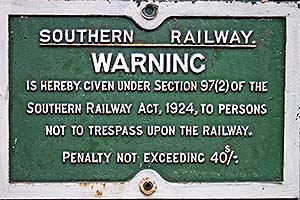 In 1962, the Westerham Valley Railway Association, born of a merger between two local interest groups, the Westerham Branch Railway Passengers' Association and the Westerham Valley Railway Society, began to investigate the possibility of reopening the line, staffed by volunteers, for commuters on weekdays with diesel railcar service and as a heritage railway at weekends between April and October using steam haulage. British Railways offered the ownership of the line for £30,000 on the basis that a commuter service would be provided, thereby allowing it to cease its subsidies of the 403 bus services which were now over-subscribed following the closure of the Westerham branch. In July 1962, British Railways granted a lease of Westerham station building, which became the headquarters of the Association. A lease of Brasted Station was also later agreed.
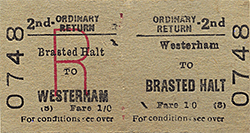 More positive news was received in November 1963 when it was revealed that not only had a new backer been found, but also that terms were agreed with British Railways for the sale of the land to the Association. However, one month later Kent County Council contacted the Association and informed them that the Council's intended purchase of the land would save taxpayers the sum of £120,000 and, furthermore, that in the event British Railways were unwilling to sell the land to the council, as had been intimated, compulsory purchase powers would be used. Faced with the prospect of a compulsory sale, British Railways now broke off negotiations with the Association and agreed to sell the line to the Council.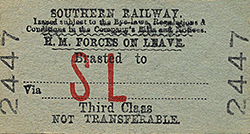
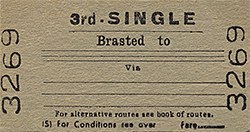
old23.jpg)
28.jpg) Looking along Brasted's platform towards Dunton Green in 1976. Compare this with the similar, but monochrome, view from February 1977. One of the coal hoppers in the former goods yard is visible on the right. These belonged to the coal merchant and were nothing to do with the railway having been installed after closure of the line.
Looking along Brasted's platform towards Dunton Green in 1976. Compare this with the similar, but monochrome, view from February 1977. One of the coal hoppers in the former goods yard is visible on the right. These belonged to the coal merchant and were nothing to do with the railway having been installed after closure of the line.old_thumb10.jpg)
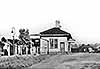
old_thumb34.jpg)
thumb22.jpg)
thumb32.jpg)
thumb42.jpg)
thumb41.jpg)
thumb36.jpg)
thumb37.jpg)
thumb38.jpg)
thumb39.jpg)