Notes: West Kirby’s Birkenhead Joint Railway (BJR) station was situated at the northern end of the company’s 12-mile branch that connected to its main line at Hooton. The BJR was a joint railway of the London & North Western Railway (LNWR) and the Great Western Railway (GWR) and its line to West Kirby had opened in two stages: to Parkgate on 1 October 1866, and to West Kirby on 19 April 1886. The line passed through the Wirral settlements of Neston, Parkgate, Heswall and Thurstaston.
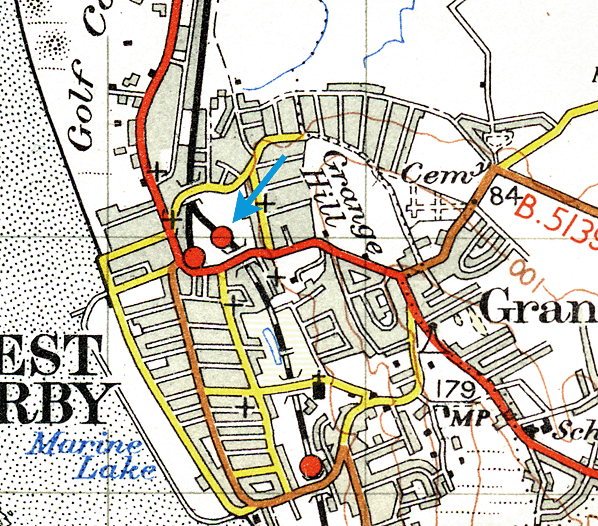
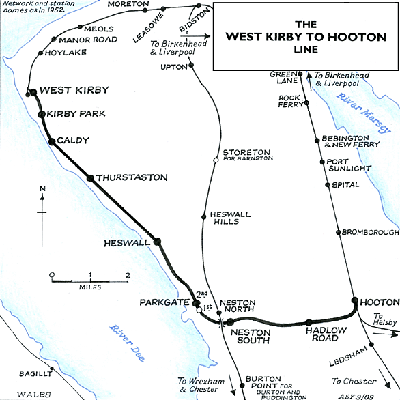 The station opened with the extension of the line on 19 April 1886 and was known simply as West Kirby. It was located on the north side of Grange Road which passed over the line on a bridge. It was a short distance east of the Seacombe, Hoylake & Deeside Railway (SH&DR) West Kirby station which was the western terminus of their line that ran along the northern part of the Wirral Peninsula to Birkenhead. The BJR had a connection with the SH&DR to the north of their West Kirby station. The station opened with the extension of the line on 19 April 1886 and was known simply as West Kirby. It was located on the north side of Grange Road which passed over the line on a bridge. It was a short distance east of the Seacombe, Hoylake & Deeside Railway (SH&DR) West Kirby station which was the western terminus of their line that ran along the northern part of the Wirral Peninsula to Birkenhead. The BJR had a connection with the SH&DR to the north of their West Kirby station.
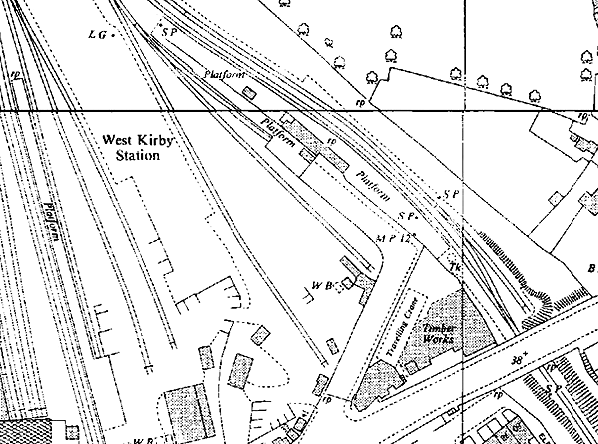
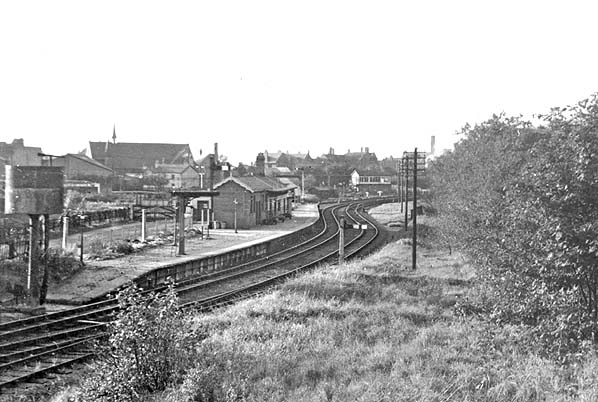
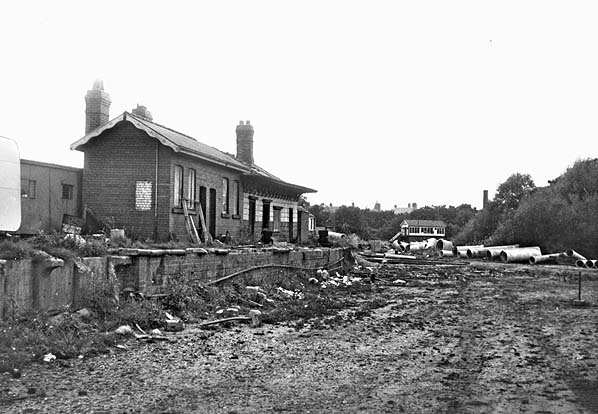
The facilities at the BJR West Kirby station were relatively modest. They consisted of a single platform located on the west side of the line. On the platform there were two single-storey buildings with pitched roofs, standing side-by-side. One was of brick, its simple design enlivened by scalloped bargeboards. The other, immediately north-west of it, was of timber, and it possessed a modest flat awning on the platform elevation. There was a passing loop at the station so that engines could run around their trains and at the south-eastern end of it, and adjacent to Grange Lane, on the east side of the line, there was a turntable. At the southern end of the platform there was a water tank and directly opposite the station building, east of the line, was a signal box. To the north of the station there were sidings and, beyond them, the junction with the SH&DR which was controlled by that company’s signal box.
West Kirby had goods facilities in the form of three sidings to the west of the station. There was a 5 ton crane and a weighing machine. A driveway connected the station and goods yard to Grange Lane.
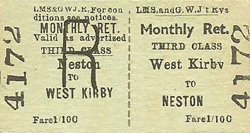 At the time of opening passenger trains ran between West Kirby and Hooton, with some peak hour services running between West Kirby and Birkenhead Woodside. At Hooton connections could be made with express services of both the LNWR and the GWR. Both companies had London services, the LNWR to Euston and the GWR to Paddington. The December 1895 timetable showed West Kirby as having 11 arrivals and 10 departures Monday-to-Friday. There were extra working on Saturdays and 4 trains in each direction on Sundays. Trains on the West Kirby branch were operated alternately by the LNWR and the GWR. At the time of opening passenger trains ran between West Kirby and Hooton, with some peak hour services running between West Kirby and Birkenhead Woodside. At Hooton connections could be made with express services of both the LNWR and the GWR. Both companies had London services, the LNWR to Euston and the GWR to Paddington. The December 1895 timetable showed West Kirby as having 11 arrivals and 10 departures Monday-to-Friday. There were extra working on Saturdays and 4 trains in each direction on Sundays. Trains on the West Kirby branch were operated alternately by the LNWR and the GWR.
The SH&DR had become the Wirral Railway (WR) on 1 July 1891 and the connection between it and the BJR at West Kirby was used mostly for the transfer of goods. Passenger services in the form of excursions also passed over the connection at this time.
During the 1890s consideration was given to creating one station at West Kirby to be shared by the BJR and the WR. The plans were not realised and the WR built a new station, slightly further to the west of its original, which opened in 1896.
For the residents of West Kirby the WR route to Birkenhead was much more direct that the BJR route so journeys from the BJR station tended to be much more local in nature.
The July 1922 timetable showed 15 arrivals and 14 departures Monday-to-Friday. On Saturdays there was an extra departure and on Sundays there were 5 trains in each direction.
On 1 January 1923 the LNWR became part of the London Midland & Scottish Railway (LMS). The WR also became part of the LMS and consideration was once again given to the creation of a single station at West Kirby. However the plan was never realised and, after the closure of Neston colliery in 1927 - which had been the main source of freight on the BJR West Kirby branch - the line became unprofitable.
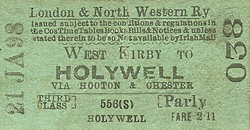 The LMS ran through coaches between New Brighton and London Euston which passed through the West Kirby BJR station. The coaches were attached and detached from express trains at Hooton. The LMS ran through coaches between New Brighton and London Euston which passed through the West Kirby BJR station. The coaches were attached and detached from express trains at Hooton.
The summer 1932 LMS timetable showed 19 Monday-to-Friday arrivals 2 of which, the 11.59am and the 10.03pm, were through trains to New Brighton (the coaches having originated from London Euston). There were 18 departures 1 of which, the 10.26am, ran through to London Euston. On Saturdays there was 1 less departure and on Sundays there were 7 trains in each direction. In the late 1930s the LMS embarked upon the electrification of its network between Birkenhead and West Kirby and the New Brighton branch. The joint railway to Hooton was not thought worthy of electrification. Electric services were introduced to the former West Kirby WR station on 12 March 1938.
At the outbreak of the Second World War on 3 September 1939 passenger services on the line were reduced, but a number of military facilities were created in the West Kirby and Thurstaston areas which generated extra traffic. The New Brighton – London through coaches were withdrawn and never reinstated.
The LMS summer timetable for 1947 showed 12 departures and 12 arrivals on Monday-to-Saturday as shown in the table below. There were no trains on Sunday.
Departures Summer 1947 |
To |
Arrivals Summer 1947 |
From |
6.17am |
Birkenhead Woodside |
7.00am |
Hooton |
7.19am |
Birkenhead Woodside |
7.40am |
Birkenhead Woodside |
7.55am |
Birkenhead Woodside |
8.15am |
Hooton |
8.25am |
Birkenhead Woodside |
8.59am |
Birkenhead Woodside |
9.30am |
Birkenhead Woodside |
11.07am |
Birkenhead Woodside |
11.17am |
Birkenhead Woodside |
1.39pm (Saturdays Only) |
Birkenhead Woodside |
1.50pm (Saturdays Only) |
Hooton |
2.30pm (Saturdays Only) |
Birkenhead Woodside |
2.45pm (Saturdays Only) |
Birkenhead Woodside |
3.23pm (Saturdays Excepted) |
Birkenhead Woodside |
3.35pm (Saturdays Excepted) |
Birkenhead Woodside |
4.16pm |
Hooton (from Birkenhead Woodside on Saturdays) |
4.25pm |
Hooton (Birkenhead Woodside on Saturdays) |
5.24pm (Saturdays Excepted) |
Hooton |
5.40pm (Saturdays Excepted) |
Birkenhead Woodside |
6.32pm |
Hooton |
6.45pm (Saturdays Only) |
Birkenhead Woodside |
7.05pm (Saturdays Only) |
Birkenhead Woodside |
6.48pm (Saturdays Excepted) |
Hooton |
7.35pm (Saturdays Excepted) |
Hooton |
7.25pm (Saturdays Only) |
Hooton |
8.53pm |
Hooton |
7.50pm (Saturdays Excepted) |
Hooton |
9.48pm |
Hooton |
9.05pm |
Birkenhead Woodside |
|
|
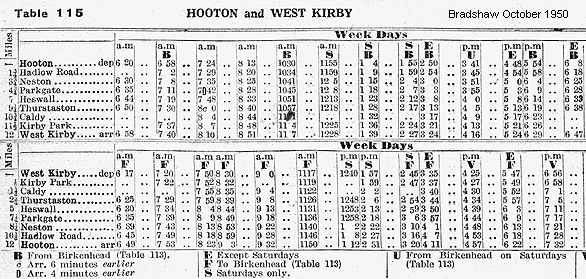
On 1 January 1948 the Hooton and West Kirby branch became part of British Railways London Midland Region (BR[LMR]). By 1950 the service had dropped to 10 in each direction on Monday-to-Saturday.
By the mid 1950s passenger numbers had declined to such an extent that BR[LMR] decided to withdraw the service. The last trains ran on Saturday 15 September 1956. The final train left West Kirby at 6.55pm, and many local people turned out to watch it depart. Attached to it was a box van containing two circus elephants which emitted a loud noise as the train pulled away. The former BJR West Kirby station closed to passengers on Monday 17 September 1956.
Goods services continued to run to West Kirby, but by the end of the 1950s they had become infrequent. In 1961 new DMUs ran to and from West Kirby for a few weeks on driver training runs but the increased level of traffic was short lived. The last goods service departed from West Kirby on 7 May 1962. It called at all of the stations along the line removing redundant assets.
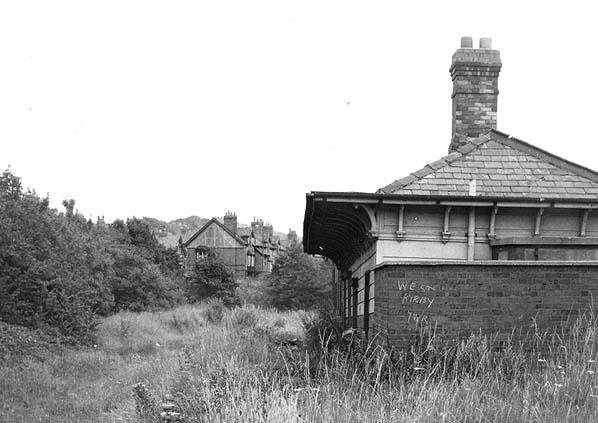
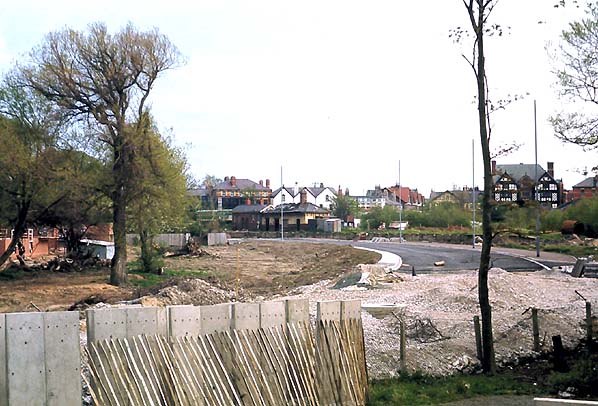
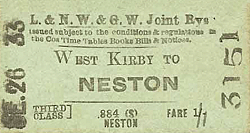 The line remained in situ until early 1964 when rails were lifted at West Kirby station to form a break in the line. In the following weeks track was lifted back to Hooton. The station itself stood in a derelict condition until the early 1970s after which Orrysdale Road was built on its site. The line remained in situ until early 1964 when rails were lifted at West Kirby station to form a break in the line. In the following weeks track was lifted back to Hooton. The station itself stood in a derelict condition until the early 1970s after which Orrysdale Road was built on its site.
In 1968 the route of the Hooton to West Kirby branch was chosen to create Britain’s first Country Park - the Wirral Country Park - and a 12-mile footpath/bridleway called the Wirral Way. The park and footpath opened in 1973. At West Kirby the Wirral Way starts just to the south of the station site, on south side of Grange Road.
Tickets from Michael Stewart
To see the other
stations on the Hooton - West Kirby line click on the station
name: Kirby Park, Caldy, Thurstaston, Heswall, Parkgate (2nd), Parkgate (1st), Neston South, Hadlow Road & Hooton
See also: West Kirby 1st |

kirby_old5.jpg)
map.gif)
kirby6.jpg)
kirby_old2.jpg)
kirby5.jpg)
 Home Page